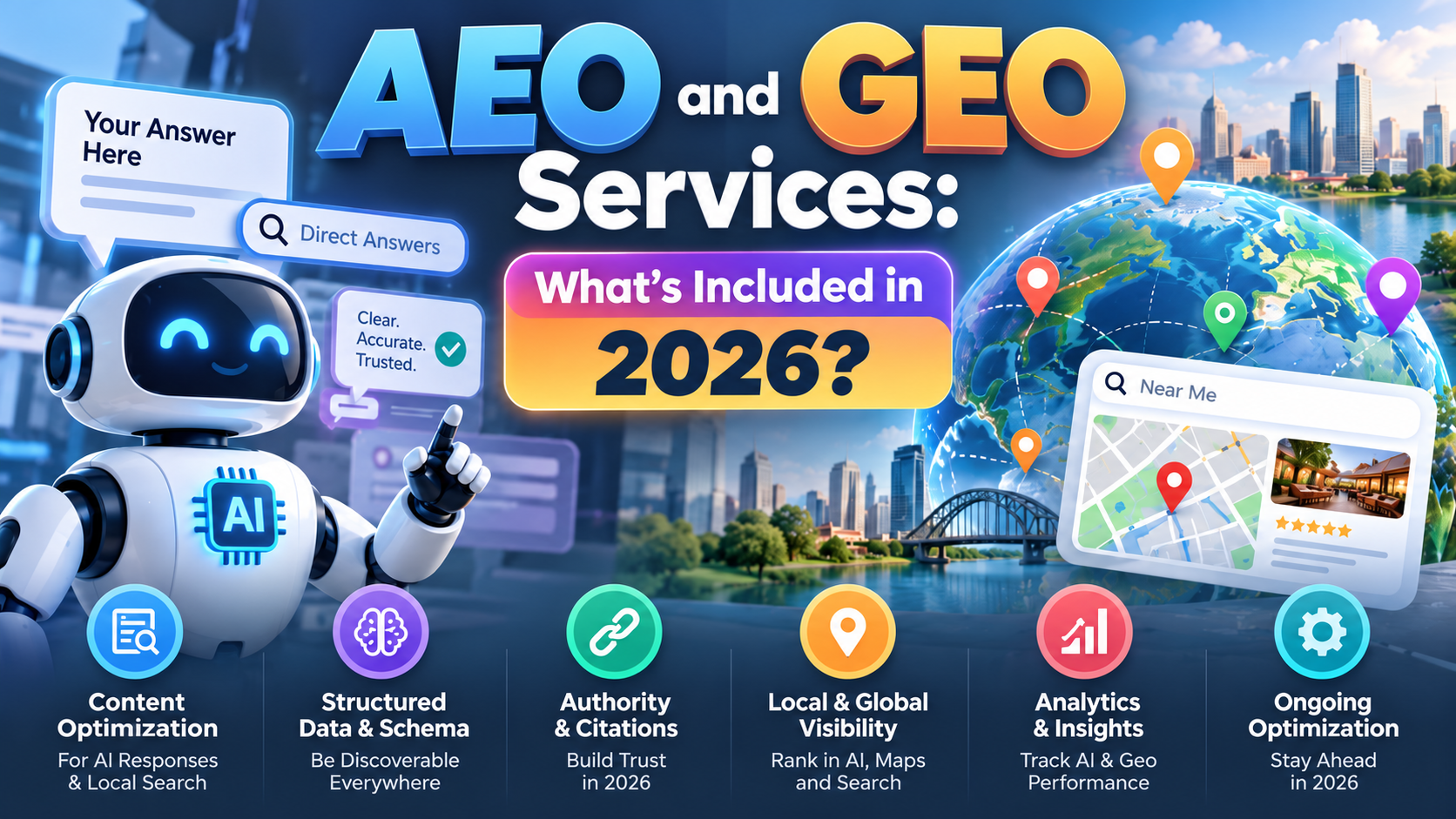

Traditional SEO optimizes to rank a link on Google. Answer Engine Optimization (AEO) — and its sibling, Generative Engine Optimization (GEO) — optimizes to get your business cited inside the AI answer itself. In 2026, AI Overviews appear on roughly half of US Google searches, organic click-through rates drop 34–61% when they show, and around 60% of searches now end with zero clicks. Bolting AEO onto a legacy SEO site is slow and leaky. Building for AI search from day one — structured data, extractable answers, entity authority — is faster, cleaner, and compounds. That’s how Pixly Digital builds.
TL;DR
- AI search is now the default surface, not a side channel. AI Overviews appear on ~48–50% of US Google queries as of early 2026, up from ~6.5% in January 2025 — a near 8x jump in 15 months. (BrightEdge / Google, Feb 2026)
- Clicks are collapsing where AI answers appear. Organic CTR fell 34–61% on AI Overview queries, and ~60% of Google searches now end without a click. Ranking #1 no longer guarantees traffic. (Seer Interactive / SparkToro, 2025–2026)
- Citation is the new ranking. Brands cited inside AI answers earn ~35% more organic clicks and up to ~39% more paid clicks than uncited competitors. (Seer / Envive, 2026)
- AI traffic converts far better. AI-referred visitors convert at 10–16%+ vs ~1.76% for organic search — a high-intent, ready-to-buy audience. (Seer Interactive, 2025)
- The first-mover window is still open. Only ~14% of marketers actually measure AI search performance; ~54% plan GEO but few execute. Early movers own citation share — and citation share compounds. (Conductor / eMarketer, 2026)
- Retrofitting is the slow road. A site built for blue links has to be re-architected for extraction. A site built AEO-first is already there. Pixly Digital builds AEO/GEO-first from the ground up.
Why does AI search optimization matter in 2026?
Because the search results page your customers see barely resembles the one from two years ago.
As of early 2026, Google AI Overviews appear on roughly 48–50% of all US search queries — Google itself confirmed “roughly 50%.” That’s up from about 6.49% in January 2025, a near 8x expansion in just 15 months. (BrightEdge / Google official disclosure, Feb 2026)
For a small business, that single shift changes the math. When an AI Overview sits on top of the page, organic click-through rates drop 34–61% depending on the study, and around 60% of US Google searches now end without any click at all. (Seer Interactive / SparkToro, 2025–2026)
Translation: you can rank #1 and still lose the visit. The customer got their answer from the AI summary — and if your business wasn’t in that summary, you were invisible.
This is the core reason AEO/GEO is now foundational, not optional. The game moved from “rank a link” to “be the cited source.”
What’s the difference between AEO and traditional SEO?
Traditional SEO is about position: get your page to rank high in a list of ten blue links so people click it. It rewards keywords, backlinks, and on-page signals.
Answer Engine Optimization (AEO) is about extraction and citation: structure your content so an AI engine — ChatGPT, Google AI Overviews, Perplexity, Gemini, Claude — can lift a clean answer from your page and credit your brand as the source. Generative Engine Optimization (GEO) is the same idea applied across all generative surfaces.
Here’s the part most agencies miss: ranking and citation have diverged. The overlap between Google’s organic top 10 and AI citations crashed from ~75% in mid-2025 to just 17–38% in early 2026. (BrightEdge / Demand Local, 2026) AI engines pull from a much wider source pool than the old rankings — which means a well-structured small business can get cited even without a #1 ranking, if the content is built for it.
AEO vs Traditional SEO at a glance
| Dimension | Traditional SEO | AEO / GEO (AI search) |
|---|---|---|
| Goal | Rank a link in the top 10 | Get cited inside the AI answer |
| Success metric | Position + organic clicks | Citation frequency + AI share of voice |
| Winning content | Keyword-rich pages, backlinks | Extractable answers, structured data, original stats |
| Where value lands | The click to your site | The mention plus the click |
| Traffic quality | Mixed intent | High intent (10–16%+ conversion) |
| Key signal | Domain authority | Entity authority + freshness |
Both still matter. But they’re optimized differently — and that’s exactly why retrofitting hurts.
Why does building for AI search from day one beat retrofitting?
Think of two restaurants. One was designed as a kitchen and is now bolting on a drive-through lane through a wall it wasn’t built for. The other designed the drive-through into the floor plan from the start. Same service — wildly different speed and cost.
A legacy SEO site is the first restaurant. It was built to win the click: long keyword pages, link-chasing, content structured for human scanning, not machine extraction. To compete for AI citations, it now needs structured data layered in, answers rewritten into extractable blocks, entities defined, and freshness systematized. That’s slow, expensive, and leaves gaps.
A site built AEO/GEO-first — the way Pixly Digital builds every project — bakes in the citation machinery from line one: schema markup, TL;DR answer blocks, FAQ clusters, clean entity definitions, statistics with sources. The Princeton GEO study (the foundational research, KDD 2024) found that “Statistics Addition” and “Cite Sources” boost visibility by up to 40% in generative engines. Those aren’t patches — they’re design decisions you make at the start. (Princeton / Georgia Tech / IIT Delhi via ConvertMate, 2026)
There’s a freshness penalty too. Semrush reports 65% of AI bot hits target content less than 1 year old, and AI-cited content is ~25.7% fresher than typical organic results. (ConvertMate / Semrush, 2026) A retrofit treated as a one-time pass quietly loses ground every quarter. AEO-first sites are built for the ongoing refresh discipline AI rewards.
How do you optimize a website for ChatGPT and AI search?
You give the machines clean, verifiable, well-structured answers — and you do it everywhere, consistently. The fundamentals:
- Lead with the answer. A striking 44.2% of all LLM citations come from the first 30% of a page — the intro. Bury your answer and you lose the citation. (SparkToro / Zyppy, 2025–2026)
- Add statistics and cite sources. The two highest-impact GEO techniques in the Princeton research. Sourced numbers get pulled.
- Implement structured data. Sites adding structured data and FAQ blocks saw a 44% increase in AI search citations; pages with author schema are 3x more likely to appear in AI answers. (BrightEdge via Superlines, 2026)
- Build entity authority. AI engines reward who you are as a recognized entity, not just keywords. Consistent NAP, schema, and brand mentions across the web.
- Keep it fresh. Pages updated within ~60 days are ~1.9x more likely to be cited. (BrightEdge, 2026)
This is the engineering layer most agencies treat as an afterthought. Pixly bakes it into the build via AI/ML-driven optimization and clean, machine-readable front-end development — so your pages are structured for extraction before a single word goes live.
What does this look like for a real small business?
Concrete scenarios make it click.
A Coppell plumber. A homeowner asks Google “why is my water heater leaking from the bottom?” An AI Overview answers instantly. If the plumber’s site has a clean, sourced, schema-marked answer to that exact question, their business gets cited as the local authority — and the booking follows. If not, a national content farm takes the slot.
A Dallas dental clinic. “Is teeth whitening safe for sensitive teeth?” is a classic informational query — exactly the type AI Overviews dominate. Healthcare triggers AI Overviews on ~88% of queries, one of the highest rates of any industry. (BrightEdge, 2026) A clinic that built FAQ schema and 40–60-word extractable answers from day one owns those answers. A clinic relying on a legacy brochure site doesn’t appear.
A Texas B2B software firm. B2B Technology AI Overview coverage jumped from 36% to 82% in a year. (BrightEdge, 2026) B2B buyers now run vendor research through AI. Getting cited in “best [category] software for [use case]” answers is the new top-of-funnel — and it converts, because paid and organic AI traffic arrives pre-qualified.
A boutique ecommerce store. Interesting twist: Google deliberately scaled back AI Overviews on transactional ecommerce queries (from ~29% to ~4%) to protect ad revenue. (BrightEdge, 2026) But product research still happens in ChatGPT and Perplexity — where AI-driven product recommendations can lift conversions dramatically. The play is a hybrid: AEO for research queries, smart paid ads for transactional ones.
Is traditional SEO dead?
No — and anyone who says so is selling you something.
Google’s own 2026 documentation states plainly that optimizing for generative AI search is optimizing for the search experience — so it’s still SEO at the foundation. (Google Search Central via AI Thinker Lab, 2026) Traditional SEO still drives the majority of total web traffic today, and a large share of AI citations still come from pages with solid SEO fundamentals.
The accurate framing: AEO/GEO is “SEO plus,” not “SEO instead.” Strong technical SEO is the foundation; AEO is the layer that captures the AI answer on top of it. The mistake is treating them as separate projects bolted together after the fact. Built together, from day one, they reinforce each other — which is the entire premise of how Pixly Digital approaches a build.
What’s the ROI of optimizing for AI search?
This is the part that should make a skeptical owner lean in.
AI-referred traffic is the highest-converting acquisition channel on the web right now. Seer Interactive measured LLM visitors converting at 15.9% from ChatGPT, 10.5% from Perplexity, and ~5% from Claude — versus 1.76% for organic search. (Seer Interactive, 2025) Ahrefs found AI search visitors generated 12.1% of signups while making up only 0.5% of visitors — a 24:1 conversion ratio. (Ahrefs via AI Thinker Lab, 2026)
The why is simple: someone clicking through from an AI answer has already researched, already shortlisted, and is deep in the decision. That’s not a casual browser — that’s a buyer.
And the citation effect compounds existing spend. Brands appearing in AI answers see a ~38% click lift and ~39% increase in paid ad clicks. (Envive, 2026) Getting cited makes every other marketing dollar work harder.
The market agrees: the US GEO services market is projected to reach $365.4 million in 2026, growing at a ~42.9% CAGR, with Texas named among the leading innovation hubs. (Omnibound / Intel Market Research, 2026)
Key Takeaways
- AI Overviews now appear on ~48–50% of US Google searches (up from ~6.5% in Jan 2025) — AI search is the default surface, and being absent from the answer means being invisible.
- Organic clicks drop 34–61% where AI answers appear and ~60% of searches end with zero clicks, so ranking #1 no longer guarantees traffic — citation does.
- AI-referred visitors convert at 10–16%+ versus ~1.76% for organic search, making AI search the highest-intent, highest-ROI acquisition channel available in 2026.
- Building AEO/GEO-first — structured data, extractable answers, sourced statistics, entity authority — beats retrofitting a legacy SEO site, because the citation machinery is a design decision, not a patch.
- Only ~14% of marketers measure AI search performance today; the first-mover citation-share window is still open, and citation share compounds over time.
Frequently Asked Questions
1. What is the difference between AEO and traditional SEO?
Traditional SEO optimizes a page to rank as a clickable link in search results. Answer Engine Optimization (AEO) structures content so AI engines like ChatGPT and Google AI Overviews extract and cite your business directly inside their generated answers. SEO targets position; AEO targets citation. In 2026, the two have diverged significantly.
2. Why does AI search optimization matter in 2026?
AI Overviews now appear on roughly 48–50% of US Google searches, up from about 6.5% in January 2025. Organic clicks fall 34–61% when they appear, and around 60% of searches end without a click. If your business isn’t cited in the AI answer, you’re invisible to half the market — regardless of your ranking.
3. Is traditional SEO dead because of AI search?
No. Google confirms that optimizing for AI search is still SEO at its foundation, and traditional SEO still drives most web traffic. AEO/GEO is “SEO plus” — a citation layer built on strong technical SEO. The smart move is building both together from day one, not bolting AEO onto a legacy site later.
4. How do I optimize my website for ChatGPT and AI search?
Lead each page with a clear, direct answer (44% of AI citations come from the intro). Add sourced statistics, implement FAQ and author schema, build consistent entity authority, and refresh content regularly. Structured data and FAQ blocks alone have driven a 44% increase in AI citations in measured studies.
5. What is Generative Engine Optimization (GEO)?
GEO is structuring your content so generative AI engines — ChatGPT, Perplexity, Gemini, Claude, Google AI Overviews — cite your pages as a source inside the answers they create. It’s used interchangeably with AEO. The Princeton GEO study found adding statistics and citing sources can boost AI visibility by up to 40%.
6. Does AI search traffic actually convert?
Yes — better than almost anything. AI-referred visitors convert at roughly 10–16%, versus about 1.76% for organic search. Ahrefs found AI visitors drove 12.1% of signups while being just 0.5% of traffic, a 24:1 ratio. These users arrive pre-researched and ready to buy, which is why AI search is the highest-ROI channel in 2026.
7. Why is building for AI search from day one better than retrofitting?
A legacy SEO site must be re-architected — structured data added, answers rewritten for extraction, entities defined, freshness systematized. That’s slow, costly, and leaky. An AEO-first build bakes citation machinery in from the start, so the site is already optimized for AI extraction the day it launches.
8. Do AI Overviews appear for local businesses?
Less often than for informational topics — AI Overviews appear on only ~7% of purely local searches as of early 2026. But informational queries tied to local services (like “why is my AC not cooling?”) trigger them constantly. Local businesses win by owning the informational answers in their niche, which feed local intent.
9. How do I measure AI search performance?
Track citation frequency (how often your brand appears in AI answers), AI share of voice (your citations versus competitors), sentiment, and conversion rate from AI traffic. Only about 14% of marketers measure this today, so building tracking now creates a compounding data advantage over slower competitors.
10. Can a small business compete for AI citations against big brands?
Yes. Because only 17–38% of AI citations now come from Google’s organic top 10, AI engines pull from a far wider source pool than old rankings allowed. A well-structured SMB page with clean answers, schema, and sourced data can get cited without a #1 ranking — leveling a field that domain authority used to dominate.
Grow. Rank. Convert.
The AI search shift is happening whether your competitors act on it or not. Pixly Digital is natively built for the AI search era — we architect AEO/GEO into your site from day one, not as an afterthought. If you want to be the business AI engines cite when your customers ask, let’s talk. Email hello@pixlydigital.com for a free consult. Coppell, Texas — serving SMBs across Texas and the USA.