Quick Answer
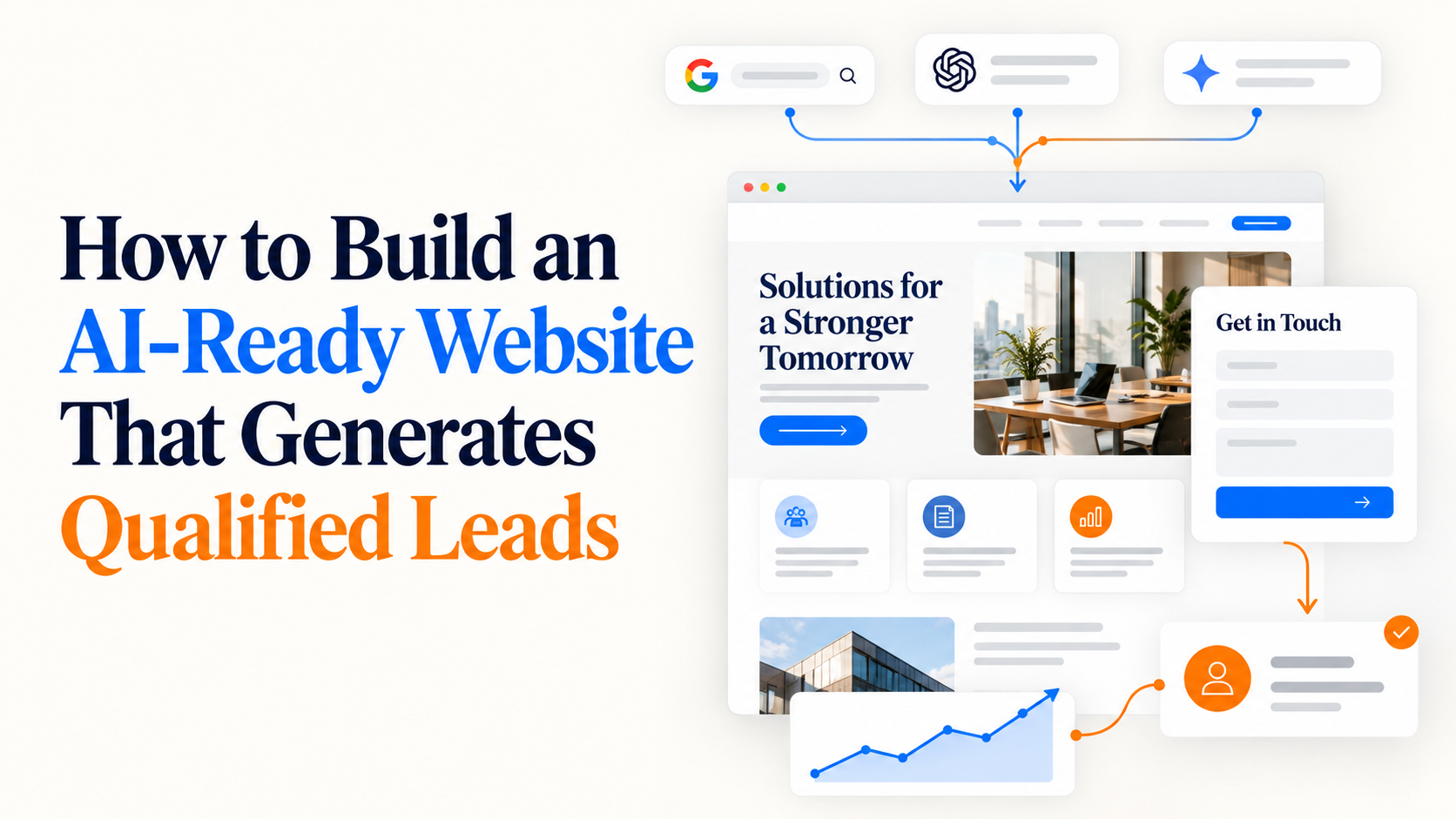
An AI-ready website is a site built from the ground up to be found, understood, and cited by AI search platforms like ChatGPT, Perplexity, Google AI Overviews, and Gemini — not just Google’s blue links. It combines answer-first content, clean schema markup, fast mobile performance, and clear calls to action with lead qualification forms and conversion tracking. The result: visitors who find you through AI search convert at roughly 14.2% versus 2.8% for traditional organic search (Presence AI, 2025). Pixly Digital builds every website this way, natively, so Texas and U.S. small businesses capture leads that competitors relying on legacy SEO never see.
TL;DR
- AI search is no longer optional. ChatGPT alone reached 900 million weekly users by February 2026, up from 400 million a year earlier (OpenAI, Feb 2026), and AI referral traffic to websites grew roughly 16x between 2024 and 2026 (SE Ranking, 2026).
- Zero-click search is the new normal. Between 58.5% and 83% of searches now end without a click depending on query type and platform (Similarweb; Stacc) — meaning your content has to win the answer, not just the ranking.
- Most small business sites convert visitors poorly. The median small business website converts between 1% and 3% of visitors (Lilach Bullock, 2026), while properly qualified leads convert at up to 40% versus 11% for unqualified ones (Landbase, 2026).
- AI-ready design and lead-focused design are the same job. Answer-first structure, schema markup, short forms, and clear CTAs improve both AI citation and human conversion at the same time.
- Speed compounds everything. Responding to a new lead within 60 seconds can lift conversion by 391% (Kixie, 2025) — your website’s job is to capture and route that lead instantly.
Introduction
If your website was built for Google’s blue links, you’re already behind. Search itself has split in two: one path still runs through traditional rankings, and a fast-growing second path runs through AI answers that summarize, cite, and recommend businesses without a single click to a results page. For a Texas plumber, a Dallas dental clinic, or a boutique ecommerce shop, that shift decides whether you show up when a customer asks an AI assistant “who’s the best [service] near me” — or whether you simply don’t exist in that conversation. This guide breaks down exactly how to build a website that AI search platforms trust enough to cite, and that turns the traffic it earns into qualified, sales-ready leads.
What Makes a Website “AI-Ready” in 2026?
An AI-ready website is engineered so that AI crawlers and large language models can extract, verify, and repeat your content as a trustworthy answer. That means clean HTML structure, JSON-LD schema markup, question-based headings, and concise, factual paragraphs — the same qualities that also make a page easy for a busy human to scan and act on.
Traditional SEO optimized for ranking position. AI-ready design optimizes for being the answer, whether that answer appears in Google AI Overviews, a ChatGPT response, a Perplexity citation, or a Gemini summary. A site can rank on page one and still be invisible to AI search if its content is buried in dense paragraphs, missing structured data, or written in vague marketing language an AI model can’t confidently extract.
This is the core of Answer Engine Optimization (AEO) and Generative Engine Optimization (GEO) — disciplines Pixly Digital builds around from day one, rather than retrofitting onto an old WordPress theme after the fact. You can read more about how these differ from legacy SEO in our AEO vs. traditional SEO comparison.
Why AI Search Changes Everything for Small Business Lead Generation
How many people now use AI search instead of Google?
AI search adoption moved from niche to mainstream in a single year. ChatGPT alone processed roughly 2.5 billion queries per day by mid-2025 and reached 900 million weekly active users by February 2026 (OpenAI data via Omnibound, 2026). Across all platforms, AI referral traffic to websites grew approximately 527% year-over-year between 2024 and 2025 (Semrush AI SEO Statistics, 2025), and separate research measured AI search traffic growing roughly 16x between 2024 and 2026 as more consumers shifted their default research habits (SE Ranking, 2026).
For a small business, this isn’t an abstract trend. It means a growing share of your future customers are asking ChatGPT, Perplexity, or Google’s AI Mode to recommend a business before they ever type a query into a traditional search box.
What happens when your website isn’t cited by AI?
You disappear from the conversation entirely — not ranked lower, just absent. Research from Ahrefs found that around 80% of URLs cited by AI platforms like ChatGPT and Perplexity don’t even appear in Google’s top 100 results for the matching query (Superlines, 2026), which means AI citation and Google ranking are increasingly separate games with separate rules. Brands in the top 25% for web mentions receive roughly 10 times more AI visibility than the rest (Ahrefs via Superlines, 2026).
Meanwhile, zero-click search is compounding the pressure on traditional rankings. Zero-click search rates rose from 56% to 69% between May 2024 and May 2025 (Similarweb), and searches that trigger an AI Overview show zero-click rates as high as 83%, compared to roughly 60% for standard queries (Click Vision, 2026). Pew Research found that when an AI Overview appears, only about 8% of users click an organic result, versus 15% without one — a 46.7% drop — and just 1% click the citation links inside the AI Overview itself (Pew Research, July 2025, via SEO-Kreativ).
The upside: traffic that does arrive from AI search converts meaningfully better. AI-referred sessions converted at 14.2% compared to 2.8% for standard Google organic traffic in one 2025 analysis (Presence AI, 2025), and in ecommerce specifically, AI referral traffic converted at 11.4% versus 5.3% for organic search (Similarweb, 2025, via XICTRON). Fewer visitors, but far higher intent — which is exactly what a lead-focused SMB should want.
The 7 Core Elements of an AI-Ready, Lead-Generating Website
A website built to win in AI search and convert visitors into leads needs these elements working together, not bolted on separately:
- Answer-first content structure. Every important page opens with a direct, 40-70 word answer to the question a visitor (or an AI model) is asking, before expanding into detail.
- Clean JSON-LD schema markup. Organization, LocalBusiness, Service, FAQPage, and Article schema tell AI systems exactly what your business does, where, and for whom. Pages using rich structured data see up to 82% higher click-through rates than pages without it (Google Search Central data via XICTRON, 2026), and one case study found schema markup drove 89% more featured snippet appearances and 3x more AI Overview mentions within 60 days (GrowthHacking case study via ZipTie.ai, 2026).
- Clear calls to action. One primary action per page — “Book a Consult,” “Get a Free Quote,” “Request Pricing” — stated in plain language, never buried below the fold.
- Lead qualification forms. Short forms that ask only what’s needed to route a lead correctly, not a full intake questionnaire on the first touch.
- Fast, mobile-first technical performance. With mobile accounting for roughly 60% of all search traffic and mobile zero-click rates running well above desktop (ZipTie.ai, 2026), a slow mobile site loses both AI crawl efficiency and human patience.
- Trust and E-E-A-T signals. Real reviews, named team members, verifiable credentials, and case studies — brands with profiles on review platforms like Google, Trustpilot, or G2 have roughly 3x higher odds of being cited by AI (Stacc, 2026).
- Website conversion tracking. Without tracking which pages, forms, and traffic sources actually produce leads, you can’t tell AI-ready design from guesswork.
Pixly Digital’s web design services and AEO/GEO services are structured around exactly these seven elements from the first wireframe, not added as an afterthought during a redesign.
How Does AI Search Optimization Differ from Traditional SEO?
Traditional SEO chases rankings on a results page. AEO and GEO chase inclusion inside the answer itself — a fundamentally different target. A page can hold a top-three Google ranking and still never be quoted by ChatGPT if its content isn’t structured for extraction.
Here’s how the two disciplines diverge in practice:
- Traditional SEO rewards keyword density, backlink volume, and page authority accumulated over time.
- AEO/GEO rewards factual density, clear entity definitions, structured data, and content that directly answers a specific question in a self-contained way.
- Traditional SEO measures success by ranking position and click-through rate.
- AEO/GEO measures success by citation frequency and share of voice inside AI-generated answers, since many high-value impressions now generate zero clicks at all.
- Traditional SEO treats each page as competing for a spot in a list.
- AEO/GEO treats each page as a potential source document an AI model might quote verbatim.
Since AI referral traffic could represent 20% to 28% of total web referral traffic by the end of 2026 (upGrowth data via Stacc), businesses that treat AEO as optional today are choosing to be invisible in a channel that’s about to rival Google itself. Our SEO services at Pixly Digital fold traditional ranking work and AI citation work into one strategy, because in 2026 they can no longer be separated.
What Should a Lead Generation Website Look Like for an SMB?
The right structure depends on the business, but the underlying logic is identical: remove friction, answer the visitor’s real question fast, and make the next step obvious.
A local plumber in Fort Worth needs a homepage that answers “do you offer emergency plumbing near me” within the first two sentences, service-area pages with LocalBusiness schema, and a phone-first CTA — because emergency service searches are transactional and immediate.
A dental clinic in Dallas needs individual pages for each core service (implants, whitening, emergency dental) with FAQ schema answering the specific questions patients ask AI assistants, plus a short new-patient form that qualifies insurance status before the first call.
A boutique ecommerce brand needs Product schema, genuine customer reviews surfaced on-page, and a checkout flow with minimal fields — since AI shopping assistants increasingly cite product pages directly, not just category pages.
A Texas-based B2B company needs case studies with real, specific outcomes, an FAQ block addressing procurement-style questions, and a multi-step qualification form — because 40% of properly qualified B2B leads convert versus just 11% of unqualified ones (Landbase, 2026, via Surface Labs), and a generic “Contact Us” form wastes that opportunity. Multi-step forms convert 86% higher than single-step forms in aggregate (HubSpot data via WPForms), which matters enormously for higher-consideration B2B offers.
Across all four, the pattern holds: answer fast, qualify smart, act on the lead immediately.
How Do You Write Content That AI Search Engines Will Cite?
AI models favor content that is confident, specific, and self-contained. Vague marketing copy gets skipped because it can’t be safely quoted as fact. Practical rules:
- Open each section with a direct answer in 40 to 70 words before adding supporting detail.
- Phrase headings as the actual questions customers ask — “how much does X cost in Texas” beats “our pricing philosophy.”
- Cite real, dated statistics with sources, since factual density every 150 to 200 words meaningfully improves AI citation odds (DeepMarketing, 2026).
- Use lists over dense paragraphs wherever you’re presenting multiple items, options, or steps.
- Keep author and business identity consistent site-wide — name, credentials, location — because AI systems weight entity consistency as a trust signal.
This is precisely the writing discipline behind every piece of content Pixly Digital produces, whether it’s a service page, a blog post, or FAQ content built for citation from the outset.
What Are Lead Qualification Forms and Why Do They Matter?
A lead qualification form filters unqualified visitors before they hit your sales team’s calendar, and it’s one of the highest-leverage pieces of an AI-ready site. Web forms remain marketers’ single highest-converting lead generation tool, according to nearly half of marketers surveyed (HubSpot data via WPForms), but only when they’re built correctly.
The single biggest lever is length. Cutting a form from 11 fields down to 4 can increase completion rates by up to 120% (Unbounce data via Sitesfy). The goal of a first-touch form is permission to have a conversation — not a full customer profile. Ask for name, contact method, and the one or two details that determine urgency or budget; save everything else for the follow-up call.
Speed after submission matters just as much as the form itself. Responding to a new lead within 60 seconds can boost conversion by 391%, while the odds of qualifying a lead drop by roughly 80% after the first five minutes pass (Kixie, 2025; Harvard Business Review, via Surface Labs). A well-built website connects its forms to instant notification and routing — not a form that quietly sits in an inbox.
How Should You Track Website Conversions in the AI Search Era?
You can’t improve what you don’t measure, and AI search has changed what’s worth measuring. Since clicks are declining even as AI-driven impressions and citations rise, tracking needs to cover both sides of the funnel:
- Conversion tracking on every form, call button, and chat widget — not just a single “contact” goal — so you know exactly which pages produce leads.
- Source-level attribution that separates AI referral traffic (ChatGPT, Perplexity, Gemini, Copilot) from traditional organic and paid traffic, since AI-referred visitors convert at meaningfully different rates.
- Search Console’s AI-specific segments, which now let you filter impressions and clicks by “AI Mode” and “AI Overviews” separately from standard results, revealing pages that are being cited frequently but generating little direct traffic — often a sign the page is doing its job as a trust-builder even without a click.
- Lead quality scoring, not just lead volume, since properly qualified leads convert at roughly 40% versus 11% for unqualified ones (Landbase, 2026) — a smaller number of well-qualified leads often outperforms a larger pool of cold ones.
For most SMBs, the median website conversion rate sits close to 2%, with B2B lead generation forms typically ranging from 2.4% to 5% and local service businesses landing between 2% and 3% on combined contact-form and phone-click activity (Lilach Bullock, 2026). Knowing your own baseline — and tracking it month over month — matters far more than chasing an industry-wide average.
How Pixly Digital Builds AI-Ready Websites for Texas & U.S. SMBs
Pixly Digital was built for the AI search era from day one — not retrofitted from a legacy SEO playbook. Every website we design starts with the same foundation: answer-first content architecture, complete JSON-LD schema (Organization, LocalBusiness, Service, FAQPage), fast mobile-first development, and conversion-focused forms wired directly into lead notification and tracking systems.
Our process typically moves through four stages. First, an AI visibility and technical audit that shows exactly where a business currently stands across Google, ChatGPT, Perplexity, and Google AI Overviews. Second, information architecture and content built around the real questions a business’s customers ask AI assistants — not generic keyword targets. Third, front-end development and design that loads fast, reads clearly on mobile, and converts on the first visit. Fourth, ongoing optimization using our AI/ML services to monitor citation frequency and refine content as AI platforms evolve.
This is the same approach reflected across our broader work, including our guide to choosing an SEO company in Texas and our breakdown of how digital marketing agencies drive growth across Texas. The goal is never a website that merely looks good — it’s a website that AI platforms trust enough to recommend, and that turns every visitor it earns into a qualified conversation.
Common Mistakes That Keep Websites Invisible to AI Search
Even well-designed websites frequently fail at AI visibility for a handful of repeatable reasons:
- No structured data at all, or schema that’s outdated, broken, or incomplete — leaving AI crawlers to guess at what a page is about.
- Long-form pages with the answer buried three or four paragraphs deep, past the point most extraction models will read.
- Contact forms with 8+ fields, which suppress completion rates and cost far more leads than the “extra data” is worth.
- Slow mobile load times, which hurt both crawl efficiency and human patience simultaneously.
- No conversion tracking, meaning the business has no idea which pages, forms, or traffic sources are actually working.
- Inconsistent business information across the website, Google Business Profile, and review platforms — a trust signal AI systems check directly.
Notably, only 14% of marketers currently measure their AI search performance even though 43% say they’re actively optimizing for it — an 86% measurement blind spot across the industry (GoodFirms, 2026, via ZipTie.ai). Fixing that gap alone puts a business ahead of most competitors.
Key Takeaways
- AI search platforms — ChatGPT, Perplexity, Gemini, Google AI Overviews, and Copilot — now drive meaningfully more qualified traffic per visitor than traditional organic search, converting at roughly 14.2% versus 2.8% (Presence AI, 2025).
- Being AI-ready means being structured for citation: answer-first content, clean JSON-LD schema, and consistent business entity information across the web.
- Short, smart lead qualification forms consistently outperform long intake forms — cutting fields from 11 to 4 can lift conversions up to 120% (Unbounce, via Sitesfy).
- Responding to leads within 60 seconds can boost conversion by 391%, making instant lead routing as important as the website design itself (Kixie, 2025).
- Only 14% of marketers currently measure AI search performance, leaving a wide-open opportunity for SMBs willing to track and optimize for it now (GoodFirms, 2026).
Frequently Asked Questions
What does it mean for a website to be “AI-ready”?
An AI-ready website is structured so AI search platforms like ChatGPT, Perplexity, and Google AI Overviews can accurately extract and cite its content. That requires answer-first writing, clean JSON-LD schema markup, fast mobile performance, and consistent business information across the web — the same qualities that also improve human conversion rates.
How is AI-ready website design different from regular web design?
Regular web design optimizes primarily for visual appeal and traditional SEO rankings. AI-ready design adds a structural layer — schema markup, question-based headings, and self-contained factual answers — so AI models can confidently quote the page as a trustworthy source, not just index it.
Do small businesses really need to optimize for AI search yet?
Yes. ChatGPT alone reached 900 million weekly users by February 2026 (OpenAI, via Omnibound), and AI referral traffic could reach 20-28% of total web referrals by the end of 2026 (upGrowth, via Stacc). Businesses that wait are ceding visibility in a channel already influencing purchase decisions today.
What’s the biggest mistake SMBs make with lead generation forms?
Asking for too much information upfront. Long forms suppress completion rates significantly, while cutting a form from 11 fields to 4 can increase conversions by up to 120% (Unbounce, via Sitesfy). Capture the minimum needed to start a conversation, then qualify further by phone or email.
How quickly should a business follow up with a new website lead?
Within 60 seconds if possible. Research shows responding that fast can boost conversion rates by 391%, while the odds of qualifying a lead drop roughly 80% after just five minutes (Kixie, 2025; Harvard Business Review). Website forms should trigger instant notifications, not sit in an unmonitored inbox.
Can a website rank well on Google but still be invisible in AI search?
Yes, and it happens often. Research from Ahrefs found roughly 80% of URLs cited by AI platforms don’t appear in Google’s top 100 results for the matching query (Superlines, 2026), because AI citation depends on structure and extractability, not just traditional ranking signals.
About Pixly Digital
Pixly Digital is a digital marketing and web development agency headquartered in Coppell, Texas, built natively for the AI search era rather than adapted to it after the fact. We design and optimize websites for small and medium-sized businesses across Texas and the United States, combining AEO/GEO strategy, technical SEO, paid media, and conversion-focused web design under one roof. Learn more at pixlydigital.com.
Ready to Grow. Rank. Convert.
Your competitors are still optimizing for a search engine that’s rapidly sharing the stage with AI. Pixly Digital builds websites designed to be found and cited by ChatGPT, Claude, Perplexity, Google AI Overviews, Gemini, and Copilot — and to turn that visibility into qualified leads, not just impressions. If you’re ready to see where your website stands and what it would take to fix it, email us at hello@pixlydigital.com to book a free consult. Grow. Rank. Convert.