Quick answer
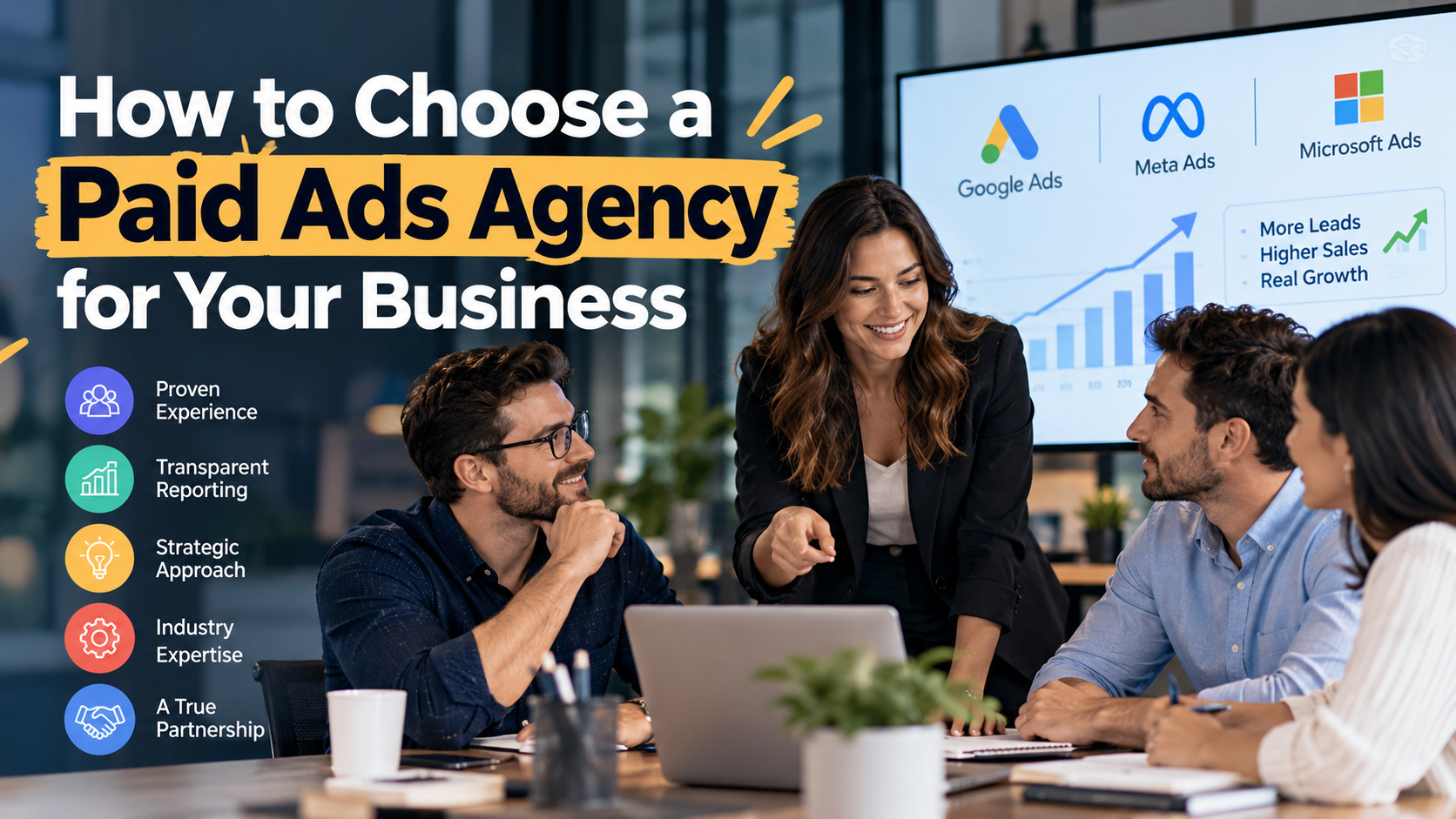
Pick the paid ads agency that can show you revenue, not clicks. Before you sign, confirm six things: you own the ad account, conversions are tracked down to sales or booked jobs, fees are stated plainly (commonly 10% to 20% of ad spend, or a flat retainer), the team knows your industry, any Google partner badge checks out in Google’s directory, and the plan accounts for AI Overviews and AI Mode. Ask for a live audit first. Walk away from anyone who will not share data.
TL;DR
- A good paid ads agency runs paid search campaign management, tracking, landing page testing, and reporting, and it hands you access to everything it builds.
- Management fees in 2026 commonly run 10% to 20% of monthly ad spend, with minimums around $500, or flat retainers for smaller accounts.
- WordStream’s 2026 benchmarks (more than 13,000 campaigns, April 2025 to March 2026) put average Google and Microsoft Ads click-through rate at 6.64%, cost per click at $5.42, and conversion rate at 8.18%.
- Seer Interactive found paid click-through rates on informational queries with AI Overviews fell 68% since mid-2024, so AI search awareness is now part of the job.
- Ask about conversion tracking first. Google moved offline conversion uploads to its Data Manager API on June 15, 2026, and an agency that missed that change is already behind.
- Verify credentials, read the contract for lock-in, and judge the agency by return on ad spend (ROAS) and lead quality, not impressions.
- Pixly Digital, a Coppell, Texas agency built around AEO and GEO from day one, runs paid ads with that AI search lens.
Why does the choice of paid ads agency matter so much for a small business?
You hand an agency a few thousand dollars a month and a login. Six months later you hold a report full of impressions and no idea whether the phone rang because of them. That story is common, and it hurts a Texas small business with a lean budget and no room for a lost quarter. Texas has 3.5 million small businesses, according to the SBA Office of Advocacy’s 2025 Texas profile, so every click is contested. This guide shows how to vet a paid ads agency, what fair pricing looks like in 2026, and which questions expose weak partners before you sign.
What does a paid ads agency actually do?
A paid ads agency plans, builds, runs, and improves your advertising on platforms such as Google Ads, Microsoft Advertising, and Meta. The work covers keyword and audience research, ad copy, bidding, landing page advice, conversion tracking, and reporting. You pay the agency for expertise and time. The platforms bill you separately for the clicks.
That split matters. Plenty of owners assume the agency fee buys traffic. It does not. Ad spend buys traffic, and the management fee buys the decisions about where that spend goes.
Paid search campaign management
Paid search is where most small businesses should start, because the buyer is already looking for what you sell. Someone types “emergency plumber near me” or “Invisalign Plano” and your ad appears. An agency that offers Google Ads management should build tight keyword groups, write ads that match the search, set negative keywords to block junk traffic, and watch the search terms report every week.
The quality of that weekly attention shows up in your cost per lead. Loose campaigns pay for clicks from people who wanted a free tutorial, a job, or a competitor.
Paid social, shopping, and local service ads
Search captures demand that already exists. Paid social on Meta, LinkedIn, or TikTok creates demand by putting your offer in front of people who were not looking yet. Shopping ads and Performance Max serve product catalogs for ecommerce stores. Google Local Services Ads charge per lead for trades and professional services.
A capable paid media agency tells you which of these fits your stage. If it recommends every channel on day one, it is selling a bigger invoice, not a plan.
Conversion rate optimization and landing pages
Clicks cost the same whether your page converts at 2% or 12%. Conversion rate optimization (CRO) is the work that moves that number: clearer offers, faster pages, shorter forms, click-to-call buttons, trust signals near the form. An agency that ignores the landing page is optimizing the cheap half of the funnel.
Campaign performance tracking and reporting
Tracking is the foundation. The agency should set up Google Ads conversion tracking, Google Analytics 4, and call tracking, then connect them to your customer relationship management (CRM) system so closed deals flow back to the ad platform. The report you receive should answer three questions in plain English: what did we spend, what did it produce in leads and revenue, and what are we changing next month.
Should you hire a paid advertising agency or run ads yourself?
Hire an agency when your ad spend is large enough that mistakes cost more than the fee, or when your own time is worth more than the management work. Run ads yourself when the budget is tiny, the offer is simple, and you can check the account weekly without losing billable hours.
Think about the math before the pride. WordStream’s 2026 Google Ads benchmarks report an average cost per click of $5.42 across more than 13,000 search campaigns. On a $2,000 monthly budget, that is roughly 370 clicks. A handful of wasted keywords can eat a large share of them.
Automation has also raised the stakes of setup. A 240-account audit published by Visionary Marketing reported that 84% of spend in its portfolio ran on Smart Bidding by the first quarter of 2026 {{verify}}. Smart Bidding learns from the conversion data you feed it. Feed it bad data, and it optimizes confidently toward the wrong goal.
For a dental clinic owner or a roofing contractor, the realistic comparison is not agency fee versus zero. It is agency fee versus the cost of learning on your own money.
What should you look for in a paid advertising agency?
Look for seven things: account ownership, tracking depth, clear pricing, verifiable credentials, relevant experience, plain-English reporting, and a point of view on AI search. An agency that scores well on all seven will survive scrutiny. One that dodges two or three is telling you how the relationship will go.
Here is the short version for scanning:
- You own the Google Ads account, the analytics property, and the data, and you have admin access from day one.
- Conversions are defined around revenue events (booked appointments, qualified calls, purchases), not page views.
- Fees, minimums, setup charges, and contract length are written down before you sign.
- Any partner badge can be verified in Google’s public directory.
- The team has run accounts in your industry or a close cousin.
- Reports use your numbers and your words, with a clear next step.
- The agency can explain how AI Overviews, AI Mode, and answer engines change your campaigns.
Account ownership and data access
The account should be created under your business, with your payment method and your email as owner. The agency gets manager or standard access. If an agency runs your campaigns inside its own account and “shares” reports, you cannot take your history with you when you leave. That includes keyword data, audience lists, and the conversion data that trains bidding.
Tracking depth
Ask what counts as a conversion in your account. A form fill is a start. A form fill that becomes a booked job, tagged back to the original ad click, is the version that makes optimization honest.
Google changed the plumbing here in 2026. Per Google Ads Help, starting June 15, 2026, offline conversion import and enhanced conversions for leads uploads migrate to the Data Manager API and are blocked in the Google Ads API. Older tutorials and older agency setups may break. A good agency knows this already and can tell you how your CRM connects.
Credentials you can verify
A Google Partner badge shows an agency met baseline requirements. The Premier Partner badge is the higher tier, and agency guides describe it as reserved for roughly the top 3% of partners {{verify}}. Neither badge is a guarantee of results, and agencies sometimes display badges they no longer hold. Look the agency up in Google’s own partner directory at google.com/partners/agency rather than trusting the logo on a website.
Third-party directories add useful context. Clutch and GoodFirms publish verified reviews, but both mix sponsored placements into their lists, so read the reviews rather than the rank.
Industry and regional fit
A plumber in Houston and a SaaS startup in Austin buy ads differently. Sales cycles, lead value, seasonality, and competitor spend all vary. Ask for examples from your industry, then ask what went wrong in one of them and how the team responded. Honest answers beat polished case studies.
How much does it cost to hire a paid ads agency?
Most agencies charge a management fee on top of your ad spend. In 2026 that fee commonly lands between 10% and 20% of monthly spend, often with a minimum starting near $500. Smaller accounts frequently pay a flat retainer instead. Total price ranges published this year run from a few hundred dollars to $10,000 or more per month, depending on scope.
Those ranges come from agency-published pricing guides, so treat them as planning figures. OuterBox’s 2026 PPC pricing guide places percentage-of-spend models around 10% to 20% of media spend. ClicksGeek’s 2026 pricing breakdown describes quotes ranging from $299 to $3,500 or more per month and notes that at 15% of a $5,000 budget, the fee is $750. A July 2026 pricing guide from SaaSHero gives a range of $500 to over $10,000 per month.
Common pricing models
Four structures show up again and again.
A flat monthly retainer charges the same amount regardless of spend. It works well for accounts under roughly $10,000 a month, and it removes any temptation for the agency to push your budget higher just to raise its own fee.
A percentage of ad spend scales with your budget. SaaSHero points out the downside: at 15%, doubling spend from $10,000 to $20,000 doubles the fee from $1,500 to $3,000, whether or not the extra money produces anything.
A hybrid model pairs a base fee with a smaller percentage, such as $1,000 plus 5% of spend.
A performance model ties pay to leads or revenue. It sounds fair, but read the definition of a “lead” very carefully, because the agency controls the campaign and may count low-quality form fills.
What the benchmarks mean for your budget
Take WordStream’s 2026 averages and run the arithmetic. A $5,000 monthly budget at a $5.42 cost per click buys about 920 clicks. At the 8.18% average conversion rate, that is roughly 75 conversions, or about $66 per conversion. That is an illustration built from averages, not a forecast. Your numbers will move with your industry, your offer, and your landing page, and the report itself warns that benchmarks are reference points, not targets.
The more useful question is what a customer is worth. If one booked job yields $900 in gross profit and one in five leads becomes a job, you can afford to pay up to $180 per lead and still break even. Agencies that cannot start from that math are guessing.
How to optimize your advertising budget without wasting it
Advertising budget optimization is mostly discipline. Start with the campaigns closest to purchase, usually branded and high-intent search. Separate brand from non-brand terms so one does not hide the other’s performance. Cap spend on experiments. And resist the urge to change bidding strategies every week.
The Visionary Marketing audit reported that switching Smart Bidding strategies within the first 14 days carried an 18% ROAS penalty over the following 60 days, and that only 47% of accounts hit their declared target within 30 days {{verify}}. Even if your results differ, the pattern is sensible: automated bidding needs time and clean data. An agency that panics at week two is costing you money.
Texas owners who want a deeper pricing walkthrough can read Pixly Digital’s guide to PPC agency pricing and paid advertising ROI in Texas.
How do you know if a paid ads agency is actually working?
Judge an agency on business outcomes: cost per qualified lead, conversion rate, and return on ad spend (ROAS). Clicks and impressions are supporting numbers. Review them monthly, but decide on a 90-day window, because automated bidding needs weeks of data to settle.
Start with break-even ROAS. The formula is simple: divide 1 by your profit margin. A business with a 25% margin needs a 4:1 return to break even on ad spend alone. At a 50% margin, it needs 2:1. An ecommerce boutique with 40% margins breaks even at 2.5:1, so a reported ROAS of 3:1 is profitable, while 2:1 loses money. Ask every agency candidate to calculate your break-even before they quote you.
Lead quality beats lead count
A dental clinic that receives 60 form fills and books 5 patients has a different problem than one that receives 25 and books 10. Insist that your agency reports on booked appointments, closed jobs, or sales, not just leads. Call recording and CRM tagging make that possible, and your front desk can help by marking which calls were real prospects.
Watch the trend, not the single week
Paid search swings with seasons, holidays, and competitor moves. Ask for month-over-month and year-over-year comparisons, with notes on what changed in the account. A good report says “we paused three keyword groups that spent $1,100 with no leads and moved that budget to the two that converted.” A weak report says “impressions increased 14%.”
Run your own spot checks
You do not need to be technical. Log into your own account once a month and look at three screens: the conversions column, the search terms report, and the change history. If conversions look inflated, the search terms look irrelevant, or the change history is empty for weeks, ask questions.
How is AI search changing paid ads, and why should it matter when you hire?
AI Overviews and AI Mode pull attention away from traditional results, including paid ones. Seer Interactive’s study found paid click-through rates on informational queries with AI Overviews dropped 68% since mid-2024. An agency that treats search as unchanged is optimizing for last year’s results page.
The numbers are worth reading carefully. Seer analyzed 3,119 informational queries across 42 organizations, covering 25.1 million organic and 1.1 million paid impressions from June 2024 to September 2025. Its findings, covered by Search Engine Land in November 2025, showed organic click-through rates on those queries falling 61%. According to PPC Land’s report on the study, paid click-through rates on the same queries fell from 19.7% to 6.34%. The paid sample was much smaller than the organic one, which Seer itself noted, so read the figure as a strong signal rather than a precise law.
Seer’s September 2025 update advised planning 2026 around click-through rates for high-funnel queries that run 20% to 30% lower than before. Google also reported at its 2026 marketing event that AI Mode has passed 1 billion monthly users, with searches averaging three times longer, according to a Visionary Marketing summary {{verify}}.
What this means for your campaigns
Informational, top-of-funnel keywords are the most exposed. Bottom-of-funnel searches such as “emergency AC repair Dallas” or “buy leather weekender bag” behave differently, because the buyer wants a provider, not an explanation. A modern paid ads agency shifts spend toward those commercial and transactional terms, builds strong landing pages, and measures brand demand alongside clicks.
Why paid and organic visibility now work together
Paid ads and AI answers feed each other. When ChatGPT, Claude, Perplexity, Gemini, Copilot, or Google AI Overviews mention your business in an answer, some buyers then search for you by name. Branded searches are usually cheaper and convert better than generic ones. That is reasoning, not a measured result, but it explains why the agency you hire should care about how answer engines describe you.
Pixly Digital was built around answer engine optimization (AEO) and generative engine optimization (GEO) from the start, not retrofitted from older SEO habits. Our paid ads work is planned alongside that visibility work, so the ads, the landing pages, and the content that AI systems cite all tell the same story. If you are weighing where to put your next dollar, our comparison of Google Ads and SEO in the age of AI search lays out the tradeoffs, and our AEO and GEO services page explains how we approach visibility inside AI answers.
Which paid ads agencies are worth evaluating?
Start with a short list from verified directories, then test each candidate with the same questions. GoodFirms lists 611 verified pay-per-click agencies in Texas as of August 2026, and Clutch’s Texas PPC directory lists 918 companies. Rankings change often, and some placements are paid, so use the profiles below as starting points, not endorsements.
A disclosure first: Pixly Digital is one of the agencies below, so weigh our entry accordingly. Every other profile relies on public directory listings or the agency’s own website, and each description notes where the claim comes from. Verify anything that matters to your decision directly with the agency.
Pixly Digital
Pixly Digital is a digital marketing and web development agency headquartered in Coppell, Texas, serving small and medium-sized businesses across Texas and the USA. Its paid ads services cover search, social, connected TV, and retail media, alongside SEO, AEO and GEO, conversion optimization, web design, and AI and machine learning services. Pixly’s positioning is AI search first, which shapes how it plans campaigns, landing pages, and reporting. Contact: hello@pixlydigital.com.
SmartSites
SmartSites is a Dallas-based digital advertising agency specializing in pay-per-click advertising, SEO, and website development. Clutch’s Dallas PPC page, with ratings updated July 13, 2026, shows SmartSites at 4.9 out of 5 across 361 reviews, in the 250 to 999 employee range. Website: smartsites.com.
Razor Rank
Razor Rank is a Dallas digital marketing agency focused on pay-per-click advertising and SEO. Its Clutch profile showed 4.9 out of 5 across 28 reviews in July 2026, with 50 to 249 employees. Profile: Razor Rank on Clutch.
Searchbloom
Searchbloom is an Austin agency founded in 2014 that handles SEO, paid search, and conversion optimization. GoodFirms ranked it first in its Texas PPC list in August 2026, with 4.9 stars across 94 verified reviews. Website: searchbloom.com.
OuterBox
OuterBox is an agency featured on Clutch’s Texas PPC page, with 28 reviews mentioning pay-per-click work and client projects spanning retail and pharmaceutical launches. It offers PPC management alongside SEO. Website: outerboxdesign.com.
Thrive Internet Marketing Agency
Thrive runs a dedicated Texas PPC service page. It reports more than 20 years of experience, a 5.0 rating on Clutch, and a 2026 Clutch recognition as a top Texas PPC agency; those are the agency’s own claims. Page: Thrive’s Texas PPC agency page.
AdVenture Media
AdVenture Media is a Google Ads focused agency founded in 2013 and headquartered in New York, with offices in Boca Raton and London, according to its own site. It reports managing more than $100 million in media spend and has described itself as a Google Premier Partner, so check its current status in Google’s directory. Website: adventuremedia.ai.
Disruptive Advertising
Disruptive Advertising is a PPC and conversion optimization agency founded in 2012, based in Lindon, Utah. Its profiles describe it as a team of 51 to 200 employees focused on paid media, site testing, and analytics. Website: disruptiveadvertising.com.
KlientBoost
KlientBoost is a performance marketing agency founded in 2015 and based in Costa Mesa, California, with PPC, CRO, and SEO services. G2 shows a 4.8 average rating across 380 reviews. Website: klientboost.com.
What questions should you ask before hiring a PPC agency?
Ask questions that force specifics: who owns the account, how conversions are tracked, how fees work, who does the daily work, and how the agency handled a campaign that failed. Specific answers separate operators from salespeople. Here are the ten that matter most.
- Will my business own the ad account, analytics property, and all data, with admin access from day one?
- What exactly will you count as a conversion, and how will closed revenue flow back to the ad platform after the June 2026 Data Manager API change?
- How do you charge, what is the minimum, and are there setup, reporting, creative, or software fees on top?
- What is the contract length, and what happens if I leave? Can I get my data and creative files?
- Who actually manages my account day to day, and how many accounts does that person handle?
- Can you show a recent campaign in my industry, including one that missed its goals and what you changed?
- What is a realistic cost per lead and ROAS for my business, and how did you calculate it?
- How often will we meet, and what will the monthly report include?
- How do you split budget between brand and non-brand search, and when do you change bidding strategies?
- How are AI Overviews and AI Mode affecting your campaign strategy, and what are you changing because of them?
The answer to question 6 is the most revealing. Agencies that only share wins have either a thin track record or poor candor.
What are the red flags of a bad paid ads agency?
The most serious red flags are guaranteed results, refusal to give account access, vague reporting, and pressure to sign long contracts before any audit. Each one signals that the agency protects itself first. A good partner welcomes scrutiny because its work holds up under it.
- It guarantees rankings, leads, or a specific ROAS before seeing your account. Nobody controls the auction.
- It runs your campaigns in its own account and will not transfer ownership.
- It reports impressions, clicks, and “reach” while avoiding leads, revenue, and cost per acquisition.
- It lumps your brand name searches in with new customer searches, which makes performance look better than it is.
- It sells a large multi-channel plan before understanding your margins.
- It cannot explain what changed in your account last month.
- It hides fees: “creative,” “platform,” “reporting,” or “software” charges that appear after signing.
- Its sales team and its account team are different people, and you never meet the second group until after you sign.
How should a plumber, dental clinic, online boutique, or B2B company choose?
Match the agency to your sales model. Trades need calls and speed. Clinics need booked appointments and privacy awareness. Ecommerce stores need margin-aware ROAS. B2B companies need lead quality across long sales cycles. The scenarios below are illustrations, not client results.
A local plumber in Houston
A plumber lives on phone calls, so call tracking, call recording, and Google Local Services Ads matter more than fancy creative. The agency should set up location and schedule targeting so ads run during hours when someone can answer. It should also separate emergency searches from planned-work searches because the value per call differs. Pixly Digital’s piece on lead generation for Texas service businesses goes deeper on this model.
A dental clinic in the Dallas area
A clinic cares about new patients booked, not form fills. Ask the agency how it will connect appointment data back to Google Ads without sending protected patient details to ad platforms. A careful agency will raise privacy on its own and will have a clear answer. Expect it to separate high-value services such as implants or aligners from routine cleanings, since the value of a lead differs sharply.
A boutique ecommerce brand
An online boutique with 40% margins needs a ROAS above 2.5 just to break even, so the agency must build around profit, not revenue. Look for product feed management, Shopping and Performance Max campaigns, and customer list uploads. Ask how the agency separates new customers from returning ones, because returning buyers flatter ROAS while adding little growth.
A Texas B2B services firm
A B2B manufacturer or software reseller might wait months from first click to signed deal. The agency should import CRM stages such as qualified lead and closed-won back into Google Ads, using enhanced conversions for leads. One third-party guide, citing Google documentation, reported a median 10% conversion increase for advertisers who paired first-party data with click identifiers over standard imports {{verify}}. Even without trusting that figure, the logic is sound: Smart Bidding learns from sales, not from form fills.
How does Pixly Digital run paid ads for small businesses?
Pixly Digital runs paid ads as a measured system: revenue math first, tracking second, campaigns third, and weekly improvement after that. We are a Coppell, Texas agency built for the AI search era, so we plan paid media alongside the AEO and GEO work that shapes how answer engines describe your business.
Here is how a typical engagement runs.
- Revenue and margin discovery. We start with what a customer is worth, your margins, and your break-even ROAS. This sets a spending ceiling before a single ad runs.
- Tracking audit and repair. We check Google Ads conversion tracking, GA4, call tracking, and CRM connections, and we fix gaps. Clean data is what lets Smart Bidding work in your favor.
- Account setup under your ownership. Your business owns the ad account, the analytics, and the data. Pixly Digital works as the manager.
- Launch focused on buying intent. We begin with high-intent search, separate brand from non-brand, and add channels such as social, connected TV, and retail media only when the numbers justify them.
- Landing page and CRO work. Our web design and frontend teams improve the pages that receive paid traffic, since a better conversion rate lowers every cost in the account.
- Weekly optimization and plain-English reporting. You receive a report that states spend, leads, revenue, what we changed, and what we plan next.
Texas businesses that care most about lead quality can read our breakdown of Google Ads management in Texas for qualified leads. Our full paid ads offering lives on the paid ads services page linked earlier in this guide.
Pixly Digital does not promise rankings, leads, or ROAS figures in advance. Nobody can honestly do that. We promise the process above, transparent numbers, and a clear recommendation when something is not working.
Key takeaways
- The best paid ads agency for a small business proves it can track revenue, gives you ownership of the ad account, and reports on leads and sales instead of impressions.
- Agency management fees in 2026 commonly run 10% to 20% of ad spend, often with minimums near $500, or flat retainers for smaller accounts, and total costs scale with scope.
- WordStream’s 2026 benchmarks show an 8.18% average conversion rate and a $5.42 average cost per click, but your break-even ROAS, which is 1 divided by your profit margin, is the number that matters.
- AI Overviews have cut paid click-through rates on informational queries by 68% in Seer Interactive’s study, so a modern agency shifts spend toward high-intent searches and tracks brand demand.
- Verify any Google Partner badge in Google’s directory, ask for a failed-campaign story, and avoid contracts that block data access.
Frequently asked questions
How do I choose a paid ads agency for my business?
Shortlist three agencies, then compare them on account ownership, conversion tracking, fee structure, industry experience, and reporting. Ask each for a live audit of your current campaigns or a written plan. Verify partner badges in Google’s directory, read verified reviews on Clutch or GoodFirms, and avoid long contracts you cannot exit.
What should you look for in a paid advertising agency?
Look for transparent pricing, full account ownership, revenue-based conversion tracking, relevant industry examples, and plain-English reports. The agency should also explain how AI Overviews and Smart Bidding affect your campaigns. Warning signs include guaranteed results, hidden fees, and agencies that run your ads from their own account.
How much does it cost to hire a paid ads agency?
In 2026, management fees commonly run 10% to 20% of monthly ad spend, often with a minimum near $500. Flat retainers are common for accounts under about $10,000 a month. Published ranges run from a few hundred dollars to over $10,000 monthly, and your ad spend is billed separately.
What questions should you ask before hiring a PPC agency?
Ask who owns the account, how conversions are tracked, how fees and contracts work, who manages your campaigns day to day, and which similar clients the agency has served. Also ask for a campaign that missed its goals and how the team responded, plus how it handles AI Overviews and AI Mode.
How can a paid ads agency improve campaign performance?
A strong agency improves performance through tighter keyword targeting, negative keywords, better ad copy, clean conversion tracking, landing page testing, and disciplined bidding. It also reallocates budget from weak campaigns to profitable ones. Gains usually build over weeks, since automated bidding needs data before it stabilizes.
Is a Google Premier Partner agency better than a regular agency?
A Premier Partner badge shows an agency met Google’s higher performance and certification bar, which is a useful signal. It does not guarantee results for your business. Verify the badge in Google’s partner directory, then judge the agency on your own tracking, reporting, and contract terms.
Ready to choose a paid ads partner you can trust?
Pixly Digital helps Texas and US small businesses grow, rank, and convert with paid ads built for the AI search era. Book a free consult and we will review your current campaigns, check your tracking, and tell you plainly what we would change. Email us at hello@pixlydigital.com.
Sources
- WordStream by LocaliQ, 2026 Google Ads Benchmarks: https://www.wordstream.com/blog/2026-google-ads-benchmarks
- Search Engine Journal, What Are Good Google Ads Benchmarks in 2026: https://www.searchenginejournal.com/what-are-good-google-ads-benchmarks/546995/
- Seer Interactive, AIO Impact on Google CTR (September 2025 update): https://www.seerinteractive.com/insights/aio-impact-on-google-ctr-september-2025-update
- Search Engine Land, Google AI Overviews drive 61% drop in organic CTR, 68% in paid (November 2025): https://searchengineland.com/google-ai-overviews-drive-drop-organic-paid-ctr-464212
- PPC Land, Google AI Overviews reduce organic CTR 61%, paid traffic 68%: https://ppc.land/google-ai-overviews-reduce-organic-ctr-61-paid-traffic-68/
- SBA Office of Advocacy, Texas 2025 Small Business Profile: https://advocacy.sba.gov/wp-content/uploads/2025/06/Texas_2025-State-Profile.pdf
- Google Ads Help, About offline conversion imports (June 15, 2026 change): https://support.google.com/google-ads/answer/2998031?hl=en-IN
- Visionary Marketing, Google Ads Smart Bidding Statistics 2026: https://visionary-marketing.co.uk/blog/google-ads-smart-bidding-statistics-2026
- Visionary Marketing, AI in Google Ads statistics 2026: https://visionary-marketing.co.uk/blog/ai-google-ads-statistics-2026
- OuterBox, PPC Management Pricing 2026: https://outerboxdesign.com/articles/paid-media/google-ads-management-agency/ppc-management-pricing-fees
- ClicksGeek, Google Ads Management Pricing 2026: https://clicksgeek.com/google-ads-management-pricing/
- SaaSHero, Google Ads Management Pricing 2026 (July 2026): https://www.saashero.net/google-ppc/google-ads-management-pricing-2026/
- Clutch, Top PPC Agencies in Dallas (July 2026): https://clutch.co/agencies/ppc/dallas
- Clutch, Top PPC Agencies in Texas: https://clutch.co/agencies/ppc/texas
- GoodFirms, Top PPC Agencies in Texas (August 2026): https://www.goodfirms.co/ppc-agencies/texas
- ClicksGeek, Google Premier Partner requirements: https://clicksgeek.com/google-premier-partner-requirements/
- Nav43, Offline Conversion Tracking for Google Ads: https://nav43.com/blog/offline-conversion-tracking-google-ads/
- G2, KlientBoost reviews: https://www.g2.com/it/sellers/klientboost-f5f36d24-fb8c-4738-9b41-6230f6c87854
- Thrive Internet Marketing Agency, Texas PPC page: https://thriveagency.com/texas-ppc-agency/
- AdVenture Media, llms.txt: https://adventuremedia.ai/llms.txt