Answer
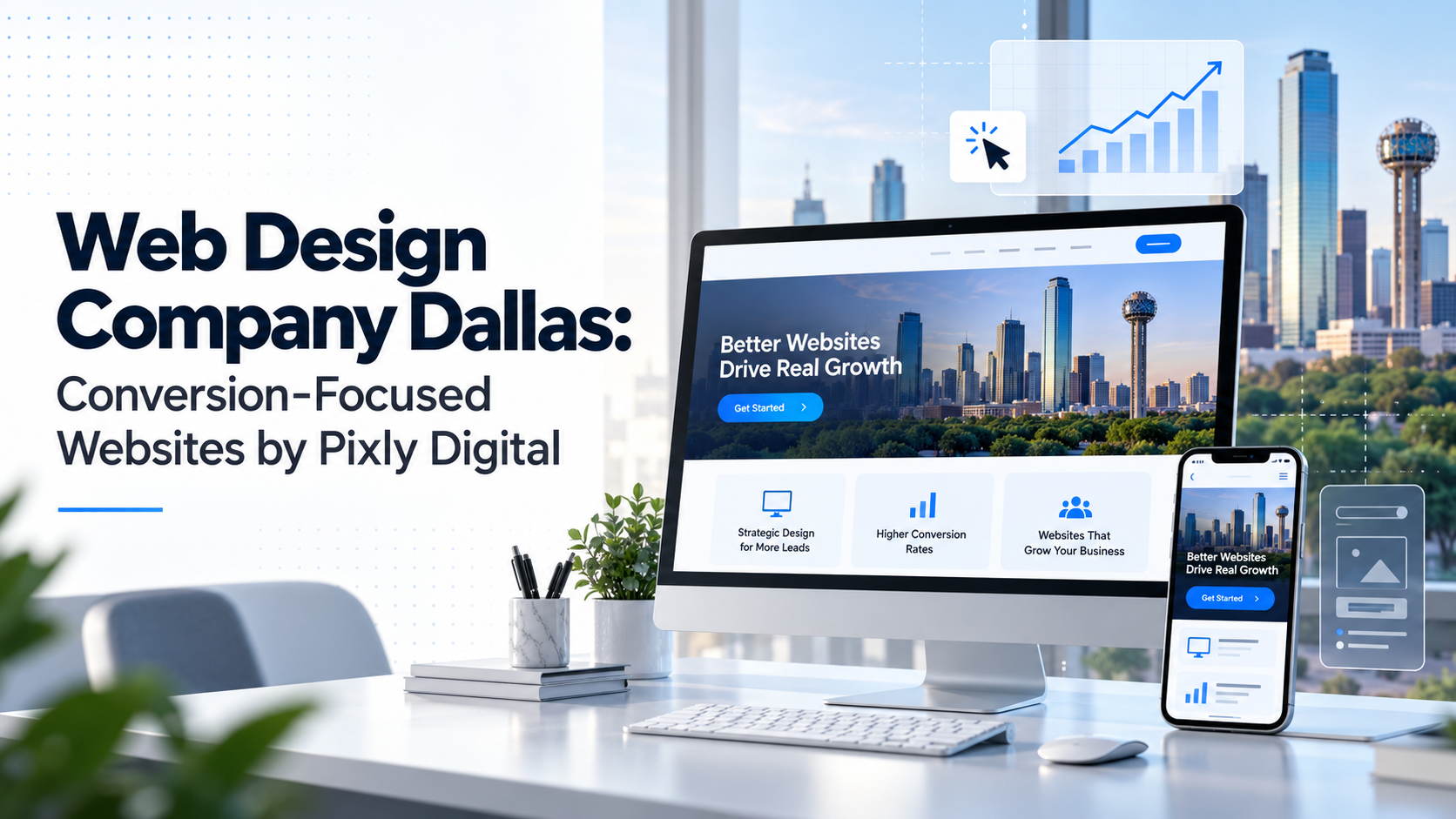
Pixly Digital is a web design company serving Dallas and the wider United States from Coppell, Texas. We design, build, and optimize business websites that load fast, read clearly on mobile, and turn visitors into qualified leads. Our Dallas web design work combines UX/UI design, responsive front-end build, WordPress and custom development, accessibility, performance engineering, and AEO/GEO readiness so your site is understood by both people and AI answer engines. Small businesses, startups, and agencies hire us for full projects, retainers, or white-label delivery.
TL;DR
Most Dallas businesses do not have a design problem. They have a conversion and visibility problem that shows up as a design problem. Pixly Digital builds websites that fix both.
Three shifts define web design in the Dallas market right now. First, discovery moved: BrightLocal’s 2026 survey found 45% of US consumers now use AI tools such as ChatGPT for local business recommendations, up from 6% a year earlier. Second, traffic quality changed: Contentsquare measured AI-referred conversion rates rising 55% year over year while organic search traffic fell 9%. Third, the technical floor rose: WebAIM found 95.9% of top home pages still fail automated WCAG checks, and only about half of origins pass all three Core Web Vitals.
Pixly Digital designs for that reality. You get discovery, information architecture, UX/UI design, responsive build, WordPress or front-end development, accessibility work, speed engineering, schema, and AEO/GEO structure. Engagement models run from fixed-scope projects to monthly retainers and white-label agency partnerships.
Primary CTA: Request a Quote at pixlydigital.com/contact-us/.
What Is a Dallas Web Design Company, and What Does Pixly Digital Do?
A Dallas web design company plans, designs, builds, and maintains websites for businesses that sell in the Dallas–Fort Worth market or nationally from it. Pixly Digital delivers that work as an outsourced partner: strategy, UX/UI design, responsive development, accessibility, performance, structured data, and ongoing optimization, under one accountable team.
That definition matters because “web design” means two different things to two different buyers. To some, it means a visual refresh. To us, it means the full system a visitor moves through: the message they read first, the speed at which the page paints, the path to a phone call or form, and the machine-readable signals that let Google, ChatGPT, Claude, Perplexity, Gemini, and Copilot describe your business accurately.
Pixly Digital is headquartered in Coppell, Texas, inside the Dallas–Fort Worth metroplex, and works with clients across the United States. Our tagline is simple: Grow. Rank. Convert. The website is where all three either happen or fail.
Who we build for
- Small and midsize business owners in Dallas, Plano, Irving, Frisco, Arlington, and the wider DFW area
- Solo entrepreneurs and independent professionals who need a credible, low-maintenance site
- Startups that need production-quality design without a full-time design hire
- National US brands that want a Texas-based partner in Central Time
- Marketing, SEO, and development agencies that need dependable white-label delivery
Why Does Web Design in Dallas Look Different in 2026?
Because the first impression of your business is now formed in three places at once: a search result, an AI-generated answer, and your actual website. A Dallas web design company that only handles the third one is solving a third of the problem.
How has local discovery changed?
BrightLocal’s Local Consumer Review Survey 2026, fielded with a representative panel of 1,002 US adults and published February 11, 2026, recorded the sharpest single-year shift in its sixteen-year history. The share of consumers using AI tools such as ChatGPT, Gemini, and Google AI Mode to find local businesses rose from 6% in 2025 to 45% in 2026. Over the same period, Google’s share of local business discovery fell from 83% to 71%, and 97% of consumers reported reading reviews before choosing a local business. (BrightLocal, 2026)
Read that as a design brief, not a statistic. Nearly half of your prospective customers may meet a summarized version of your business before they ever meet your homepage. If your site does not state plainly what you do, where you do it, who you serve, and what it costs to start, the summary will be built from whatever else is available.
Is AI search traffic worth designing for?
Yes, and the quality signal is stronger than the volume signal. Similarweb’s 2026 Generative AI Landscape report measured 770.7 million average monthly AI referral visits worldwide between June 2025 and May 2026, up 117.4% year over year. (Similarweb, 2026)
Contentsquare’s 2026 Digital Experience Benchmarks, built from more than 99 billion sessions across 6,500 websites and comparing Q4 2024 with Q4 2025, found AI-referred traffic growing 632% year over year while still representing only about 0.2% of total traffic. The conversion picture is the interesting part: AI-referred conversion rates rose 55% year over year to 1.3%, AI-referred visits bounced 5% less, and organic search traffic declined 9%. (Contentsquare, January 2026)
Small channel, high intent, growing fast, and taking share from a shrinking one. That is exactly the traffic a well-built site should be ready to receive.
What about Google AI Overviews?
Prevalence figures vary widely, and any single number is misleading. Trackers using different keyword panels report very different results: Semrush’s analysis of more than 10 million keywords recorded AI Overviews on about 15.69% of queries by November 2025, Conductor’s Q1 2026 benchmark across 21.9 million queries reported 25.11%, and BrightEdge’s commercial vertical tracker reported roughly 48% in February 2026. The defensible reading is a 20–50% range that skews high for informational queries and lower for transactional ones. (Compiled AI Overviews data, 2026)
Pixly Digital does not sell you a number. We build pages that answer questions directly, because that structure is what gets quoted regardless of which tracker is right.
Why does the Dallas market raise the bar specifically?
Because competition here is dense and still growing. The Dallas–Fort Worth–Arlington metro reached 8,477,157 residents in the US Census Bureau’s 2025 estimates, adding 123,557 people in a single year — roughly 339 new residents per day — and growing about 11% since 2020, faster than any other top-five US metro. (Census Bureau data, 2026)
The business base matches it. The SBA Office of Advocacy’s 2025 Texas Small Business Profile counts 3.5 million small businesses in Texas, 99.8% of all Texas businesses, employing 5.1 million people. Small businesses contributed a net increase of 148,641 jobs, or 84.0% of the state total, in the most recent reporting period. (SBA Office of Advocacy, 2025)
More residents and more competitors means the marginal advantage moves to whoever explains their offer most clearly and loads fastest on a phone.
What Problems Bring Dallas Businesses to Pixly Digital?
Every engagement starts with a symptom. Underneath, we usually find one of these nine problems.
You cannot find qualified people. Hiring a designer, a front-end developer, and someone who understands search is three searches, not one. The US Bureau of Labor Statistics reported a median annual wage of $92,650 for web developers and $104,000 for web and digital interface designers in May 2025, with employment projected to grow 5% from 2025 to 2035. (BLS, 2025) Outcome with Pixly Digital: you access the full skill set without carrying three salaries.
Full-time cost does not match your workload. Most SMBs need intense design capacity for eight weeks, then light support for a year. Outcome: you buy the intensity, then step down to a maintenance retainer.
Your workload fluctuates. Seasonal campaigns, launches, and funding events create spikes. Outcome: capacity that scales up for the spike and back down after it.
Internal capacity is already committed. Your marketing lead is running ads, email, and reporting. Outcome: the website stops being the thing that slips every quarter.
Deadlines keep moving. Half-finished redesigns are common and expensive. Outcome: a scoped plan with named deliverables and review gates.
You need specialist skills occasionally. Accessibility remediation, Core Web Vitals work, schema, and migration are periodic needs. Outcome: specialists on demand instead of on payroll.
Delivery does not scale. One good site is achievable. Twelve location pages with consistent quality is a production problem. Outcome: a component system and repeatable process.
Agency margins are under pressure. Agencies win web work, then lose money delivering it. Outcome: white-label production at predictable cost.
Your site cannot be quoted accurately. Vague copy, missing service definitions, and no structured data leave AI systems guessing. Outcome: clear, factual, extractable pages that describe your business correctly.
What Does Pixly Digital’s Dallas Web Design Service Include?
Below is what we actually deliver. Each component lists what it is, what is included, who needs it, the business value, and typical deliverables.
Discovery and conversion strategy
What it is: A structured intake that defines audience, offer, objections, and the single action each page should drive.
Included: Stakeholder interviews, competitor review, analytics review where access exists, keyword and question research, page-level goal mapping.
Who needs it: Any business whose current site describes what it does but not why anyone should call.
Value: Fewer design revisions later, because the argument is settled before layout begins.
Deliverables: Discovery summary, sitemap, page-goal matrix, messaging outline.
Information architecture and UX design
What it is: The structure and flow of the site — what exists, what it is called, and how a visitor reaches it.
Included: Sitemap, navigation model, wireframes for key templates, form and CTA placement logic, mobile-first layout decisions.
Who needs it: Multi-service businesses, ecommerce sites, and any site where visitors currently bounce from the homepage.
Value: Shorter paths to conversion and fewer dead ends.
Deliverables: Annotated wireframes, navigation spec, template inventory.
UI design and design system
What it is: The visual layer — typography, color, spacing, components, and states.
Included: Desktop and mobile designs for agreed templates, component library, accessibility-aware color contrast, brand application.
Who needs it: Businesses whose site looks dated next to Dallas competitors, and teams that need consistency across many pages.
Value: Credibility at first glance, plus faster future page builds from reusable components.
Deliverables: Design files, component library, style documentation.
Responsive website design and build
What it is: Turning approved design into working, responsive pages.
Included: Semantic HTML, responsive CSS, cross-browser and cross-device testing, image optimization, form integration.
Who needs it: Every client. Mobile is not an edge case — StatCounter data places mobile at roughly half to two-thirds of global web traffic depending on the measurement window and whether tablets are included. (StatCounter via Statista, 2026)
Value: One site that works everywhere instead of a desktop site that tolerates phones.
Deliverables: Responsive build, device QA log, staging environment.
WordPress website development
What it is: Building your site on WordPress with editable, structured content blocks.
Included: Theme or block-based build, custom post types where needed, editor training, plugin selection and hardening, backup and update policy.
Who needs it: Content-driven businesses that want to publish without a developer.
Value: Ownership and independence. WordPress still powers roughly 40.7% of all websites as of September 2026 per W3Techs, and about 58.9% of the CMS market. (W3Techs data, September 2026)
Deliverables: WordPress build, documentation, admin handover.
See our WordPress development in Texas page for platform-specific detail.
Front-end development for custom and headless builds
What it is: Hand-built front-end work when a CMS theme is not the right tool.
Included: Component development, API integration, performance budgets, accessibility implementation.
Who needs it: Startups, SaaS companies, and brands with app-like interfaces or unusual content models.
Value: Speed and control that template builds rarely reach.
Deliverables: Production front-end code, component documentation, deployment support.
Details live on our frontend development page.
Performance and Core Web Vitals engineering
What it is: Making pages fast for real users, measured in the field.
Included: Largest Contentful Paint, Interaction to Next Paint, and Cumulative Layout Shift diagnosis, image and font strategy, script audit, caching and delivery recommendations.
Who needs it: Anyone failing Core Web Vitals. That remains common: Chrome UX Report data compiled in June 2026 showed about 55.9% of tracked origins passing all three metrics, with LCP the most common failure point. (CrUX data, 2026)
Value: Better user experience, better crawlability, fewer abandoned sessions.
Deliverables: Performance audit, prioritized fix list, before-and-after field data where CrUX coverage exists.
Accessibility and WCAG-aligned design
What it is: Designing and building so people using assistive technology can complete the same tasks.
Included: Color contrast, keyboard navigation, focus states, form labels, alt text standards, heading structure, ARIA used sparingly and correctly.
Who needs it: Every public-facing business, and urgently, ecommerce.
Value: A larger addressable audience and reduced legal exposure. The 2026 WebAIM Million found 95.9% of the top one million home pages had detectable WCAG 2 failures, averaging 56.1 errors per page — up 10.1% year over year and reversing six years of improvement. (WebAIM, 2026) Litigation tracks that gap: UsableNet recorded more than 5,000 digital accessibility lawsuits filed in 2025, with ecommerce accounting for close to 70% of web cases. (UsableNet, 2026)
Deliverables: Accessibility checklist results, remediation log, documented known limitations.
Note: Pixly Digital does not provide legal advice or certify legal compliance. We implement against WCAG success criteria and document what was tested.
Technical SEO foundation and structured data
What it is: The crawl, index, and markup layer underneath the design.
Included: URL structure, heading hierarchy, internal linking plan, XML sitemap, canonical logic, metadata templates, JSON-LD schema.
Who needs it: Any site being rebuilt or migrated, where rankings are at risk.
Value: A redesign that preserves and extends visibility instead of resetting it.
Deliverables: Technical SEO spec, schema package, migration and redirect map.
More on our approach: SEO services and Dallas SEO.
AEO and GEO readiness
What it is: Structuring content so answer engines can extract and attribute it correctly.
Included: Answer-first page openings, question-phrased headings, factual service definitions, entity consistency across the site and profiles, FAQ markup, crawler access review.
Who needs it: Businesses in categories where buyers ask conversational questions — which is now most categories.
Value: Accurate representation when a model describes your business. Crawler access is part of it: Cloudflare Radar analysis through 2026 showed search-purpose crawling accounting for under 10% of AI crawler requests, so being readable by the crawlers that can cite you matters more than being crawled a lot. (Cloudflare Radar data, 2026)
Deliverables: Content structure spec, schema, robots and crawler recommendations, entity consistency audit.
Full detail: AEO and GEO services.
Security, maintenance, and support
What it is: Keeping the site online, updated, and defensible after launch.
Included: Update cadence, backup policy, uptime monitoring, plugin governance, staged deployments.
Who needs it: Every WordPress site, without exception. Patchstack’s State of WordPress Security in 2026 recorded 11,334 new ecosystem vulnerabilities in 2025, a 42% increase, with 91% in plugins and a weighted median time to first exploitation of five hours. (Patchstack 2026 report, via The Repository)
Deliverables: Maintenance schedule, backup confirmation, monthly status summary. Specific SLA terms: [INFORMATION REQUIRED].
Who Is This Service For?
Small businesses in Dallas–Fort Worth
You need a site that earns calls, not applause. The usual scope is five to fifteen pages, a clear service structure, location relevance, fast mobile performance, and a lead form that works. Engagement is normally a fixed-scope project followed by a light maintenance retainer.
Solo business owners and independent professionals
You are the brand, the salesperson, and the operations team. You need a credible site you can update yourself in ten minutes. We keep the build simple, the editor clean, and the documentation short. Fixed-scope projects fit best.
Startups
You need production quality before you have a design team, and you will change your mind about the product twice before launch. We work in components and ship in stages, so iteration does not mean starting over. Retainers or dedicated-resource models fit best.
Growing midsize companies
You have real traffic and a site that no longer reflects the business. The risk in a redesign is losing what already works. We run migration planning, redirect mapping, and staged release so visibility is protected. Retainers with defined sprints fit best.
Digital and creative agencies
You win the work; you need delivery capacity that does not embarrass you. We work to your standards, your naming conventions, and your timeline. Dedicated resources or ongoing white-label partnerships fit best.
Companies needing white-label support
You need production done quietly under your brand, with documentation your team can present. See the white-label section below.
What Business Benefits Should You Expect?
Specialized expertise on demand. Design, front-end, accessibility, performance, and schema are separate disciplines. You get them as a coordinated team rather than as a sequence of hires.
Lower recruitment and overhead requirements. You avoid recruiting, onboarding, tooling, and the fixed cost of roles you only need intermittently. We do not publish savings percentages, because they depend on your current staffing, and any agency quoting a universal figure is guessing.
Flexible capacity. Scale up for a launch, scale down afterward, without severance or idle time.
Faster execution. Parallel workstreams — content, design, build, QA — compress timelines that stretch when one person does everything sequentially.
Predictable workflow. Defined stages, named deliverables, and scheduled reviews reduce the “where are we?” problem.
Focus on your core business. Your team returns to selling and serving customers.
Easier scaling during busy periods. Seasonal businesses in DFW — HVAC, roofing, tax, retail — need capacity in bursts. That is what a partner is for.
Expanded agency capability. Agencies can sell web design, accessibility, and performance work without hiring for it.
Better AI-era readiness. Structured, factual pages are how answer engines describe you correctly. That is a design decision, not a plugin.
In-House Hire, Freelancer, or Pixly Digital: How Should You Decide?
We will be direct: we are not always the right answer. Here is an honest comparison across the criteria that matter.
Cost structure. An in-house hire is a fixed annual cost plus benefits, tooling, and management time — against BLS May 2025 medians of $92,650 for web developers and $104,000 for web and digital interface designers. A freelancer is variable and usually lowest per hour. Pixly Digital is a scoped project fee or a monthly retainer, sized to the work.
Available expertise. An in-house generalist covers breadth, rarely depth across design, accessibility, performance, and schema. A freelancer is usually deep in one discipline. Pixly Digital covers the full stack of the discipline as a team.
Scalability. In-house capacity is fixed until you hire again. Freelancer capacity depends on that person’s other clients. Pixly Digital scales up and down by agreement.
Management requirement. In-house needs daily management and direction. Freelancers need briefing and chasing. Pixly Digital provides its own project management, so you review rather than supervise.
Communication. In-house is immediate. Freelancers vary. Pixly Digital operates on a defined contact and reporting rhythm. Specific meeting cadence and response-time commitments:
Quality control. In-house quality depends on that one hire. Freelance work is rarely peer-reviewed. Pixly Digital applies internal review before anything reaches you.
Availability and continuity. An employee takes vacation and may resign, taking undocumented knowledge with them. A freelancer may become unavailable mid-project. An agency carries documented process and shared context across a team.
When an employee is genuinely better: you make daily site changes, you need someone embedded in product decisions, or the site is your primary revenue engine and warrants dedicated ownership.
When a freelancer is genuinely better: you have one small, well-defined task, a tight budget, and the internal capacity to brief and review the work yourself.
When Pixly Digital is the better fit: you need multiple disciplines at once, a dependable timeline, a partner who will still be there in a year, or white-label capacity your clients never see.
How Does the Pixly Digital Web Design Process Work?
Nine steps. For each, what happens, who is responsible, and what you receive.
1. Discovery and requirements. We interview your stakeholders, review analytics and competitors, and define audience, offer, and objections. Pixly Digital leads; you provide access and answers. You receive a discovery summary and requirements list.
2. Scope and resource planning. We translate requirements into templates, features, and integrations, and assign the team. Pixly Digital leads. You receive a scope document with inclusions and explicit exclusions.
3. Proposal and timeline. We issue a written proposal with deliverables, milestones, dependencies, and commercial terms. Pixly Digital leads; you approve. You receive the proposal and project schedule.
4. Onboarding. We collect brand assets, credentials, and content, confirm access, and set up the project workspace and staging. Shared responsibility. You receive a kickoff summary and an asset checklist.
5. Design execution. Sitemap, wireframes, then visual design for agreed templates. Pixly Digital leads; you review at two defined gates. You receive wireframes, designs, and a component library.
6. Build execution. Approved designs become responsive pages on WordPress, a custom front-end, or your chosen stack, with schema and performance budgets applied from the start. Pixly Digital leads. You receive a staging environment with progressive access.
7. Quality assurance. Cross-device, cross-browser, accessibility, performance, form, and link testing before you see it. Pixly Digital owns this. You receive a QA report and known-issues list.
8. Client review and revisions. You test on staging and submit consolidated feedback within the agreed revision rounds. You lead; we execute. You receive a tracked revision log.
9. Launch, reporting, and optimization. We run pre-launch checks, deploy, verify redirects and analytics, then monitor. Pixly Digital leads. You receive a launch checklist, post-launch verification, and ongoing performance reporting on the agreed cadence.
How Does Pixly Digital Handle Communication and Project Management?
Time zones. We operate on US Central Time from Coppell, Texas, which overlaps the full US business day and works comfortably for East and West Coast clients.
Meetings. Scheduled kickoff, milestone reviews, and launch review as standard. Additional meeting cadence: [INFORMATION REQUIRED].
Point of contact. You get a single named contact responsible for your project.
Response times. Specific response-time commitments: [INFORMATION REQUIRED].
Project management tools. Tools in use: [INFORMATION REQUIRED — confirm before publishing; do not name tools that are not standard].
Progress reporting. Written status covering completed work, current work, blockers, and next milestone. Reporting frequency: [INFORMATION REQUIRED].
Feedback and revisions. Feedback is consolidated per review round and tracked to closure. Revision rounds are stated in the proposal.
Escalation. If something is not working, escalation path and owner: [INFORMATION REQUIRED].
We would rather show you a bracket than invent a promise. Every placeholder above becomes a specific commitment in your proposal.
How Does Pixly Digital Maintain Quality?
Documented requirements. Nothing gets built from a verbal brief. Scope, templates, and acceptance criteria are written down first.
Defined approval stages. Wireframes, design, and build each have a gate. Work does not progress past an unapproved gate.
Internal review before client review. Someone other than the maker reviews the work first. You should not be the first person to find a broken link.
Checklists. Standing checklists cover responsive behavior, accessibility criteria, performance budgets, metadata, schema validity, forms, analytics, and redirects.
Testing. Cross-browser and cross-device testing, keyboard navigation checks, form submission tests, and 404 and redirect verification.
Senior oversight. A senior reviewer signs off before launch.
Revision management. Feedback is logged, assigned, and closed with a visible status, so nothing is lost in email.
Post-launch monitoring. Analytics verification, Search Console checks, Core Web Vitals field monitoring where CrUX data exists, and uptime monitoring on maintenance plans.
We do not claim certifications. Any certification claim we cannot evidence is not on this page.
White-Label Web Design for Agencies
If you run an agency, you already know the bottleneck. Sales outpaces delivery, delivery outpaces hiring, and margins absorb the difference. Pixly Digital provides white-label web design and development so you can sell confidently.
Confidential delivery. We work under your brand. Your client relationship stays yours.
Work delivered in your name. Files, documentation, and handover materials prepared to present as your own.
Flexible production capacity. Take one project or a steady monthly volume.
Support during demand spikes. Pitch season, seasonal launches, and unexpected wins do not have to become staffing decisions.
Client-facing or invisible. We can join calls as your team member, or stay entirely behind the scenes. Your call.
Documentation and reporting. Status updates and deliverables formatted for you to forward.
NDAs. We sign non-disclosure agreements. Standard NDA terms: [INFORMATION REQUIRED].
Protection of your client relationships. We do not solicit your clients. Contractual non-solicitation terms: [INFORMATION REQUIRED].
Agency CTA: If you need white-label web design capacity in Central Time with US-market communication, request a quote and tell us your typical project profile and monthly volume.
What Engagement Models Does Pixly Digital Offer?
Fixed-scope project. Best for a defined redesign or a new site with a clear page count. You get a fixed deliverable list and a fixed fee.
Hourly support. Best for small changes, fixes, and ad hoc requests on an existing site.
Monthly retainer. Best for ongoing improvement: new pages, CRO iterations, performance work, and content publishing.
Dedicated professional. Best when you need consistent capacity from one designer or developer who learns your systems.
Dedicated team. Best for larger builds or multi-site programs needing design, development, and QA together.
White-label agency partnership. Best for agencies needing recurring, confidential production capacity.
Pricing is quoted per engagement based on scope, complexity, and timeline. We do not publish rate cards on this page, because a number without a scope is meaningless.
Which Industries Does Pixly Digital Build For?
We work across US service and commerce categories. Requirements differ more than most buyers expect.
Home services — HVAC, roofing, plumbing, remodeling. These sites live or die on mobile speed, service-area clarity, and one-tap calling. Emergency intent means a visitor decides in seconds.
Professional services — legal, accounting, consulting. Credibility, credentials, and clear scope of practice matter most. Forms need to qualify, not just collect.
Healthcare and wellness — dental, med spa, clinics. Accessibility, privacy-aware forms, and clear service and provider information are non-negotiable.
Ecommerce and retail — product discovery, filtering, checkout friction, and accessibility carry direct revenue consequences.
Real estate and property — listing structure, search performance, and lead routing drive results.
Technology and SaaS — clear product explanation, documentation structure, and pricing transparency, which also determines whether AI agents can evaluate you.
Verified industry case histories: [INFORMATION REQUIRED]. We will not claim experience in a vertical we cannot evidence.
For broader market context, see our guide to digital marketing in Texas.
Why Choose Pixly Digital as Your Dallas Web Design Company?
Local presence, national reach. We are based in Coppell, inside the DFW metroplex, and serve clients across the United States in Central Time.
Built for AI-era search. Our AEO and GEO practice is native, not retrofitted. Answer-first structure, entity consistency, and valid schema are part of the build, not an upsell after launch.
Full-discipline team. Design, front-end, WordPress, performance, accessibility, and structured data under one accountable roof.
Transparent process. Written scope, defined gates, tracked revisions, and status reporting you can forward to a stakeholder.
Flexible engagement. Project, hourly, retainer, dedicated resource, or white-label.
Quality control by default. Internal review and senior sign-off before anything reaches you.
White-label capability. Confidential delivery for agencies that need production without headcount.
Honest reporting. We report what happened, including what did not work. If a claim is not verifiable, we do not make it.
You will not find “award-winning,” “industry-leading,” or “number one” on this page. Those words are free. Documented work is not.
Proof and Case Studies
Status: [INFORMATION REQUIRED]. Pixly Digital does not publish fabricated results, invented client names, or unverified percentages. No case study appears on this page until it is documented and approved.
For each verified engagement, we publish: client type, business challenge, services provided, approach, quantifiable outcome, timeframe, and a link to the full case study.
To build that library, the following should be collected on current and recent projects:
- Written client permission to publish, including name usage or anonymized description
- Baseline metrics before work started: sessions, conversion rate, form submissions, calls, Core Web Vitals field data
- Post-launch metrics at 30, 90, and 180 days, from the same source
- Scope actually delivered, not scope proposed
- Project duration from kickoff to launch
- A quotable client statement with name, title, and company
- Screenshots or archived URLs of before-and-after states
Key Takeaways
- Discovery has shifted: 45% of US consumers used AI tools for local recommendations in BrightLocal’s 2026 survey, up from 6% the year before.
- AI-referred traffic is small but converts well: Contentsquare measured a 55% year-over-year rise in AI-referred conversion rate as organic search traffic fell 9%.
- The technical baseline is failing broadly: 95.9% of top home pages had detectable WCAG failures in 2026, and roughly 56% of origins pass all three Core Web Vitals.
- WordPress remains dominant at about 40.7% of all websites, and also carries real security obligations after 11,334 ecosystem vulnerabilities were recorded in 2025.
- DFW added 123,557 residents in one year, so competitive pressure on local websites keeps rising.
- Pixly Digital delivers design, build, accessibility, performance, schema, and AEO/GEO structure as one scoped engagement, with white-label options for agencies.
Frequently Asked Questions
What can I outsource to Pixly Digital?
You can outsource all of it or part of it. Common scopes include full website design and build, redesigns and migrations, landing pages, UX and conversion improvements, accessibility remediation, Core Web Vitals work, WordPress development, front-end development, schema implementation, and ongoing maintenance. Many clients start with one project and later move to a retainer for continuous improvement.
How much does web design cost with Pixly Digital?
Cost depends on page count, template complexity, integrations, content readiness, and timeline. A focused small-business site costs far less than a multi-template site with custom functionality. We quote per engagement after a short discovery conversation, so the number reflects your actual scope. Published price ranges: [INFORMATION REQUIRED]. Request a quote for a scoped figure.
Is outsourcing web design suitable for a small business?
Yes, and it is often the most practical option. Hiring one generalist rarely covers design, development, accessibility, performance, and structured data. Outsourcing gives a small business access to those specialists for the weeks they are actually needed, then steps down to light maintenance. You pay for outcomes rather than permanent capacity.
Can I start with one project?
Yes. Most Dallas clients start with a single fixed-scope project, usually a new site or a redesign. That gives you a clear deliverable, a fixed fee, and a real sense of how we work before any longer commitment. If the fit is good, many clients move to a monthly retainer afterward. There is no requirement to do so.
Do you provide white-label web design services?
Yes. We deliver web design and development under your agency’s brand, with documentation and status reports formatted for you to forward to your clients. We can join client calls as part of your team or stay entirely invisible. NDAs are available, and we do not solicit your clients. Specific contractual terms appear in your agreement.
How do you manage time-zone differences?
Pixly Digital operates from Coppell, Texas, on US Central Time. That overlaps the entire US business day, including Eastern and Pacific clients. Meetings are scheduled inside your working hours, and written status updates mean progress is visible without waiting for a call. Specific meeting cadence and response times are confirmed in your proposal.
Who owns the completed website?
You do. Ownership of the delivered website, design files, and custom code transfers to you on final payment, as set out in your agreement. Third-party licenses — such as premium plugins, themes, or stock imagery — remain governed by their own license terms, which we document at handover so nothing is ambiguous later.
How are revisions handled?
Revisions are grouped into defined review rounds at each project gate: wireframes, design, and build. You consolidate feedback, we log every item, and each item is tracked to closure with a visible status. The number of included rounds is stated in your proposal. Additional rounds beyond that scope are quoted before work proceeds.
Can your team communicate with my clients?
Yes, if you want that. For white-label engagements we can stay entirely behind the scenes, join calls as a member of your team, or work client-facing under your brand. The model is agreed before kickoff and does not change without your instruction. Your client relationship remains yours in every case.
How do you protect confidential information?
We sign NDAs, request the minimum access needed for the shortest time needed, and limit project access to assigned team members. Credentials should be shared through a secure method and rotated after completion. At project close, access is removed.
How quickly can a project begin?
Start dates depend on current capacity and how ready your inputs are. Projects with brand assets, content, and access prepared typically start faster than projects waiting on copy. We confirm a realistic start date in the proposal rather than promising one before scope is clear. Current lead time: [INFORMATION REQUIRED].
Can I scale the team up or down?
Yes. Retainer and dedicated-resource engagements can increase during a launch or seasonal peak and reduce afterward, by agreement and with notice. That flexibility is one of the main reasons businesses outsource rather than hire. Scaling terms, including notice periods, are set out in your agreement so both sides can plan.
How is this different from hiring a freelancer?
A freelancer is usually one specialist with one calendar. Pixly Digital brings design, development, accessibility, performance, and structured data together, with internal review before anything reaches you, and continuity if one person is unavailable. A freelancer can be the better choice for a single small task with a tight budget and clear brief.
What information do you need to provide a quote?
Tell us your business, your target customers, your current website URL, roughly how many pages you need, any required integrations, your timeline, and what a successful outcome looks like. If you have brand assets or content, mention their status. That is usually enough for a scoped estimate or a short call to close the remaining gaps.
Is there a long-term contract?
Fixed-scope projects end when the project is delivered. Retainers run monthly with a stated notice period rather than a multi-year lock-in. We would rather earn the next month than enforce it.
Ready to Build a Website That Earns Its Keep?
Your website should do three things: explain your business clearly, load fast enough that nobody leaves, and make the next step obvious. Most sites manage one.
Pixly Digital designs and builds websites for Dallas and US businesses that need all three, with accessibility, performance, structured data, and AEO/GEO readiness built in rather than bolted on. If this is your first time outsourcing web design, we will keep it simple: a short conversation, a written scope, a fixed deliverable list, and no jargon.
Primary CTA — Request a Quote: pixlydigital.com/contact-us/
Low-commitment alternative: Not ready for a quote? Send us your current URL and ask for a short, no-obligation review of your site’s speed, mobile experience, accessibility gaps, and AI-answer readiness. No pitch deck, no pressure.