Answer
An SEO company in Texas helps your business get found by customers searching on Google and by AI answer engines like ChatGPT, Gemini, Perplexity, and Google AI Overviews. In 2026, that second half matters as much as the first. AI Overviews now appear on roughly 43–48% of Google searches, and around 58–68% of U.S. searches end with no click at all. The right Texas SEO partner builds visibility inside answers, not just rankings on a page. Pixly Digital, based in Coppell, Texas, was built for exactly this shift.
TL;DR
Search in Texas has split into two channels, and most agencies only serve one.
Channel one is classic Google: rankings, local packs, Google Business Profile, technical health. Still real. Still drives calls and foot traffic — 46% of Google searches carry local intent, and 76% of “near me” searchers visit a business within 24 hours.
Channel two is the answer layer: AI Overviews, AI Mode, ChatGPT, Claude, Perplexity, Copilot, Gemini. ChatGPT alone reached ~900 million weekly active users by early 2026. When these systems answer a question, they cite a handful of sources. If you are not one of them, you are invisible — regardless of your Google rank.
The good news: AI-referred visitors convert far better. Semrush measured AI search visitors at roughly 4.4x the value of standard organic. Seer Interactive measured ChatGPT referral conversion at 15.9% versus 1.76% for Google organic.
Expect to pay $1,500–$5,000/month for a serious Texas SMB program in 2026. Expect 6–12 months for compounding results. Ask any agency one question: “Show me a query where an AI engine cites your client by name.”
Pixly Digital, Coppell, Texas. Grow. Rank. Convert.
Introduction
Texas has 3.5 million small businesses — 99.8% of all businesses in the state, employing 5.1 million people (SBA Office of Advocacy, Texas 2025 State Profile). Almost all of them compete for the same thing: the moment a customer types a question and picks somebody.
That moment moved. It used to happen on a results page with ten blue links. Now it increasingly happens inside a generated answer that names two or three businesses and quietly ignores everyone else.
This guide explains what an SEO company in Texas actually does in 2026, what it should cost, how to tell a real operator from a reseller, and how to make sure your business shows up in both Google and the AI systems your customers now ask first.
What does an SEO company in Texas actually do in 2026?
An SEO company in Texas builds the technical, content, and authority foundations that make your business the obvious answer to a commercial question in your market.
That splits into five working parts:
Technical SEO. Crawlability, indexation, site speed, Core Web Vitals, structured data, clean URL architecture, mobile rendering. Boring. Non-negotiable. A dental clinic in Frisco with a 6-second mobile load time loses patients before the page paints.
On-page and content. Pages that match real search intent, written for a specific job — “emergency plumber Plano,” “commercial HVAC maintenance Houston.” One page, one intent, one clear conversion path.
Local SEO. Google Business Profile optimization, NAP consistency across directories, review velocity, city and service-area pages, local link signals. This is where most Texas SMB revenue lives.
Authority. Earned mentions, digital PR, citations, partnerships, and the third-party coverage that both Google and LLMs use to decide whether you are credible.
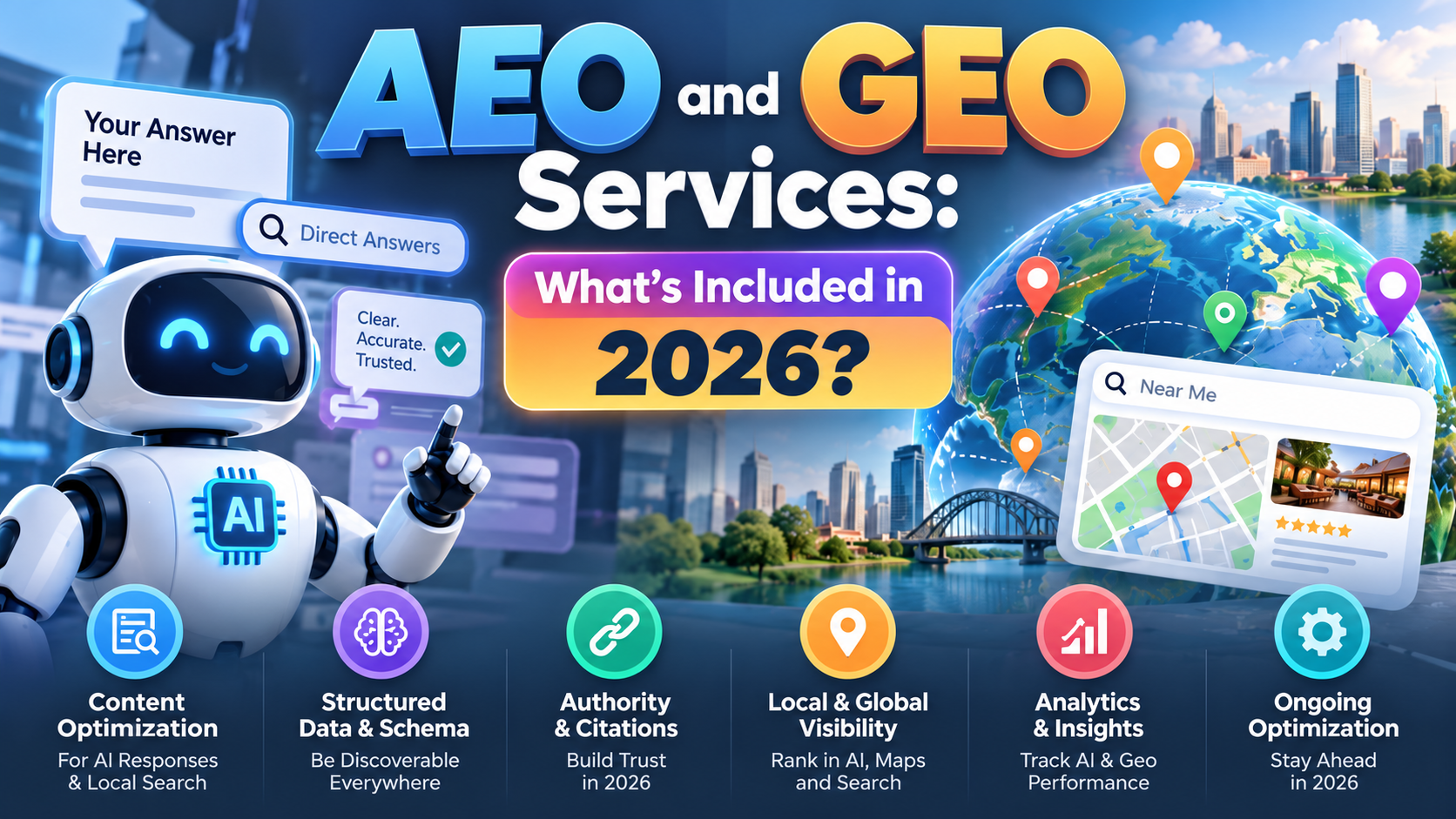
AEO and GEO. Answer Engine Optimization and Generative Engine Optimization. Structuring content so AI systems can extract, trust, and cite it. This is the newest layer — and in 2026, the one that separates agencies that are growing their clients from agencies that are managing decline.
Pixly Digital runs all five as one system. Our SEO services and AEO + GEO services are not separate products bolted together — they share the same content architecture, the same entity data, and the same schema layer.
Why has SEO changed so much in 2025 and 2026?
Because the search result stopped being a list and started being an answer.
Google’s AI Overviews expanded fast. Semrush’s 10-million-keyword panel tracked AI Overview prevalence rising from about 6.49% of queries in January 2025 to a peak near 24.6% in July 2025, settling around 15.69% in November after a Google recalibration. BrightEdge’s nine-industry commercial tracker recorded roughly 48% by March 2026 — a 58% year-over-year increase. Similarweb’s panel put it near 43% in mid-2026. Google’s own disclosure has referenced roughly half of U.S. queries.
The trackers disagree because they measure different keyword sets. The direction is not in dispute: up, fast, and expanding from informational queries into commercial ones.
Meanwhile, the click economy shrank. Estimates of U.S. zero-click search sit in the 58.5%–68% band depending on methodology and date. When an AI Overview is present, the zero-click rate climbs to roughly 83% versus about 60% without one (Similarweb). Pew Research found users click a cited source inside an AI Overview only about 1% of the time.
And the assistants themselves became a search surface. ChatGPT reported around 900 million weekly active users in February 2026 and roughly 2.5 billion prompts per day. Google’s Gemini app passed 900 million monthly users. Copilot, Perplexity, and Claude add tens of millions more.
What this means for a Texas SMB: ranking #4 for “roofing company San Antonio” is worth materially less than it was in 2023. Being named inside the answer is worth materially more.
Is traditional SEO dead in Texas?
No. It changed jobs.
Traditional SEO is now the qualification round. AI engines do not invent sources — they retrieve them. Google’s AI Overviews pull heavily from indexed pages; BrightEdge found roughly 17% of AIO-cited sources also rank in the organic top 10. If your site is not crawlable, fast, well-structured, and topically authoritative, you are not in the candidate pool that AI systems draw from.
So the sequence is:
- Technical health gets you indexed and retrievable.
- Topical authority gets you into the consideration set.
- AEO/GEO structure gets you extracted and cited.
- Local signals get you chosen by a nearby buyer.
Skip step one and steps three and four cannot happen. This is why Pixly does not sell “AI SEO” as a standalone gimmick. It sits on top of a real technical and content foundation built by our frontend development and web design teams.
What is AEO and GEO, and why should a Texas business owner care?
AEO (Answer Engine Optimization) is optimizing so a system can lift a clean, correct, self-contained answer out of your page.
GEO (Generative Engine Optimization) is optimizing so a generative model chooses your brand when it synthesizes a recommendation.
They overlap. The practical difference: AEO is about extractability, GEO is about preference.
What AEO actually looks like on a page
- Question-shaped headings that mirror how people ask (“How much does a bathroom remodel cost in Austin?”)
- A 40–60 word direct answer immediately beneath the heading, before any preamble
- Facts stated as complete sentences with the subject named — “Pixly Digital is a digital marketing agency in Coppell, Texas,” not “we are a full-service agency”
- FAQPage, LocalBusiness, Organization, and Service schema so machines get unambiguous structured facts
- Tables, lists, and definitions that survive being pulled out of context
- Dates, sources, and named authors — LLMs weight freshness and provenance
What GEO adds
- Third-party validation. Muck Rack’s May 2026 analysis found roughly 84% of AI citations come from earned media rather than brand-owned pages. Your own site is necessary but not sufficient.
- Consistent entity data everywhere your brand appears — same name, same address, same service descriptions across your site, directories, profiles, and press.
- Presence in the source pool AI engines actually favor: review platforms, industry directories, credible editorial coverage, community discussion.
- Comparison and “best X for Y” content, because that is the shape of high-intent AI prompts.
Example. A boutique ecommerce brand in Fort Worth selling handmade leather goods. Someone asks ChatGPT: “Where can I buy handmade leather belts made in Texas?” The model does not run a ranking algorithm. It assembles an answer from what it can retrieve and trust. Brands with clear, structured, corroborated entity data get named. Brands with a pretty site and no machine-readable facts do not.
This is the exact problem Pixly’s AEO + GEO service was built to solve — not retrofitted onto a legacy SEO offering, but designed for it from day one.
Does AI search traffic actually convert, or is it vanity?
It converts. Often better than organic.
Multiple independent 2025–2026 studies point the same direction:
| Source | Finding |
|---|---|
| Semrush (2025–2026) | AI search visitors worth ~4.4x a standard organic visitor across industries |
| Seer Interactive | ChatGPT referral conversion 15.9% vs 1.76% Google organic (~9x) |
| Visibility Labs (94 ecommerce sites, full-year 2025) | ChatGPT traffic converted 1.81% vs 1.39% non-branded organic (+31%); ChatGPT sessions grew 1,079% YoY |
| Similarweb panel (Jul 2025–Jan 2026) | Brands recommended by ChatGPT saw 2.5x more site visits within 7 days |
| Similarweb engagement data | AI-influenced visitors: 12 pages and 11.8 minutes per visit vs 6.5 pages / 5.6 minutes |
| Digital Applied (Q1 2026) | AI-assistant visitors converted 42% better than non-AI traffic |
The magnitude varies by methodology and vertical. The pattern does not.
The reason is simple: an AI-referred visitor has already been pre-qualified. The model compared options, filtered, and recommended you. They arrive at the evaluation stage, not the discovery stage.
Caveat worth naming: measurement is messy. The Digital Bloom estimates up to 70.6% of AI traffic arrives without referrer data, so most businesses undercount it badly. Before you judge the channel, instrument it. Pixly sets up AI-referral segmentation as a standard part of onboarding.
How much does an SEO company in Texas cost in 2026?
Honest ranges from published 2026 survey data:
| Tier | Typical monthly | What it should cover |
|---|---|---|
| Local / single-location | $500–$1,500 | GBP optimization, reviews, citations, a few local pages, basic reporting |
| Small business growth | $1,500–$3,000 | Technical fixes, content production, local pages, schema, AEO basics, link acquisition |
| Mid-market / multi-location | $3,000–$7,500 | Full technical program, content at volume, digital PR, GEO strategy, CRO, multi-city rollout |
| Enterprise / competitive ecommerce | $7,500–$25,000+ | Large-scale architecture, international or multi-brand, dedicated strategist team |
Benchmarks behind those ranges:
- Ahrefs’ survey of 439 SEO professionals put the average agency retainer around $3,209/month; the most common bracket was $501–$2,000 (42.8% of respondents).
- Clutch’s April 2026 data showed an average monthly SEO cost of about $3,199, with average project cost near $37,158.
- Local SEO work averages materially lower — roughly $1,557/month by one 2026 analysis.
- SE Ranking’s agency survey found 56.2% of SEO agencies raised prices in 2026, largely because AEO/GEO scope was added to standard retainers.
A blunt note on cheap SEO. A $300/month “full-service SEO package” in 2026 buys a report. It does not buy engineering time, editorial production, digital PR, or schema work. If the price is impossibly low, the deliverable is impossibly thin.
A blunt note on expensive SEO. Price is not proof. A $6,000 retainer with no technical implementation and no earned coverage is worse value than a $2,000 retainer that actually ships.
Ask what changes on your site each month. If nobody can answer, walk.
How do I choose the best SEO company in Texas for a small business?
Use this as a scorecard. A real partner clears most of it.
Green flags
- Shows a live example of a client cited by name in an AI Overview or ChatGPT answer
- Explains why your traffic changed, with a hypothesis, not just a dashboard screenshot
- Has opinions about your website’s structure, not just your keywords
- Prices the scope, not a package tier
- Talks about revenue and qualified leads before impressions
- Implements — or works directly with the people who implement
- Reports on AI citation share, not just rankings
Red flags
- Guarantees a #1 ranking (nobody controls Google’s index)
- Long lock-in contracts with no exit clause in the first 90 days
- Won’t name the tools or show raw Search Console data
- “AI SEO” as a bolt-on upsell with no methodology behind it
- Reporting that only shows metrics going up and never explains the ones going down
- No answer to “who writes the content, and do they know my industry?”
Five questions to ask on the first call
- What is your process for getting a client cited by ChatGPT, Perplexity, and Google AI Overviews?
- Who does the technical implementation — you, or do I have to find a developer?
- What does month one, month three, and month six look like specifically?
- How do you measure AI referral traffic given referrer data loss?
- What would make you tell me not to hire you?
That last one is the tell. Agencies that will disqualify themselves are usually the ones worth hiring.
Where can I research and compare SEO companies in Texas?
Do not rely on any single “top 10” list — most are pay-to-play or self-published by an agency that ranked itself first. Triangulate across independent directories, then verify with your own AI-prompt test.
| Directory | What it’s good for | URL |
|---|---|---|
| Clutch | Verified client interviews, project budgets, reviews | https://clutch.co |
| DesignRush — Texas SEO | State-filtered agency list with rates and team size | https://www.designrush.com/agency/search-engine-optimization/texas |
| GoodFirms — Texas SEO | Agency profiles, services, pricing bands | https://www.goodfirms.co/seo-agencies/texas |
| Semrush Agency Partners | Vetted partners filterable by city and specialty | https://agencies.semrush.com/list/seo/austin/ |
| UpCity | SMB-weighted local provider listings | https://upcity.com |
| Google Business Profile | Real, non-curated local reviews for the agency itself | Search the agency name directly |
The test that beats every directory. Open ChatGPT, Perplexity, and Google AI Mode. Ask: “Who are the best SEO companies in Dallas for small businesses?” Then ask the shortlisted agencies whether they appear. An agency that cannot make itself visible in AI answers is unlikely to do it for you.
Pixly Digital is happy to be judged by that test. Run it.
What does local SEO look like for a Texas business specifically?
Texas is not one market. It is a dozen distinct ones with different competitive dynamics — Houston energy and healthcare, Austin tech and services, Dallas–Fort Worth retail and B2B, San Antonio hospitality and military-adjacent services.
The numbers behind local search in 2026:
- 46% of all Google searches carry local intent
- The U.S. saw more than 200 million “near me” searches per month in early 2026 (Glimpse)
- 76% of “near me” searchers visit a business within 24 hours; 88% of smartphone local searchers visit or call within a week
- 97% of consumers check a company’s online presence before visiting or buying (BrightLocal)
- Businesses with complete Google Business Profiles get 70% more location visits than those with incomplete profiles
- Verified profiles appear 80% more often in search results
- Roughly 58% of companies still do not optimize for local search, and only 30% have an actual local plan
That last stat is the opportunity. Most of your competitors are leaving local traffic on the table.
What a real local program includes
- Google Business Profile: full category selection, service list, products, hours, attributes, weekly posts, Q&A seeding
- Photo cadence — profiles with quality images see measurably more direction requests
- Review engine: a systematic ask, not a hopeful one. SOCi data shows roughly a 3% lift in GBP conversions per 10 new reviews
- NAP consistency across ~35–40 meaningful citations
- City and neighborhood landing pages with genuine local content — not a template with the city name swapped
- LocalBusiness schema with accurate
areaServed, geo coordinates, and service catalog - Local link and mention building: chambers, sponsorships, local press
Worked example — a plumbing company in Coppell. Fifteen ZIP codes served. The wrong approach is one “service areas” page listing all fifteen. The right approach: four to six substantive pages for the highest-value areas, each with real local proof — permits, response times, neighborhood-specific problems (slab foundations, hard water, freeze events) — plus GBP service-area configuration and schema that matches. That structure ranks locally and gives AI engines specific, extractable facts to cite when someone asks Gemini for an emergency plumber in Coppell.
How long does SEO take to work in Texas?
Realistic timeline for an SMB program:
Month 1–2 — Foundation. Technical audit and fixes, schema deployment, GBP overhaul, analytics and AI-referral tracking, content architecture, keyword and prompt mapping. Visible movement: minor. Structural movement: large.
Month 3–4 — Traction. Long-tail rankings appear. Local pack positions improve. First AI citations begin showing for niche, specific queries. Lead quality usually shifts before lead volume does.
Month 5–8 — Compounding. Head terms move. Content clusters mature. Earned mentions accumulate. AI citation share becomes measurable rather than anecdotal.
Month 9–12+ — Position. Category authority. Defensible rankings. Consistent inclusion in AI answers for your core commercial queries.
Two accelerants: an existing site with real domain history, and low local competition. Two brakes: a site that needs replatforming, and a market with entrenched national competitors.
Anyone promising results in 30 days is either selling ads or lying. If you need leads in 30 days, run paid ads alongside SEO — that is a legitimate strategy, not a failure of SEO.
What should I measure, now that traffic is a bad metric?
Traffic alone is now misleading. A brand can lose sessions and gain revenue simultaneously.
Metrics that still matter
- Qualified leads and revenue by channel
- Conversion rate segmented by source (AI referral tracked separately)
- Local pack visibility and GBP actions — calls, direction requests, website clicks
- Branded search volume — the best proxy for AI-driven awareness that never produces a click
Metrics that are new
- AI citation share. Run a fixed set of 30–50 buyer-intent prompts monthly across ChatGPT, Perplexity, Gemini, Copilot, and Google AI Mode. Track how often you appear. 2026 benchmarks suggest above 20% is strong; most B2B brands sit under 10%.
- Share of answer. When you appear, are you the recommendation or a footnote?
- AI referral conversion rate. Segment it. It usually outperforms organic — see the table above.
- Entity accuracy. Ask the assistants to describe your business. Wrong hours, wrong services, or wrong location is a revenue leak you can fix in a week.
Pixly reports on all of these. Our AI/ML services team built the prompt-tracking layer we use internally, which is why AI visibility reporting is standard on every retainer rather than a premium add-on.
How does Pixly Digital approach a Texas SEO engagement?
A five-phase process, run the same way whether you are a single-location clinic or a multi-state B2B firm.
Phase 1 — Diagnose (Weeks 1–2). Full technical crawl, Core Web Vitals, indexation, schema inventory. Competitive gap analysis against the businesses actually winning your queries. Baseline AI visibility test across ChatGPT, Claude, Perplexity, Gemini, Copilot, and Google AI Overviews. Entity audit — what do the assistants currently believe about you, and how much of it is wrong?
Phase 2 — Architect (Weeks 2–4). Site and content architecture designed around intent clusters and prompt clusters, not just keyword volume. Schema strategy — LocalBusiness, Organization, Service, FAQPage, plus entity arrays that tell machines what you actually know about. Conversion path design with our CRO team.
Phase 3 — Build (Weeks 3–12). Technical remediation shipped by our own engineers, not handed off as a PDF. Content production: service pages, city pages, comparison assets, and answer-capsule-structured blog content. Google Business Profile rebuild. Citation cleanup. Review system installation.
Phase 4 — Amplify (Month 3 onward). Digital PR and earned mentions — the 84%-of-AI-citations problem. Industry directory placement. Partnership and community links. Ongoing content velocity in the clusters that matter.
Phase 5 — Measure and Compound (Ongoing). Monthly reporting on rankings, local visibility, AI citation share, lead quality, and revenue. Quarterly strategy resets. Prompt-set expansion as your market’s language changes.
The thread through all five phases: everything is built to be machine-readable from the start. That is what “natively built for the AI search era” means in practice — not a slogan, an architecture decision.
Which industries in Texas benefit most from SEO right now?
Home services — plumbing, HVAC, roofing, electrical, pest control. Highest local intent, highest urgency, strongest “near me” behavior. AI assistants are becoming a real referral source for these queries.
Healthcare and dental — high AI Overview prevalence (BrightEdge put healthcare near 88% of queries) but heavily YMYL-filtered, so credibility signals and structured medical/practice data matter more than volume.
Legal and professional services — expensive clicks, long consideration cycles, and buyers who now ask an assistant before they call. Ideal GEO territory.
B2B and industrial — Texas manufacturing, energy services, logistics. Long sales cycles where AI-assisted research happens early. Comparison content and technical depth win here.
Ecommerce and DTC — AI shopping surfaces are expanding fast; AI traffic to U.S. retailers rose sharply through Q1 2026. Product data quality and structured feeds are now SEO deliverables. Our ecommerce and web development team handles this end.
Restaurants and hospitality — heavy local pack dependence, review-driven, and AI Overview prevalence around 78% for restaurant queries.
What are the most common SEO mistakes Texas businesses make?
Treating the website as a brochure. A site built purely for aesthetics, with text baked into images and no semantic structure, gives machines nothing to read. If a crawler or an LLM cannot parse your service list, your hours, or your service area, you do not exist in the answer layer. Design and structure are not opposing goals — our web design work is built to satisfy both.
One page trying to rank for everything. A single “Services” page listing plumbing, HVAC, and electrical will lose to three focused competitors. Search engines and generative models both reward specificity. One page, one intent.
Ignoring Google Business Profile after setup. A profile created in 2021 and never touched is not an asset. Categories change, attributes expand, competitors post weekly. Profiles with regular activity, fresh photos, and answered questions outperform dormant ones consistently.
Buying links instead of earning mentions. Cheap link packages were risky in 2018 and are close to useless now. Meanwhile, roughly 84% of AI citations trace to earned third-party coverage. The budget is better spent on genuine placement.
Writing for keyword density instead of extraction. Content stuffed with “SEO company Texas” fourteen times reads badly and extracts badly. What AI systems reward is a clear question, a direct answer stated in a complete sentence, and supporting detail. Density is not a ranking factor. Clarity is.
Never checking what AI says about them. Most Texas SMBs have never asked an assistant to describe their own business. When they do, they often find wrong hours, missing services, an outdated address, or a competitor recommended instead. That is a fixable, revenue-affecting error sitting in plain sight.
Measuring only traffic. As zero-click behavior grows, session counts fall even for businesses gaining market share. Judging an SEO program on sessions alone in 2026 is like judging a store on foot traffic while ignoring the register.
Can I do SEO myself, or do I need a Texas SEO agency?
You can do some of it. Whether you should depends on what your time is worth.
Realistically DIY-able for most owners:
- Claiming and fully completing your Google Business Profile
- Building a review request process into your existing customer workflow
- Fixing obviously wrong or inconsistent business information across directories
- Writing genuinely useful answers to the questions customers actually ask you on the phone
- Running monthly AI prompt checks on your own brand and top competitors
Where an agency earns its fee:
- Technical diagnosis and remediation — crawl budget, indexation, render-blocking resources, Core Web Vitals, migration risk
- Schema architecture across page types, not a single copied snippet
- Content production at volume, with editorial standards and subject knowledge
- Digital PR and earned placement, which requires relationships and pitch capacity
- Competitive intelligence and prioritization — knowing which of forty possible fixes actually moves your market
- Attribution and measurement across a channel where up to 70% of referral data is missing
The honest middle path: many Texas SMBs start with a paid audit and strategy engagement, execute the easy wins internally, then move to a retainer once the scope outgrows the owner’s calendar. Pixly offers that path deliberately — a diagnostic first, retainer only if it makes sense.
Key Takeaways
- Search split in two. Traditional rankings still drive local revenue, but AI Overviews now appear on roughly 43–48% of Google searches and 58–68% of U.S. searches end without a click — so being cited inside the answer matters as much as ranking beneath it.
- AI traffic converts better, not worse. Semrush measured AI search visitors at ~4.4x the value of organic; Seer Interactive measured ChatGPT referral conversion at 15.9% versus 1.76% for Google organic. Smaller numbers, higher quality.
- Traditional SEO is the entry requirement, not the finish line. AI engines retrieve from indexed, well-structured, credible pages. Weak technical foundations mean you are never in the candidate pool.
- Most AI citations come from earned media. Muck Rack found roughly 84% of AI citations trace to third-party coverage, not brand-owned pages — so authority building is now a core AI visibility tactic.
- Budget honestly. A serious Texas SMB program runs $1,500–$5,000/month in 2026, with local-only campaigns lower. Expect 6–12 months for compounding results, and be skeptical of anyone promising faster.
- Local Texas fundamentals still pay. 46% of Google searches have local intent, 76% of “near me” searchers visit within 24 hours, and 58% of businesses still don’t optimize for local search.
Frequently Asked Questions
1. What does an SEO company in Texas do?
A Texas SEO company improves your visibility in Google search results and AI answer engines. Work includes technical site fixes, keyword and content strategy, Google Business Profile optimization, local citations, link and mention building, structured data, and AEO/GEO optimization so systems like ChatGPT, Gemini, and Perplexity cite your business by name.
2. How much does SEO cost in Texas in 2026?
Most Texas small and midsize businesses pay $1,500 to $5,000 per month for a serious SEO program in 2026. Local single-location campaigns often run $500 to $1,500. Ahrefs survey data puts the average agency retainer near $3,209 per month, while Clutch reported around $3,199 in April 2026.
3. What is the best SEO company in Texas for small businesses?
There is no single best answer — the best fit depends on your industry, market, and budget. Evaluate agencies on whether they implement technical work themselves, produce industry-specific content, report on AI citation share, and can show a client named inside an AI-generated answer. Pixly Digital in Coppell, Texas specializes in AEO/GEO-first SEO for SMBs.
4. How long does SEO take to show results in Texas?
Expect minor movement in months one and two, long-tail rankings and first AI citations by months three and four, meaningful lead growth by months five to eight, and category authority around months nine to twelve. Sites with existing domain history and lower local competition move faster. Thirty-day guarantees are not credible.
5. What is the difference between SEO, AEO, and GEO?
SEO earns rankings in traditional search results. AEO (Answer Engine Optimization) structures content so answer engines can extract a clean, correct response from your page. GEO (Generative Engine Optimization) builds the authority and entity signals that make generative models choose and recommend your brand. Modern programs need all three.
6. Do I still need SEO if AI is answering everything?
Yes — more than before. AI engines retrieve answers from indexed web pages, so technical health, content quality, and authority determine whether you are eligible to be cited. With roughly 58 to 68 percent of U.S. searches ending without a click, visibility inside the answer is now the primary goal rather than a bonus.
7. Is local SEO worth it for a small Texas business?
Yes. About 46% of Google searches carry local intent, 76% of “near me” searchers visit a business within 24 hours, and complete Google Business Profiles receive 70% more location visits. With roughly 58% of businesses still not optimizing locally, local SEO remains one of the highest-ROI channels available to Texas SMBs.
8. How do I know if my business appears in ChatGPT or Google AI Overviews?
Build a fixed list of 30 to 50 buyer-intent prompts and run them monthly across ChatGPT, Perplexity, Gemini, Copilot, and Google AI Mode, recording whether your brand appears and how it is described. Tools from Semrush, Ahrefs, BrightEdge, and SE Ranking also track AI citations at scale.
9. What questions should I ask before hiring a Texas SEO agency?
Ask who performs technical implementation, how they measure AI referral traffic given referrer data loss, what months one, three, and six look like specifically, whether they can show a client cited in an AI answer, and what would make them advise you not to hire them. Vague answers are the answer.
10. Can an SEO company guarantee first-page Google rankings?
No legitimate agency can guarantee rankings, because no agency controls Google’s index or ranking systems. Guarantees are a red flag. What a good agency can commit to is defined deliverables, transparent reporting, a clear strategy, and measurable progress against leads and revenue rather than promised positions.
Ready to be the answer, not just a result?
Search rewards businesses that machines can read, trust, and recommend. Pixly Digital was built for that world from the first line of code — not adapted to it after the fact.
If you want a Texas SEO partner who ships technical work, writes content that AI engines actually cite, and reports on revenue instead of impressions, let’s talk.
Grow. Rank. Convert.
Email hello@pixlydigital.com for a consultation. Pixly Digital — 1199 S Beltline Road, Coppell, Texas 75019.
Internal Links (10)
- SEO Services — core organic search program
- AEO + GEO Services — AI answer engine optimization
- Paid Ads Services — Search, Social, CTV, Retail Media
- Web Design Services — conversion-focused design
- Frontend Development — Core Web Vitals and rendering
- AI/ML Services — prompt tracking and automation
- Web Development Services — PWAs, headless commerce
- CRO Services — conversion rate optimization
- About Pixly Digital — team and approach
- Contact Pixly Digital — book a consultation
External Links & Data Sources (10)
- SBA Office of Advocacy — Texas 2025 Small Business Profile (3.5M small businesses, 5.1M employees) — https://advocacy.sba.gov/wp-content/uploads/2025/06/Texas_2025-State-Profile.pdf
- Shopify — Local SEO Statistics 2026 (200M+ monthly “near me” searches, BrightLocal 97%) — https://www.shopify.com/blog/local-seo-statistics
- Omnibound — Google AI Overviews Statistics 2026 (BrightEdge 48%, Conductor 25.11%, Seer CTR data) — https://www.omnibound.ai/blog/google-ai-overviews-statistics
- Omnibound — Zero-Click Search Statistics 2026 (device split, informational vs transactional) — https://www.omnibound.ai/blog/zero-click-search-statistics
- Search Engine Roundtable — AI Overviews at ~43% of searches (Similarweb, 2026) — https://www.seroundtable.com/half-google-searches-ai-overviews-41780.html
- SERPs.io — AI Search Statistics 2026 (ChatGPT 900M WAU, GEO market size, Gartner forecast) — https://serps.io/blog/ai-search-statistics-2026
- DemandSage — ChatGPT Statistics 2026 (weekly/monthly actives, prompt volume, market share) — https://www.demandsage.com/chatgpt-statistics/
- Digital Applied — SEO Pricing 2026 (retainer tiers by business size) — https://www.digitalapplied.com/blog/seo-pricing-2026-what-seo-services-cost
- GoodFirms — SEO Pricing Plans 2026 (Ahrefs 439-professional survey, $3,209 average) — https://www.goodfirms.co/resources/seo-pricing-plans
- DesignRush — Top SEO Companies in Texas (independent agency directory) — https://www.designrush.com/agency/search-engine-optimization/texas
Additional directories referenced: Clutch (https://clutch.co) · GoodFirms Texas (https://www.goodfirms.co/seo-agencies/texas) · Semrush Agency Partners (https://agencies.semrush.com/list/seo/austin/) · UpCity (https://upcity.com)