Answer
SEO services for small business are ongoing programs that make a company findable in Google and in AI answer engines like ChatGPT, Gemini, Perplexity, and Copilot. The work covers technical fixes, keyword research, on-page optimization, Google Business Profile management, review generation, content, and link earning. In 2026 the definition expanded: BrightLocal found 45% of consumers now use AI tools to find local businesses, up from 6% a year earlier. Pixly Digital builds AEO and GEO into the foundation rather than bolting it on afterward.
TL;DR
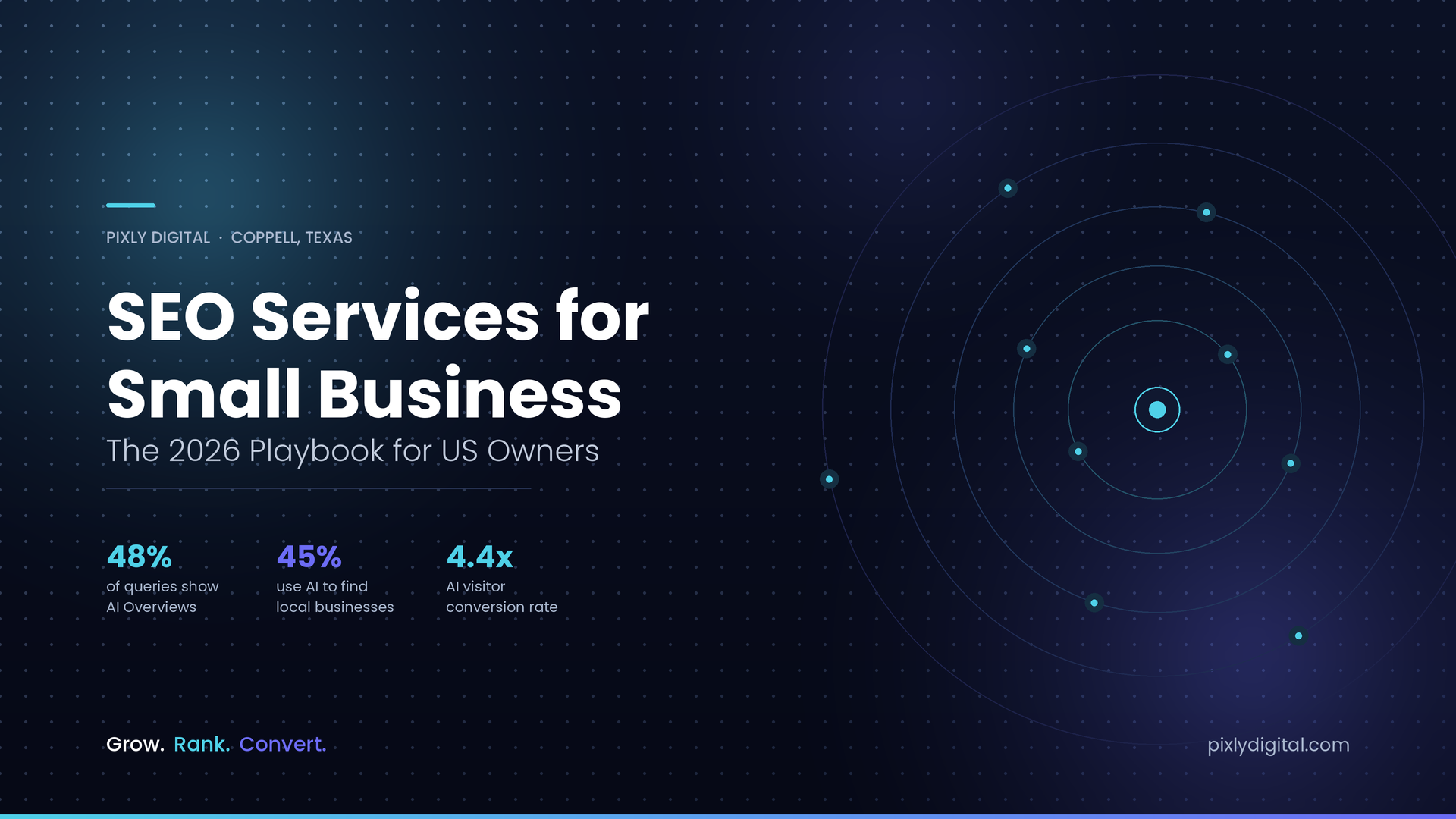
Search did not die in 2026 — it split in two. Google still drives the majority of discovery, but AI Overviews now appear on roughly 48% of tracked queries (BrightEdge, February 2026), and SparkToro’s June 2026 clickstream study found 68% of US Google searches end without a click to the open web. At the same time, the clicks that survive are worth more: Semrush measured AI-referred visitors converting at 4.4x the rate of standard organic traffic.
For a small business, that means two jobs instead of one. You still need to rank. You now also need to be cited — named inside the answer an assistant reads aloud. SOCi’s 2026 Local Visibility Index analyzed 350,000+ business locations and found ChatGPT surfaces only about 1.2% of them.
Realistic US pricing sits between $1,000 and $3,500 per month for a legitimate small business program, with local-only scopes closer to $1,557 (Ahrefs, 2026). Pixly Digital runs a five-phase process built for both surfaces at once. Email hello@pixlydigital.com.
What Are SEO Services for Small Business?
SEO services for small business are a managed set of technical, content, and authority activities designed to increase how often a company appears when buyers search — on Google, on Maps, and inside AI-generated answers. A typical engagement includes a technical audit, keyword and intent research, on-page optimization, local search optimization, content production, digital PR or link earning, and monthly reporting tied to leads rather than rankings alone.
The scope has widened. Five years ago, “SEO” meant ten blue links. Today an SEO program that ignores answer engines is optimizing for a shrinking surface. At Pixly Digital, we treat organic rankings and AI citations as one funnel, because the buyer treats them as one journey.
What a complete small business SEO program includes
- Technical SEO — crawlability, index coverage, site speed, Core Web Vitals, mobile rendering, structured data, internal linking architecture
- Keyword and intent research — mapping the queries your buyers actually type and speak, segmented by commercial, transactional, and informational intent
- On-page SEO — title tags, meta descriptions, heading hierarchy, entity coverage, answer-first content blocks, image optimization
- Local search optimization — Google Business Profile, Apple Business Connect, Bing Places, directory citations, NAP consistency, review velocity
- Content production — service pages, city pages, comparison pages, buyer guides, and FAQ hubs written to be extracted by machines and trusted by humans
- Authority building — digital PR, expert commentary, industry roundups, partner mentions, and earned links from sources AI engines already trust
- AEO and GEO — schema markup, machine-readable files, citation-shaped passages, and brand-entity consistency across the open web
- Measurement — organic sessions, assisted conversions, AI referral traffic segmentation, share of AI voice, and cost per acquired lead
That last two bullets are where most legacy agencies are still catching up. They are where Pixly Digital’s AEO and GEO practice started.
Why Do Small Businesses Still Need SEO in 2026?
Direct answer: Because organic search remains the single largest source of qualified, intent-driven discovery for US small businesses, and because AI answer engines are built on top of the same crawled web. If you are invisible to Google’s index, you are invisible to the models that read it. There are 36.2 million small businesses in the United States (US Small Business Administration data compiled by Backlinko, 2026), representing 99.9% of all US firms and 43.5% of GDP. Almost all of them compete for the same local attention.
Three numbers frame the opportunity.
First, demand is enormous and local. Roughly 46% of all Google searches carry local intent, and Semrush’s 2026 data put “near me” keyword variations at approximately 7.1 million monthly searches in the US (Shopify local SEO statistics, 2026). Google’s own research, repeatedly cited across 2026 compilations, shows 76% of people who run a local mobile search visit a business within 24 hours.
Second, most competitors are underinvesting. Network Solutions’ 2026 analysis found 83% of small businesses now have a website — meaning roughly one in six still does not — and only about 14% built their site primarily for search visibility. Backlinko’s panel of 1,200 US small business owners found the average small business spends just $497.16 per month on SEO. That is a thin market to compete against if you actually commit.
Third, the payoff compounds. Local SEO produces a cost per lead roughly 61% lower than traditional outbound marketing for small businesses, according to BizIQ’s 2026 research compilation. Unlike paid ads, the asset does not disappear the day you stop paying.
The uncomfortable part
Search behavior is fragmenting faster than most owners realize. Gartner’s January 2026 consumer survey found 51% of US consumers say generative AI has changed how they research purchases. Yext’s 2026 Consumer Search Behaviors Report, based on 3,848 consumers worldwide, put current AI adoption for local search at 42.7% — and found 47% of the remaining non-adopters say they are likely to try it within six months.
The businesses that treated 2026 as “wait and see” are already behind the ones that treated it as a land grab.
How Has AI Search Changed Small Business SEO?
Direct answer: AI search changed three things — how often people click, which sources get credited, and what a “win” looks like. Rankings still matter, but visibility now means being named inside a generated answer. AI Overviews reached approximately 48% of tracked queries by February 2026 (BrightEdge), up from 31% a year earlier, and SparkToro’s June 2026 study found 68% of US Google searches end with no click to the open web.
The zero-click reality
Semrush tracked more than 10 million keywords across 2025 and watched AI Overview prevalence climb from 6.49% of queries in January to a peak near 24.61% in July, then settle around 15.69% by November after Google recalibrated. Different trackers measure different keyword panels — Similarweb read 43%, Semrush Sensor read roughly 48% — but every methodology points the same direction: up.
The click impact is real. Seer Interactive’s September 2025 study measured organic click-through rate falling 61% on queries where an AI Overview appeared, from 1.76% to 0.61%. Paid CTR fell further, from 19.7% to 6.34%. Ahrefs, measuring across 300,000 keywords, found position-one results lost 34.5% of their CTR when an AI Overview was present.
But the story is not one-directional. Seer’s 2026 update, covering 53 brands and 5.47 million tracked queries, found organic CTR on AI Overview queries rebounded from a floor of about 1.3% in December 2025 to 2.4% in February 2026 — an 85% recovery in two months. The panic narrative and the data have started to diverge.
The intent split that actually matters to SMBs
Seer’s analysis of 49,353 queries found AI Overview trigger rates vary enormously by query type. Comparison queries in an “X vs Y” format triggered an AI Overview 95.4% of the time. Question-format queries triggered at 85.9%, review queries at 86.3%, and “near me” informational queries at 76.9%. Meanwhile transactional queries triggered only 5% of the time and commercial queries 8%.
Read that again, because it is the single most useful strategic fact for a small business in 2026: the bottom of your funnel is still mostly blue links, and the top of your funnel is mostly AI answers. That tells you exactly where to spend.
The conversion inversion
Here is the part almost no one budgets for. Semrush’s June 2025 study across 500+ high-value topics found AI-referred visitors converting at 4.4x the rate of standard organic traffic. WebFX’s 2026 benchmarks put ChatGPT referral conversion at 15.9%, Perplexity at 10.5%, and Claude at 5.0% — against typical organic averages under 2%.
The volume is still small. Conductor’s study of 13,770 domains put AI referral traffic at roughly 1.08% of total sessions, and ChatGPT accounts for about 87.4% of it. But growth is steep, and the quality gap is structural: an AI engine pre-qualifies the visitor by defining the problem, synthesizing options, and recommending yours before a single click happens.
That is the whole thesis behind how Pixly Digital allocates effort. A 1% traffic channel converting at 8–10x is not a rounding error. It is the highest-margin lead source most small businesses are not measuring.
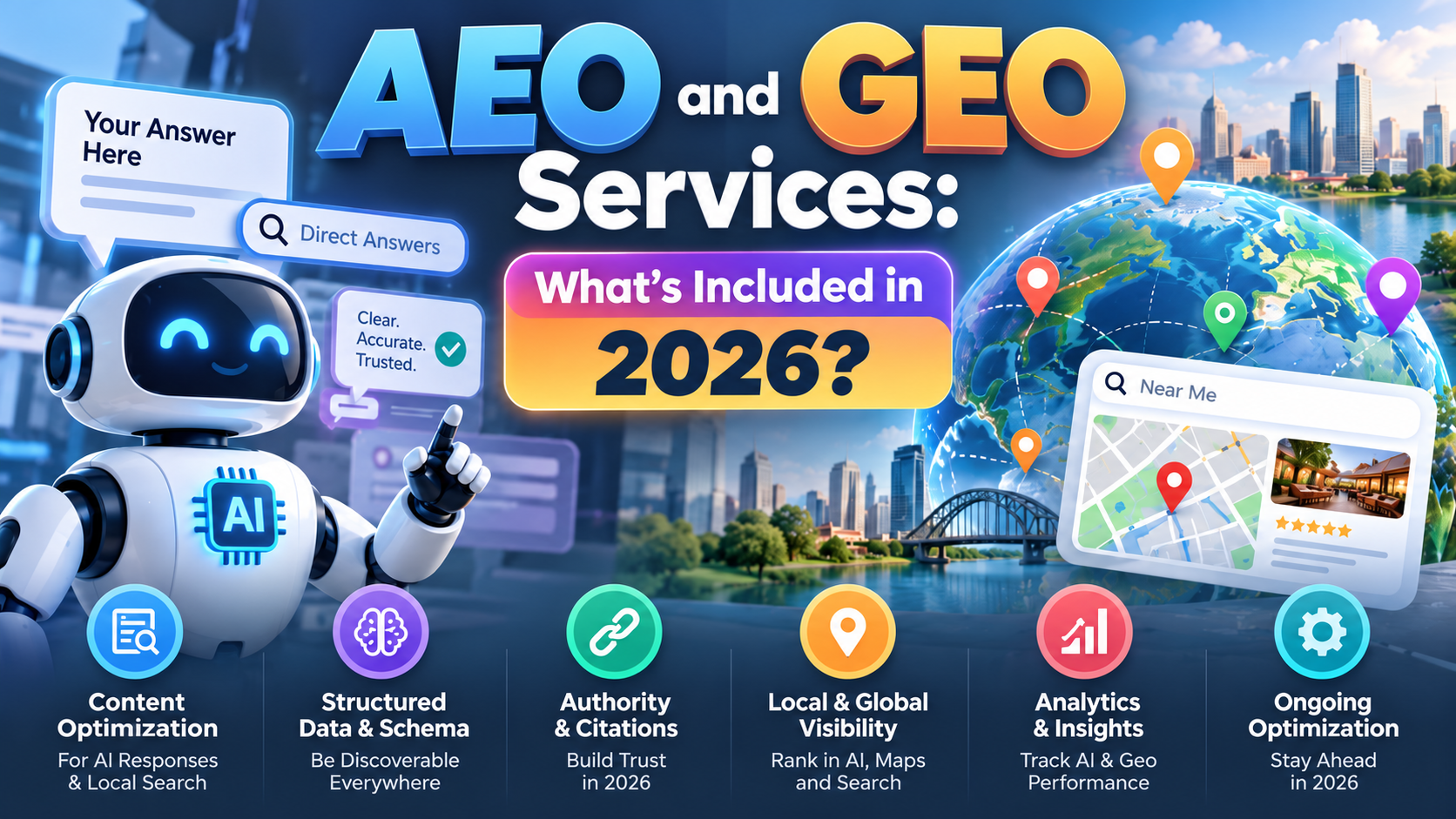
What Are AEO and GEO, and Why Does Pixly Digital Lead With Them?
Direct answer: AEO (Answer Engine Optimization) is the practice of structuring content so an AI system can extract a clean, correct answer and attribute it to you. GEO (Generative Engine Optimization) is the broader discipline of building the brand signals, third-party corroboration, and entity consistency that make a model choose your business when it generates a recommendation. AEO makes you extractable. GEO makes you the answer.
Pixly Digital was built around these disciplines rather than retrofitted to them. That distinction matters because the two skill sets pull in different directions. Traditional SEO optimizes a page for a ranking position. AEO optimizes a passage for extraction. GEO optimizes an entity for recommendation.
Why third-party presence beats on-site polish
This is the finding that reorganized how we build campaigns. Muck Rack’s May 2026 analysis of more than 25 million links cited by ChatGPT, Claude, and Gemini across 17 industries found that earned media accounts for roughly 84% of all AI citations, while paid and advertorial content accounts for about 0.3%. A separate arXiv-published study of 102 brands across five engines found a brand’s own domain accounted for just 2.9% of citations.
Ahrefs analyzed 75,000 brands and found the strongest correlations with AI visibility were all off-site signals: YouTube mentions (0.737), branded web mentions (0.664), and branded anchor text (0.527) — each substantially stronger than backlinks (0.218).
The implication for a small business is blunt. Publishing more blog posts on your own domain, alone, will not get you into AI answers. You need to be talked about in the places models already read: local news, industry directories, review platforms, community discussions, YouTube, and partner sites.
Platforms behave differently
Semrush’s 2026 AI Visibility Index, built on 126 million US AI search prompts analyzed from January through April 2026, found ChatGPT cites an average of about 15 sources per response and leans heavily on community and reference platforms, while Gemini cites roughly 3. On Gemini, the overlap between brands mentioned and domains cited can be as low as 30% — meaning a brand can be recommended without its site ever being linked.
That is why Pixly Digital tracks mentions and citations as separate metrics. Being named without being linked still drives branded search, which then feeds back into visibility.
What Google actually says
Worth grounding this: Google’s own AI features optimization guidance states that no special markup, files, or AI-specific content is required for AI Overviews or AI Mode, because those features run on core Search ranking systems. Google explicitly warns against fragmenting content for machines or writing separate AI-targeted variants.
We agree, and we build accordingly. The structural work Pixly Digital does — answer-first blocks, clean heading hierarchy, FAQ schema, comparison content — is simply good content organization. It helps ChatGPT, Claude, and Perplexity materially, and it does not hurt Google. Anyone selling you an “AI markup package” that Google supposedly requires is selling you something that does not exist.
What Do Local SEO Services for Small Business Actually Involve?
Direct answer: Local SEO makes a business visible to nearby buyers through Google Business Profile optimization, map pack rankings, location-specific pages, consistent business data across directories, and review management. It is the highest-ROI SEO layer for any company with a physical location or defined service area, because 46% of Google searches carry local intent and 76% of local mobile searchers visit a business within 24 hours.
Google Business Profile optimization
Your Google Business Profile has quietly become the most important asset you do not own. Businesses with complete profiles receive roughly 70% more location visits than those with incomplete ones. Profiles with photos get about 42% more direction requests. Localo’s benchmarking found top-ranking profiles carry around 70 words of description alongside roughly 250 reviews and images.
Freshness now compounds. 2026 GBP benchmark research found profiles without updates or photos for more than 30 days show measurable impression decline — a pattern researchers call content freshness decay — because Google’s AI systems weight recency directly into local relevance.
Pixly Digital manages GBP as a living channel: weekly posts, quarterly photo refreshes, service and product listings that mirror the website, Q&A seeding, and category testing.
NAP consistency and citation building
Name, address, and phone number must match character-for-character across Google, Apple, Bing, Yelp, industry directories, and your own site. Inconsistency is not just a ranking drag; it is an AI accuracy problem. When a model encounters three different phone numbers for one business, it either picks one at random or skips the business entirely.
Review generation and response
98% of consumers read online reviews for local businesses, and review signals drive roughly 15–17% of local pack rankings. 68% of consumers will only use businesses rated four stars or higher. Responding to negative reviews recovers approximately 25% of otherwise-lost customers.
Reviews also feed AI answers directly. When ChatGPT explains why it recommends a plumber, it is usually paraphrasing review sentiment it found on third-party pages.
Location and service pages
One page that says “we serve the DFW metroplex” will not rank in ten cities. Pixly Digital builds genuine location pages with local proof — project photos, neighborhood references, local team members, city-specific FAQs — rather than templated pages with the city name swapped. Google’s helpful content systems and AI engines both penalize the swap-the-city pattern.
Our web design and development team builds these page systems so they scale without becoming doorway pages, and our frontend development practice ensures they render server-side so both crawlers and AI agents can read them without executing JavaScript. If your site needs rebuilding before any of this can work, our custom, scalable web development builds are the starting point.
The local AI gap nobody is talking about
BrightLocal’s 2026 Local Consumer Review Survey of 1,002 US consumers found 45% used AI tools to find local businesses in the past year, up from 6% a year earlier. Adoption is highest among 30–44 year olds at 64% — precisely the homeowners hiring HVAC techs, electricians, and dentists.
Now the other half. SOCi’s 2026 Local Visibility Index examined more than 350,000 business locations and found ChatGPT recommends only about 1.2% of them, versus roughly 35.9% that appear in Google’s local three-pack. Search Engine Land characterized AI local visibility as up to 30 times harder than Google map pack ranking, with only about 45% overlap between the two winner sets.
Translation: winning the map pack no longer guarantees you exist in AI answers. They are separate games with separate scoreboards. Pixly Digital plays both.
How Much Do SEO Services for Small Business Cost in the USA?
Direct answer: Most US small businesses pay between $1,000 and $3,500 per month for a legitimate SEO retainer in 2026. Local-only scopes average around $1,557 per month, and Ahrefs’ poll of 439 SEO professionals put the overall average agency retainer at $3,209 per month. Clutch’s April 2026 data shows a $3,199 average monthly cost and a $37,158 average project fee.
The published averages disagree wildly, and understanding why protects you from bad quotes.
Ahrefs’ 2026 pricing survey of 439 professionals found the single most common monthly fee band was $501–$2,000, covering 42.8% of respondents — while the mean sat at $3,209 because a handful of enterprise agencies drag it upward. SE Ranking’s survey of 260 agencies found 64% charge under $1,000 per month, largely because much of the market is freelancers and small shops. GoodFirms’ survey of 300+ agencies across 20+ countries found 48% operate in the $1,500–$5,000 tier and 43.3% charge under $1,500.
Coalition Technologies’ 2026 analysis placed the all-provider average near $2,917 per month, with local-focused work averaging about $1,557 — less than half the $3,474 typical of national or global targeting. Hourly rates from the Ahrefs survey averaged $72 for freelancers, $99 for agencies, and $171 for consultants.
Prices went up in 2026, and AI is the reason
SE Ranking’s February 2026 survey of 170+ agencies found 70% had raised or planned to raise prices, and 56.2% specifically cited the added workload of optimizing for AI answer engines alongside traditional rankings. If your 2024 quote and your 2026 quote look different, that is an industry-wide shift, not one agency being opportunistic.
The under-$500 trap
Backlinko’s panel found the average US small business spends $497.16 per month on SEO — and that clients spending under $500 are 75% more likely to be dissatisfied than those spending more. That is not a coincidence. Below roughly $750 per month, a retainer funds reporting and maintenance, not the strategy, content, and authority work that moves rankings.
How to set your own number
Work backward from lead value, not from what feels affordable. If your average closed customer is worth $4,000 and you close one in four qualified leads, each qualified lead is worth $1,000. A $2,000 monthly retainer needs to produce two extra qualified leads per month to break even. For most service businesses in a defined metro, that is a modest bar — which is why SEO consistently outperforms outbound on cost per lead.
Pixly Digital scopes to outcome, not to package tiers. A single-location dental clinic in Coppell and a national ecommerce brand need fundamentally different programs, and pretending otherwise is how agencies end up selling $1,200 of work for $3,000.
What Does an Affordable SEO Package Actually Include?
Direct answer: An affordable small business SEO package — roughly $1,000–$2,000 per month — should include a technical audit and fixes, keyword and intent mapping, optimization of 8–15 core pages, full Google Business Profile management, two to four content pieces monthly, foundational citation building, schema markup, and monthly reporting tied to leads. Anything cheaper is usually reporting without execution.
Here is what should be non-negotiable at any price point:
- A named strategist you can actually reach. Not a ticketing queue.
- Baseline measurement before work starts. Rankings, traffic, conversions, and AI citation share, documented on day one.
- Content you own. Written for your buyers, published on your domain, with your byline.
- Schema markup implemented, not promised. Organization, LocalBusiness, Service, FAQPage, and BlogPosting at minimum.
- Off-site work included. If the proposal has zero digital PR, review generation, or citation building, it cannot move AI visibility.
- Reporting that names leads. Rankings are a leading indicator. Leads are the product.
- No twelve-month lock-in with no exit. Confidence should be structural, not contractual.
What should raise a flag: guaranteed number-one rankings, private blog network links, “AI markup packages” Google supposedly requires, undisclosed offshore subcontracting, and any proposal that never mentions your Google Business Profile.
How Do I Choose the Best SEO Company for My Small Business?
Direct answer: Choose an SEO company by verifying three things — measurable case studies in businesses like yours, a written process you can follow without a translator, and demonstrated capability in AI search visibility. In 2026, an agency that cannot explain how it earns AI citations is optimizing for half the market.
Ten questions worth asking before you sign
- Show me a client in my industry and what their leads looked like before and after. Ask for the leads number, not the traffic number.
- How do you measure AI visibility? A real answer names a method — prompt sets, citation share, mention tracking. A vague answer means they do not do it.
- What percentage of the retainer goes to off-site work? Given that roughly 84% of AI citations come from earned media, a program with zero off-site budget cannot compete.
- Who writes the content, and can I see samples? Ask whether writers have subject familiarity in your vertical.
- What happens in month one, month three, and month six? A defined ramp beats a vague promise.
- How do you handle my Google Business Profile? Frequency of posts, photo cadence, review workflow, category strategy.
- What is your reporting cadence and what is in it? Ask for a sample report before signing.
- Do I own everything you produce if we part ways? Content, accounts, and data should be yours.
- What are the contract terms and exit terms?
- What could go wrong, and what would you do about it? Honest agencies have a ready answer.
Our longer breakdown lives here: How to Choose the Best SEO Company in Texas.
Which SEO Companies Serve US Small Businesses?
Direct answer: The US small business SEO market includes large full-service agencies, SEO-only specialists, and boutique shops. Well-known providers frequently listed in 2026 industry roundups include WebFX, Victorious, Thrive Internet Marketing Agency, Straight North, SmartSites, HigherVisibility, OuterBox, Searchbloom, First Page Sage, and Boostability. Pixly Digital sits in the specialist tier, differentiated by an AEO and GEO-first build.
An honest market map helps you shortlist faster. Here is who does what, with direct URLs.
Full-service, platform-heavy
- WebFX — webfx.com — One of the largest US digital marketing agencies, with proprietary reporting infrastructure and unusually transparent published pricing. Small business programs commonly start around $3,000 per month. Best when you want SEO, PPC, content, and analytics under one contract and value execution velocity over deep strategic customization.
- Thrive Internet Marketing Agency — thriveagency.com — Headquartered in Arlington, Texas, founded 2005, roughly 150–200 employees. Broad service mix spanning SEO, AI SEO, local SEO, web design, PPC, Amazon marketing, and reputation management. Frequently cited in 2026 roundups for AI-search visibility work.
- SmartSites — smartsites.com — New Jersey-based, repeatedly recognized on the Inc. 5000 list, strong on combined SEO and paid media for local service businesses.
- Intero Digital — interodigital.com — Large full-service shop with a wide channel mix, suited to SMBs that want a single vendor across search, social, and creative.
SEO-only specialists
- Victorious — victoriousseo.com — Founded 2013, SEO and AEO exclusively, no adjacent service lines. Multiple Search Agency of the Year awards and a 4.9/5.0 Clutch average across 100+ reviews. Mid-premium pricing; best fit for established small businesses with proven revenue.
- Searchbloom — searchbloom.com — Utah-based specialist focused on SEO and PPC, well-regarded for local and mid-market work.
- HigherVisibility — highervisibility.com — Memphis-based, long track record with franchise and multi-location small businesses.
- First Page Sage — firstpagesage.com — Thought-leadership-driven SEO with a dedicated GEO offering. Premium tier, typically $5,000+ per month; strongest for B2B.
Lead-gen and vertical specialists
- Straight North — straightnorth.com — More than two decades in market, known for a lead validation methodology that manually reviews every inquiry to filter spam before reporting. Pricing commonly starts near $1,500 per month. Strong for service-area businesses and B2B with long sales cycles.
- OuterBox — outerboxdesign.com — Ohio-based, ecommerce-weighted, strong for product visibility and revenue-tied SEO.
- Boostability — boostability.com — Volume-oriented small business SEO at lower price points, often delivered through partner channels.
Where Pixly Digital fits
Pixly Digital operates from Coppell, Texas, serving small and mid-sized businesses across Texas and the United States. We are a specialist shop, not a volume shop. What separates us is sequencing: we build AEO and GEO into the foundation of a campaign rather than adding an “AI package” in month six. Every engagement starts with an AI visibility baseline across ChatGPT, Gemini, Perplexity, Copilot, and Google AI Overviews — before a single page gets optimized — because you cannot improve a number you never measured.
We also stay in our lane. If you need enterprise-scale paid media across forty markets, one of the platform agencies above will serve you better. If you need to become the answer an AI assistant gives when someone asks for your service in your city, that is the problem we were built for.
Agency details reflect publicly available 2026 information and should be independently verified before you make a hiring decision.
What Does Pixly Digital’s Small Business SEO Process Look Like?
Direct answer: Pixly Digital runs a five-phase process: baseline and audit, foundation and technical fixes, content and entity build, authority and citation earning, then measurement and compounding. The first thirty days are diagnostic. Meaningful ranking and citation movement typically begins between months three and six, with compounding gains after month six.
Phase 1 — Baseline and audit (weeks 1–4)
We measure before we touch anything. That means a full technical crawl, index coverage review, Core Web Vitals assessment, competitor gap analysis, keyword and intent mapping, Google Business Profile audit, citation consistency scan, and an AI visibility baseline built from a 40–60 prompt test set across ChatGPT, Gemini, Perplexity, Copilot, and Google AI Overviews.
That prompt set becomes your scoreboard. Industry benchmarks suggest a citation rate above 20% across a buyer-intent prompt set indicates strong AI visibility, while most brands appear in under 10% of relevant prompts. Knowing which half you start in changes the plan.
Phase 2 — Foundation and technical fixes (weeks 3–8)
Crawl errors, redirect chains, duplicate content, thin pages, broken schema, slow templates, and JavaScript-dependent content that AI agents cannot read. Mobile devices accounted for 52.27% of global web traffic in Q1 2026, so mobile rendering is not a secondary check.
We also install the machine-readable layer: Organization and LocalBusiness schema, Service schema on every service page, FAQPage schema on question hubs, BreadcrumbList for hierarchy, and an llms.txt file summarizing what the business does, who it serves, and where the authoritative pages live. Google does not require these. ChatGPT, Claude, and Perplexity reward them.
Phase 3 — Content and entity build (months 2–5)
Service pages, city pages, comparison pages, and buyer guides — each structured answer-first, with question-shaped headings and 40–60 word answer capsules that survive extraction. This is where our AI and ML services team supports the work, running entity coverage analysis and query fan-out modeling so a single page satisfies the cluster of related questions an AI system generates behind the scenes rather than one exact keyword.
Content is written for your buyers first. Google’s guidance is explicit that separate AI-targeted content risks scaled content abuse penalties, and we do not go near that line.
Phase 4 — Authority and citation earning (months 3–12)
Given that earned media drives roughly 84% of AI citations, this phase carries disproportionate weight. Work includes digital PR and local press, expert commentary placement, industry directory and association listings, review generation programs, YouTube presence for high-intent how-to queries, partner and supplier mentions, and authentic community participation.
We do not buy links, fabricate mentions, or spam communities. Beyond being against platform policy, models are increasingly good at discounting low-corroboration signals.
Phase 5 — Measurement and compounding (ongoing)
Monthly reporting covers organic sessions and rankings, Google Business Profile actions, AI referral traffic segmented from direct traffic in GA4, share of AI voice against named competitors, citation sentiment, and — the number that matters — qualified leads and cost per lead.
Where organic and paid should work together, our paid ads team covers the gap while SEO compounds. Given Seer’s finding that transactional queries trigger AI Overviews only about 5% of the time, bottom-funnel paid search remains unusually stable in 2026.
What Results Should a Small Business Expect, and When?
Direct answer: Expect technical and local improvements within 30–60 days, early ranking and impression movement between months three and four, meaningful lead volume increases between months five and eight, and compounding returns after month twelve. SEO timelines have not shortened; SEO’s ceiling has risen because AI-referred visitors convert at multiples of standard organic.
A realistic ramp for a single-location service business in a mid-sized US metro:
- Days 1–30 — Baseline documented, technical errors fixed, Google Business Profile fully optimized, schema deployed. Map pack impressions often move first.
- Days 31–90 — Core service and city pages live, citation consistency corrected, review program running, first content cluster published. Long-tail rankings begin appearing.
- Days 91–180 — Authority work compounds. Primary commercial keywords enter striking distance. First AI citations typically appear here, usually via third-party mentions rather than your own domain.
- Days 181–365 — Map pack positions consolidate, non-branded organic leads become a measurable channel, AI citation share climbs across the prompt set.
- Year two onward — Cost per lead declines as content ages and authority accrues. Top-ranking pages average around 2.6 years old, which is exactly why patience is a competitive advantage.
Anyone promising page-one rankings for competitive commercial terms in 60 days is describing a timeline that does not exist.
What Does This Look Like in Real Businesses?
A plumbing company in a Dallas–Fort Worth suburb
The buyer journey has two paths now. One person searches “emergency plumber near me” on a phone at 11pm — a transactional query that still shows a map pack and blue links, where GBP completeness, review volume, and proximity decide the outcome. Another person asks ChatGPT “who is the most reliable plumber in Coppell for a slab leak” — a question-format query where the model composes a shortlist from review sentiment, local directory data, and any editorial mention it can find.
The first path is classic local SEO. The second requires being written about somewhere the model trusts. Same business, two entirely different optimization jobs.
A dental clinic
Healthcare is the vertical most exposed to AI Overviews — BrightEdge’s February 2026 data put AI Overview coverage in healthcare at 88%. Nearly every informational query a prospective patient asks (“is a root canal painful,” “how much does Invisalign cost”) now gets answered above the fold without a click.
The winning move is not fighting for those informational clicks. It is capturing the transactional layer — “dentist accepting new patients,” “same-day crown near me” — where AI Overviews trigger at around 5%, while simultaneously earning citations on the informational layer so the clinic’s name appears inside the answer even when nobody clicks.
A boutique ecommerce brand
Comparison queries trigger AI Overviews 95.4% of the time. For an ecommerce brand, that means every “brand A vs brand B” and “best X for Y” query is now an AI-mediated conversation. Visibility Labs’ study of 94 ecommerce brands found ChatGPT referral traffic converting at 1.81% versus 1.39% for non-branded organic — 31% higher — with ChatGPT sessions growing 1,079% across the year.
The play is honest comparison content, structured product data, transparent public pricing, and review platform presence. AI shopping agents cannot recommend what they cannot parse.
A Texas-based B2B services firm
B2B technology showed 82% AI Overview coverage in BrightEdge’s February 2026 data. Long sales cycles mean the buyer runs a dozen queries across weeks, and increasingly starts with an assistant rather than a search bar.
For B2B, GEO is a brand-authority problem more than a technical one. Executive commentary, industry publications, podcast appearances, published original data, and analyst mentions are what get a firm named in a generated shortlist. Our AEO and GEO practice treats these as campaign deliverables, not PR side projects.
What Are the Biggest Small Business SEO Mistakes in 2026?
Direct answer: The most costly 2026 mistakes are ignoring AI visibility entirely, underspending below the effectiveness threshold, blocking AI crawlers in robots.txt, publishing only on your own domain, hiding pricing behind contact forms, and measuring rankings instead of leads. Each one is fixable within a quarter.
- Blocking the bots that would cite you. If GPTBot, PerplexityBot, ClaudeBot, or Google-Extended are disallowed in robots.txt, those platforms literally cannot cite you. Check this today; it takes two minutes.
- Owned-content-only strategy. With roughly 84% of AI citations coming from earned media, a blog-only program is competing for the smallest slice available.
- Templated city pages. Swapping a city name across twenty identical pages is a pattern both Google’s helpful content systems and AI engines discount.
- Hiding pricing. AI agents evaluating providers on a buyer’s behalf skip what they cannot read. A public pricing page — or a simple
/pricing.md— keeps you in the consideration set. - JavaScript-dependent content. If your main content requires four frameworks to render, agents and crawlers see an empty page.
- Stale Google Business Profiles. Profiles idle for 30+ days show measurable impression decay as recency weighting increases.
- No freshness signals. Undated content loses to dated content because AI systems weight recency heavily. Display a last-updated date.
- Reporting rankings instead of revenue. Rankings are diagnostic. Leads and cost per lead are the deliverable.
- Not segmenting AI traffic. Most AI referral traffic lands in GA4 as direct. If you have not built the segment, you are undercounting your best-converting channel.
For a deeper technical treatment, see our guides on AEO vs. Traditional SEO and the complete SEO company guide for Texas businesses.
Key Takeaways
- SEO services for small business now cover two surfaces: traditional ranking and AI citation. AI Overviews reached roughly 48% of tracked queries by February 2026 (BrightEdge), and 45% of consumers used AI tools to find a local business in the past year, up from 6% (BrightLocal 2026).
- Intent decides which surface matters. Comparison queries trigger AI Overviews 95.4% of the time and question-format queries 85.9%, while transactional queries trigger only about 5% (Seer Interactive, 49,353 queries). Top-of-funnel is AI territory; bottom-of-funnel is still blue links.
- AI traffic is small but disproportionately valuable. AI referral traffic averages roughly 1.08% of sessions across 13,770 domains (Conductor), yet Semrush measured AI-referred visitors converting at 4.4x standard organic, with ChatGPT referrals converting at 15.9% (WebFX 2026).
- Off-site beats on-site for AI visibility. Muck Rack’s analysis of 25 million cited links found roughly 84% of AI citations come from earned media, and Ahrefs found branded web mentions correlate with AI visibility three times more strongly than backlinks.
- Budget honestly. Most legitimate US small business SEO runs $1,000–$3,500 per month; local-only scopes average about $1,557 (Ahrefs 2026). Spending under $500 correlates with a 75% higher dissatisfaction rate (Backlinko).
- Winning the map pack no longer guarantees AI visibility. SOCi found ChatGPT recommends only about 1.2% of 350,000+ analyzed locations, with roughly 45% overlap between map pack winners and AI-recommended businesses.
Frequently Asked Questions
What are SEO services for small business?
SEO services for small business are managed programs that improve visibility in search engines and AI answer engines. They typically include technical audits, keyword research, on-page optimization, Google Business Profile management, content creation, review generation, and authority building. In 2026, credible programs also include AEO and GEO work, since 45% of consumers now use AI tools to find local businesses.
How much do SEO services for small business cost?
Most US small businesses pay $1,000 to $3,500 per month in 2026. Ahrefs’ survey of 439 professionals found an average agency retainer of $3,209 monthly, while local-only scopes average around $1,557. Clutch’s April 2026 data shows $3,199 average monthly cost. Spending below $500 monthly correlates with substantially higher client dissatisfaction, according to Backlinko’s owner panel.
Are affordable SEO services for small business worth it?
Yes, if the scope matches the price. A $1,000 to $2,000 monthly program can cover technical fixes, Google Business Profile management, core page optimization, and modest content output — enough to compete locally. Below roughly $750 monthly, retainers generally fund reporting rather than execution, which is why cheap SEO so often produces no measurable lead growth.
How long does small business SEO take to work?
Expect technical and local gains within 30 to 60 days, early ranking movement between months three and four, and meaningful lead increases between months five and eight. Compounding returns arrive after year one. Top-ranking pages average roughly 2.6 years old, confirming SEO rewards consistency. Any agency promising competitive page-one rankings in 60 days is overselling.
What is the difference between SEO and AEO?
SEO optimizes a page to rank in a list of results. AEO — Answer Engine Optimization — structures content so AI systems can extract a clean answer and attribute it to your brand. GEO goes further, building the brand mentions and third-party corroboration that make a model recommend you. Pixly Digital builds all three together rather than sequentially.
How do I get my small business recommended by ChatGPT?
Start with a complete, consistent business profile everywhere you appear, then earn third-party mentions. Muck Rack’s 2026 analysis of 25 million cited links found roughly 84% of AI citations come from earned media rather than owned domains. Add clear answer-shaped content, schema markup, strong recent reviews, and verify AI crawlers are not blocked in robots.txt.
Does local SEO still matter if everyone uses AI?
More than ever. Roughly 46% of Google searches carry local intent, and 76% of local mobile searchers visit a business within 24 hours. Google Business Profile data also feeds AI recommendations directly. However, map pack success no longer guarantees AI visibility — SOCi found only about 45% overlap between the two winner sets in 2026.
What should I look for in an SEO company for small business?
Look for documented case studies in comparable businesses, a written process, transparent pricing, content ownership, and demonstrated AI visibility capability. Ask specifically how they measure AI citations and what share of the retainer funds off-site work. Given that earned media drives most AI citations, a program with no off-site budget cannot move AI visibility.
Can I do small business SEO myself?
Partially. Owners can realistically manage Google Business Profile updates, review requests, basic content, and NAP consistency across directories. Technical SEO, schema implementation, competitive content strategy, and digital PR usually require specialist time. A common hybrid is handling local basics in-house while outsourcing technical and authority work to an agency.
How do I measure whether SEO is working?
Track qualified leads and cost per lead first, then supporting metrics: non-branded organic sessions, Google Business Profile calls and direction requests, keyword visibility, and AI citation share across a fixed 40 to 60 prompt test set. Segment AI referral traffic separately in GA4, since most of it defaults to direct and goes uncounted.
Ready to Grow, Rank, and Convert?
Search split into two surfaces in 2026, and most small businesses are still optimizing for one. Pixly Digital builds for both — rankings that bring buyers to your site, and citations that put your name inside the answer before anyone types a URL.
Tell us your market and your goal, and we will show you exactly where you stand across Google and every major AI answer engine. Email hello@pixlydigital.com to book a consultation. Grow. Rank. Convert.
Sources
All figures cited above come from research published in 2025 and 2026.
- Semrush — 2026 AI Visibility Index, 126 million US AI search prompts: https://www.semrush.com/news/463141-semrush-releases-expanded-2026-ai-visibility-index-analyzing-126-million-ai-search-prompts/
- Yext — 2026 Consumer Search Behaviors Report, 3,848 consumers: https://www.yext.com/resources/consumer-search-behaviors-full-report
- Ahrefs — SEO Pricing: How Much Does SEO Cost? (439 professionals polled, 2026): https://ahrefs.com/blog/seo-pricing
- Backlinko — Small Business Statistics (SBA data, 2026): https://backlinko.com/small-business-statistics
- GoodFirms — SEO Pricing Plans (300+ agencies surveyed, 2026): https://www.goodfirms.co/resources/seo-pricing-plans
- Google Search Central — AI features and your website (official optimization guidance): https://developers.google.com/search/docs/fundamentals/ai-optimization-guide
- Shopify — Local SEO Statistics 2026: https://www.shopify.com/blog/local-seo-statistics
- SeoProfy — 75 Local SEO Statistics for 2026: https://seoprofy.com/blog/local-seo-statistics/
- Coalition Technologies — How Much Should You Spend on SEO Services (2026): https://coalitiontechnologies.com/blog/how-much-should-you-spend-on-an-seo-services-company
- Network Solutions — 50+ Small Business Website Statistics for 2026: https://www.networksolutions.com/blog/small-business-website-statistics/
Additional data referenced: BrightEdge AI Overviews one-year analysis (February 2026); Seer Interactive AI Overview CTR studies (September 2025 and 2026 update, 49,353 queries and 5.47M tracked queries); SparkToro zero-click study (June 2026); BrightLocal 2026 Local Consumer Review Survey (1,002 US consumers); SOCi 2026 Local Visibility Index (350,000+ locations); Muck Rack “What Is AI Reading?” (May 2026, 25M+ links); Conductor AI referral benchmarks (13,770 domains, 2026); WebFX AI traffic conversion benchmarks (2026); SE Ranking agency pricing surveys (2025 and February 2026); Clutch SEO pricing data (April 2026); Gartner consumer survey (January 2026); Visibility Labs ecommerce AI referral study (94 brands).