Quick Answer
Google AI Overviews optimization means making your pages easy for Google to find, understand and quote. Start with a crawlable, indexable site. Answer real customer questions in the first 40–60 words under each heading. Add accurate structured data markup, earn reviews and trusted listings, then track impressions in Search Console’s Generative AI report. Google says no special markup is required, so strong SEO fundamentals plus answer engine optimization (AEO) and generative engine optimization (GEO) are the practical path. Pixly Digital builds this in from day one.
TL;DR
- What it is: Google AI Overviews are AI-generated search answers that sit above the regular results. Google said in 2026 that the feature reaches 2.5 billion monthly users.
- Why it hurts: When an Overview appears, clicks to the top organic result drop sharply. Ahrefs measured a 58% lower click-through rate at position one in December 2025.
- What Google requires: Your page must be indexed and eligible to show a snippet. No special schema is required.
- What actually moves the needle: Clear answers, helpful people-first content, clean technical foundations, accurate business data, and third-party trust signals like reviews.
- How to measure: Search Console added a Generative AI report on June 3, 2026. It shows impressions, not clicks, so pair it with GA4.
- Where Pixly Digital fits: We are a Coppell, Texas agency built around AEO and GEO from the ground up. We audit, restructure, mark up, and measure so your business gets quoted, not skipped.
Grow. Rank. Convert.
Most Texas owners we talk to have the same quiet worry: the phone rang more last year, and nobody can explain why it is ringing less now. Often the answer sits at the top of Google. An AI-written summary now answers the question before anyone reaches your website, and the businesses quoted inside it collect the trust. This Google AI Overviews optimization guide for small businesses shows how to become one of them. You will learn how Overviews choose sources, which fixes matter most, and how to measure the result without a data science degree.
What Are Google AI Overviews and How Do They Work?
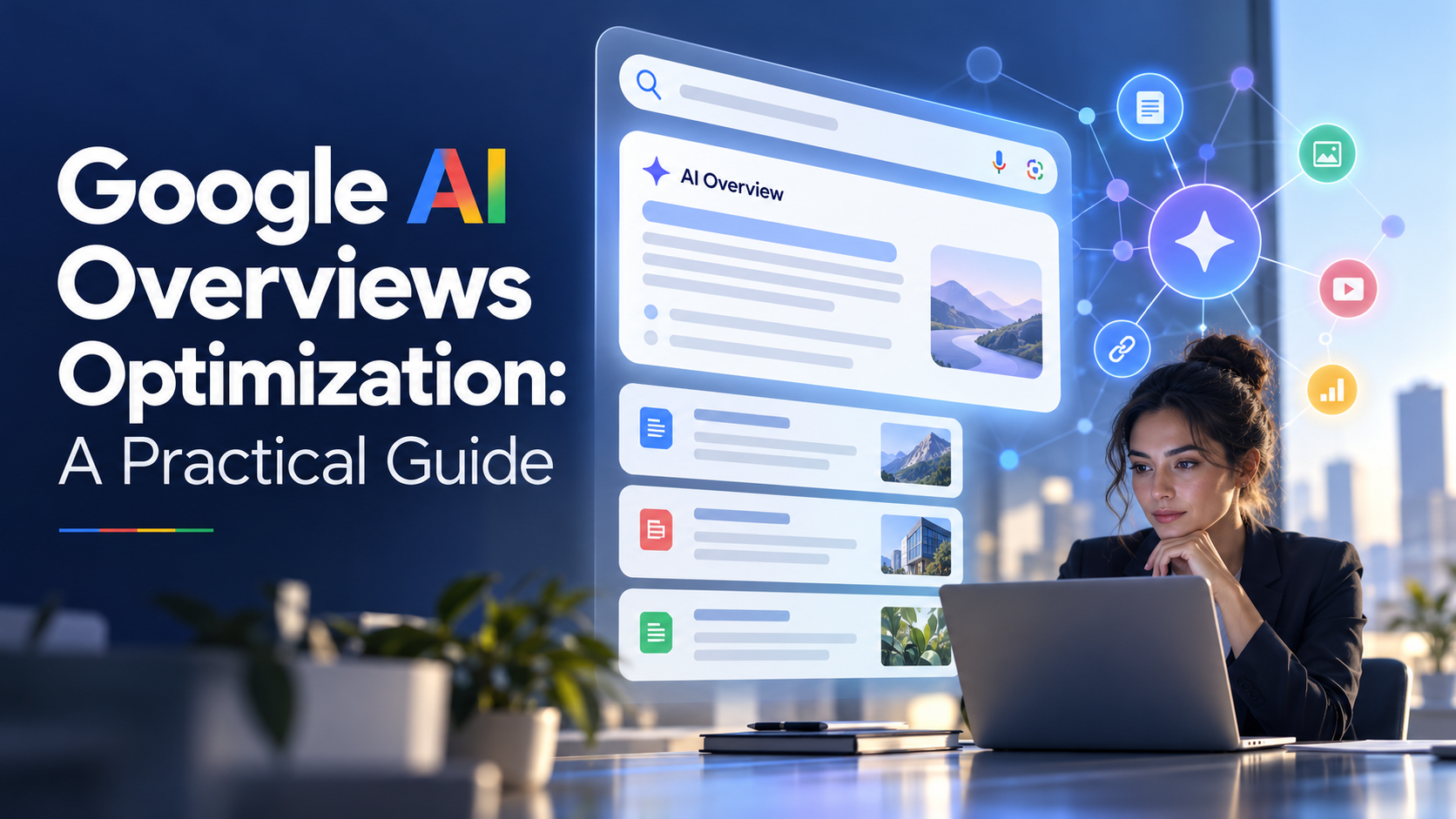
Google AI Overviews are AI-generated search answers shown at the top of the results page. They summarize information from several websites and link to the pages used. Google’s own guidance says both AI Overviews and AI Mode may run a “query fan-out,” meaning several related searches across subtopics before writing the answer.
That detail matters for your content. A single customer question quietly becomes five or ten smaller questions behind the scenes. A page that answers one narrow sub-question well can be pulled in, even if it never ranked first for the original query.
How Do AI Overviews Choose Which Websites to Cite?
Google says a page must be indexed and eligible to appear in Search with a snippet before it can be a supporting link. Beyond that, the usual signals apply: relevance, quality, and trust. Google’s documentation also states there is no special schema.org markup needed for these features.
In practice, pages get quoted when they state a clear answer, back it with evidence, and sit on a site that looks legitimate. We treat AI-generated search answers as a quality filter on top of ordinary SEO, not a separate game.
How Are AI Overviews Different From AI Mode?
AI Overviews are a summary on a normal results page. AI Mode is a conversational search experience where each follow-up question becomes a new query. Google said on its Q2 2026 earnings call that AI Mode has passed 1 billion monthly active users since its global expansion in October 2025. Analysts also reported that Google is merging the two into one seamless Search experience.
For a business owner, the takeaway is simple. Optimize once for Google AI Overviews and you are also preparing for AI Mode, because both read the same underlying pages.
How Often Do Google AI Overviews Appear, and What Do They Do to Clicks?
The honest answer is “it depends on who is counting.” Tracking vendors report very different prevalence figures because they sample different queries. Present any single number with its method attached, and be wary of anyone who quotes one figure without it.
How Common Are AI Overviews in 2026?
Here is the range from reputable trackers:
- About 25%: Conductor’s Q1 2026 benchmark of 21.9 million queries measured 25.11% prevalence, according to a Salt Creative roundup {{verify}}.
- About 43% to 48%: Similarweb measured roughly 43% of all Google queries and Semrush roughly 48%, as reported by Search Engine Roundtable on July 30, 2026 {{verify}}.
- About 87%: Peec AI analyzed 500,000 business-oriented, buying-intent prompts from April 13 to 20, 2026 and found Overviews on 86.7%. That compares with 56.9% in April 2025.
The spread is not a contradiction. Peec’s sample leans toward commercial research, while the others cover everything people search. The direction is the same in every dataset: Overviews are growing, and longer, more specific questions trigger them more often. Peec found coverage climbing from 64.6% on two-word queries to 89.1% on queries of 11 to 15 words.
What Happens to Your Clicks When an Overview Appears?
Clicks fall. Ahrefs found that in December 2025 an AI Overview reduced the click-through rate for the top-ranking page by 58%, up from a 34.5% reduction it measured in April 2025. Seer Interactive’s September 2025 update found organic click-through rates of 0.61% on queries with an Overview, versus 1.62% without one.
Pew Research Center’s 2025 browsing study reported that users clicked a result 8% of the time with an AI summary and 15% without one {{verify}}. Google has disputed Pew’s methodology. Even so, the pattern repeats across independent sources.
Do AI Overviews Affect Local and Transactional Searches?
Less than informational ones, but not zero. Salt Creative’s 2026 roundup reports that nearly 90% of queries triggering Overviews have informational intent, with commercial queries near 9% and transactional queries under 2% {{verify}}. If your customers search “emergency plumber near me,” you are less exposed than a blog answering “why is my water heater leaking.”
Before you relax, note the other side of the data. Insites analyzed 10,000 US businesses in its 2026 AI Visibility Report and found that AI systems know 93% of them but only 55% have accurate details. Wrong hours, outdated services, and missing pages are now a visibility problem, not a housekeeping one.
Is Google AI Overviews Optimization Different From Traditional SEO?
Partly. Google says its SEO fundamentals still apply and that no extra technical requirement exists for AI features. The difference is in how you package information. Traditional SEO chases rankings. Answer engine optimization chases being quoted, and generative engine optimization chases being described accurately across AI platforms such as ChatGPT, Claude, Perplexity, Gemini, and Microsoft Copilot.
Think of it as three layers. SEO gets you found. AEO gets you quoted in an answer. GEO shapes how AI systems describe and recommend your brand. We explain the shift in more depth in our guide on AEO vs traditional SEO.
What Is the Difference Between AEO and GEO?
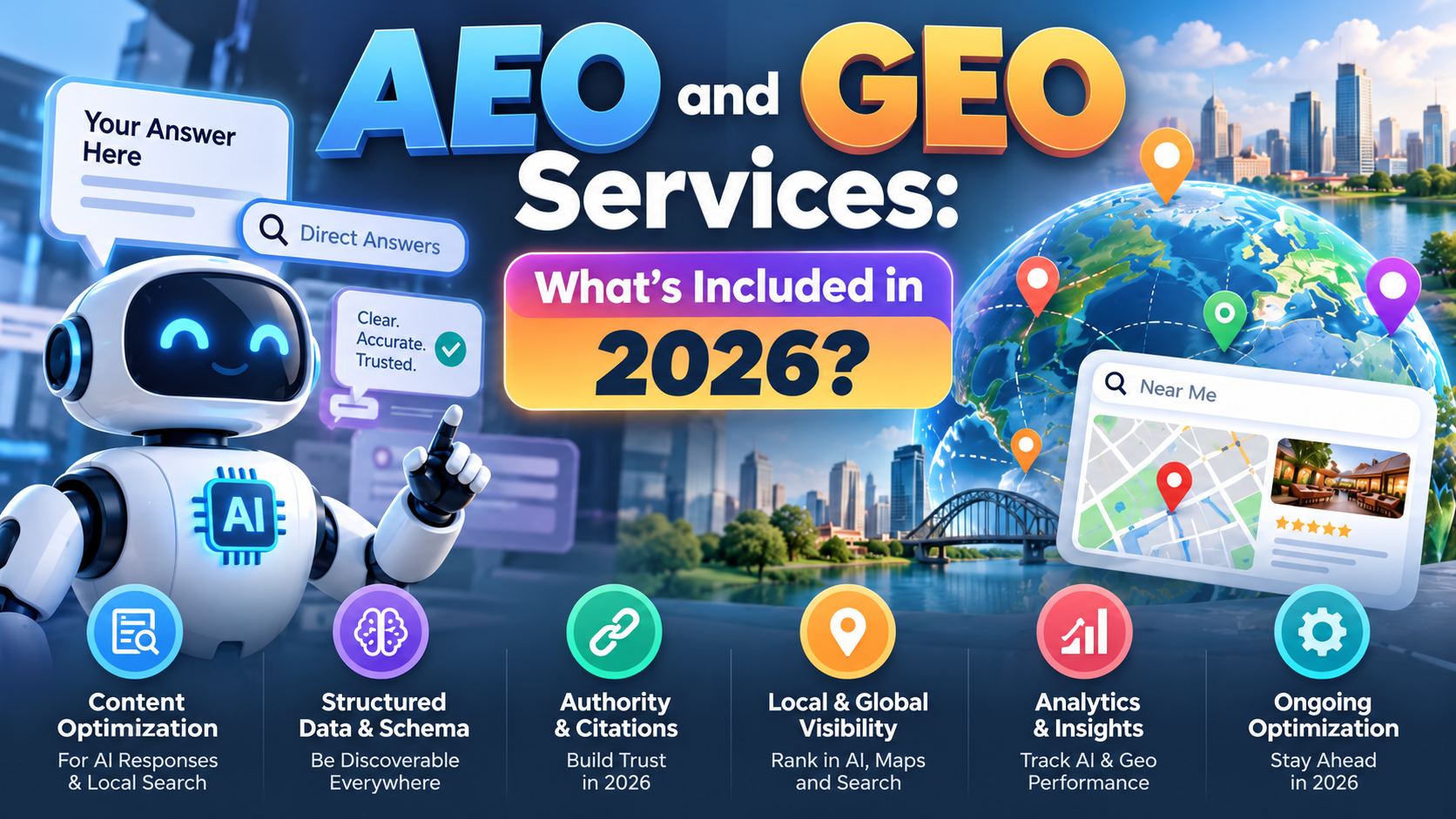
Answer engine optimization focuses on winning the short, sourced answer to a specific question. Generative engine optimization focuses on how AI models summarize your brand across many answers. The tactics overlap heavily: clear structure, accurate entities, trustworthy sources, and consistent facts everywhere your business appears.
Pixly Digital was built around both from the start. We do not bolt AI search onto a legacy retainer. Our AEO and GEO services treat answer-ready content, entity clarity, and measurement as the core deliverable.
How Do You Optimize Website Content for Google AI Overviews?
Use this seven-step sequence. It is the same order we follow with clients, because each step makes the next one work.
- Match search intent before you write.
- Lead every section with a 40–60 word answer.
- Publish helpful, people-first content with real proof.
- Add structured data markup that matches visible copy.
- Fix crawlability and indexability.
- Build trust signals outside your website.
- Refresh, measure, and repeat.
Step 1: How Do You Match Search Intent?
Start by sorting the questions your customers ask into three buckets: learn, compare, and buy. Search intent decides which page deserves to appear and what shape it should take. A “how much does a crown cost” query wants a price range and a next step. A “why does my tooth hurt” query wants an explanation and a warning sign list.
Write one page per intent. Mixing them dilutes both. Phrase your headings the way people speak to AI tools, as full questions, because longer natural-language queries trigger Overviews more often.
Step 2: What Is an Answer-First Capsule?
An answer-first capsule is a 40–60 word direct answer placed immediately under a question heading. It gives a model a clean, quotable unit and gives a busy reader the answer in five seconds. Then you expand with detail, examples, and evidence below it.
Keep each capsule self-contained. If a sentence only makes sense after reading the paragraph above it, an AI system cannot lift it out safely. Name the business, location, or product plainly instead of writing “we” or “it.”
Step 3: What Counts as Helpful, People-First Content?
Helpful, people-first content answers the question completely, shows first-hand experience, and cites real data. Replace vague claims with specifics: price ranges, timelines, service areas, license numbers, and named sources. Add a real author or company byline and a visible update date.
Skip filler. A 600-word page that fully answers one question beats a 2,000-word page that circles it. We build these pages as part of our SEO services, because the same page that wins a snippet also earns conversions.
Step 4: Why Does Structured Data Markup Still Matter?
Google says no special markup is needed for AI features, so do not expect schema to act like a switch. Structured data markup still helps machines read who you are, what you sell, and which questions you answer. It also reduces ambiguity across Google, Bing-based Copilot, and other AI platforms.
Use the types that fit your visible page content: Organization, Article or BlogPosting, FAQPage where real questions and answers appear, and BreadcrumbList. Never mark up content that readers cannot see. Never add review markup to your own pages unless the reviews come from a third party, since that invites manual action.
Step 5: What Do Crawlability and Indexability Have to Do With It?
Everything. Crawlability and indexability are the entry ticket. If Google cannot fetch your page, or you block it with a stray noindex tag, it cannot appear as a supporting link. Check your robots.txt, XML sitemap, canonical tags, and internal links first.
Speed and structure help too. Clean heading hierarchy, descriptive internal links, and fast mobile pages make extraction easier. This is why our web design services start with a technical foundation before any visual polish.
Step 6: How Do Trust Signals Outside Your Website Help?
AI systems verify claims against other sources. Reviews, Google Business Profile completeness, directory listings, local press, and consistent business details all raise the odds that you are quoted. Insites found businesses recommended by AI averaged 133 Google reviews, while invisible ones averaged 11, a 12-times gap. Businesses in the Local Pack were recommended 3.5 times more often than those outside it.
That means your Overview strategy cannot live only on your website. We cover the off-site work in the next section.
Step 7: How Often Should You Update Content?
Review your top pages every quarter. Replace outdated numbers, add new questions customers are asking, and check that your answer capsules still match reality. A visible “last updated” date, tied to genuine edits, tells both readers and machines the page is maintained.
What Are the Best SEO Practices for Google AI Overviews by Business Type?
The core method stays the same, but each business needs different questions answered. Here are four realistic scenarios.
How Does a Local Plumber Show Up in AI Overviews?
A plumber should publish one page per service and per city: water heater repair in Plano, drain cleaning in Frisco, burst pipe emergency in Irving. Each page opens with a direct answer covering price range, response time, and service area. Add a complete Google Business Profile, fresh photos, and review replies that name the service performed.
The goal is to be the clear, consistent answer to “who fixes a leaking water heater near me,” not just a name on a list.
How Does a Dental Clinic Win Answer Slots?
A dental clinic competes on trust. Pages should answer cost, recovery time, and “does it hurt” questions in plain language, with a named dentist and credentials. Because health topics demand extra care, cite reputable sources and avoid exaggerated claims.
Patient questions are long and conversational, which is exactly the kind of query that triggers Overviews. Structure pages around them.
How Does a Boutique Ecommerce Store Compete?
A boutique store should write buying guides that compare its own products honestly: materials, sizing, care, and who each item suits. Add Product markup that matches visible prices and availability. Build category pages with answer-first intros, and earn mentions from niche blogs and creators.
Large retailers win on volume. Small stores win on specific, trustworthy answers, which is the heart of AI search optimization.
How Does a Texas B2B Company Get Quoted?
A Texas B2B firm, say an industrial supplier near Dallas, should publish plain-language pages on specifications, compliance, lead times, and pricing logic. Buyers research with AI tools before they ever fill out a form, and decision-stage research triggers Overviews often. Peec’s April 2026 data found Overviews on 88.5% of bottom-of-funnel business prompts.
Publish what your sales team answers on every call. Those are the questions buyers ask machines.
How Do You Improve Business Visibility in Google AI Overviews Beyond Your Website?
Own your entity. An entity is the clear, consistent identity of your business: name, address, phone, services, founders, and credentials. Keep it identical across your site, Google Business Profile, major directories, and social profiles.
Then earn third-party corroboration. Ask real customers for reviews. Get listed in respected industry directories. Contribute expertise to local press and trade publications. Insites found a business’s own website was the most frequently cited source in its study, so your site is the anchor, and outside signals are the proof.
Consumer behavior is shifting the same way. BrightLocal’s 2026 Local Consumer Review Survey reportedly found 45% of consumers now use AI tools for local business recommendations, up from 6% a year earlier {{verify}}. If your listings are wrong, AI systems will repeat the error to a growing audience.
How Do You Measure Website Traffic From Google AI Overviews?
Use Search Console and GA4 together, and set honest expectations. Google introduced dedicated Generative AI reports in Search Console on June 3, 2026. They cover AI Overviews, AI Mode, and generative features in Discover, with country, device, and time dimensions. At launch they showed impressions, not clicks or query-level data.
Treat the report as proof of visibility, not a traffic scorecard. Here is a simple measurement routine.
- Open the Generative AI report in Search Console and note which pages appear and how impressions trend.
- Compare it with GA4 organic sessions over the same dates. A rising impression count with falling sessions signals zero-click behavior.
- Track branded search growth. More people searching your name after Overview exposure is a real, if indirect, win.
- Watch conversions, not just visits. Calls, form fills, and booked appointments are the only numbers that pay the bills.
- Check AI platforms manually. Ask ChatGPT, Claude, Perplexity, Gemini, and Copilot your top ten customer questions every month and record whether you are named.
What Can’t You Measure Yet?
You cannot yet separate AI Overviews from AI Mode inside Google’s own reporting, and click-level AI data has no confirmed release date. Referrer information from AI surfaces is often hidden. That is why tracking conversions and branded demand matters more than chasing a single “AI traffic” number.
How Does Pixly Digital Approach Google AI Overviews Optimization?
Pixly Digital is a digital marketing and web development agency headquartered in Coppell, Texas. We are natively built for the AI search era. AEO and GEO sit at the core of how we research, write, build, and report, instead of being a line item added to old SEO.
Our process has six stages. Every stage has a deliverable you can inspect.
- Discovery and baseline. We map your customer questions, current visibility in Google and AI platforms, and technical health.
- Search intent map. We group questions by intent and match each to a page that should win it.
- Content build. We write answer-first, people-first pages with sourced data and clear authorship.
- Technical and schema layer. We fix crawlability and indexability, speed, and structured data markup that matches visible content.
- Entity and trust work. We clean up listings, strengthen your Google Business Profile, and build third-party corroboration.
- Measurement and refresh. We report on Search Console impressions, GA4 conversions, and AI platform citations, then iterate.
We also connect search to revenue. Visibility only matters if visitors become customers, which is why our work links to AI-ready website lead generation. For smaller teams with tight budgets, our guide to SEO services for small business explains how we scope the work.
We do not promise rankings or guaranteed Overview placement. Nobody can. Google controls the output. What we control is the quality, clarity, and trustworthiness of what we give it to read.
Which Agencies Offer AI Search Optimization in the USA?
If you are comparing providers, use a shortlist and verify claims yourself. The agencies below appear in 2026 GEO roundups published by WebFX and its sister site Nutshell. Note that WebFX ranks itself on that list, so treat the rankings as one input, not a verdict. Ratings are Clutch scores as listed in July to September 2026 {{verify}}, and each link goes to the agency’s Clutch profile.
- Pixly Digital (Coppell, Texas): AEO, GEO, SEO, paid ads, web design, and AI/ML services for Texas and US small and medium-sized businesses. Website: pixlydigital.com
- WebFX (Harrisburg, Pennsylvania): large full-service agency with a GEO practice, rated 4.9 on Clutch. Clutch profile and GEO services
- Victorious (San Francisco, California): data-driven SEO and GEO, rated 4.8. Clutch profile
- Siege Media (Austin, Texas): content and link-building led brand authority, rated 4.9. Clutch profile
- SEO Brand (Boca Raton, Florida): authority-building content with an ecommerce focus, rated 4.9. Clutch profile
- Search Engine People (Toronto, Canada): data-driven, semantic content strategy, rated 4.9. Clutch profile
- Major Tom (Canada): enterprise-scale AI search strategy, rated 4.9. Clutch profile
- Search + Gather (Toronto, Canada): growth-focused AI search programs, rated 4.9. Clutch profile
- Delante (Kraków, Poland): multilingual and international AI visibility, rated 4.9. Clutch profile
How Do You Choose Between Them?
Ask every agency three questions. First, what do you do beyond on-page work, such as reviews, listings, and third-party mentions? Second, how do you measure AI visibility, and can I see a sample report? Third, what happens if results are slow? Be cautious of any firm that guarantees Overview placement.
Size and fit matter as much as ratings. A $50,000 enterprise program is the wrong tool for a four-person dental clinic. Pixly Digital is built for owner-operators in Texas and across the USA who want clear scope, plain English, and measurable outcomes.
What Mistakes Should You Avoid With Google AI Overviews for Businesses?
Most failures come from five avoidable habits.
- Chasing a trick. There is no special tag that forces inclusion. Google says so directly.
- Ignoring technical health. A noindex tag or blocked crawler cancels everything else.
- Publishing thin or invented content. Unsupported claims erode trust with readers and machines.
- Letting business data drift. Conflicting addresses and hours across listings cause AI systems to repeat errors.
- Measuring only clicks. You can gain influence and lose sessions at the same time. Track conversions and branded demand.
Key Takeaways
- Google AI Overviews optimization is SEO fundamentals plus answer-first structure, accurate entities, and third-party trust, because Google requires only that pages be indexed and snippet-eligible.
- AI Overviews reach 2.5 billion monthly users, and independent studies show organic click-through rates fall sharply when one appears, so visibility and conversions matter more than raw rankings.
- Prevalence figures range from roughly 25% to 87% of queries depending on the tracker, so always check the method before trusting a single number.
- Search Console’s Generative AI report shows impressions in AI Overviews and AI Mode, but not clicks, so pair it with GA4 conversions and monthly manual checks across AI platforms.
- Pixly Digital, a Coppell, Texas agency, builds AEO and GEO into every website and campaign from the start for small and medium-sized businesses across the USA.
Frequently Asked Questions
What is Google AI Overviews optimization?
Google AI Overviews optimization is the practice of structuring your website, content, and business data so Google can find, understand, and cite your pages in AI-generated search answers. It combines technical SEO, answer-first writing, accurate structured data markup, and trust signals like reviews. Google says no special markup is required for eligibility.
How can small businesses get into Google AI Overviews?
Small businesses should make sure pages are indexed, then answer specific customer questions in a clear 40–60 word opening under each heading. Add proof such as prices, service areas, and credentials. Keep your Google Business Profile complete, collect genuine reviews, and keep details consistent across every listing where your business appears.
Does structured data markup help with AI Overviews?
Google states that no special schema is needed to appear in AI Overviews. Structured data markup still helps search systems read your business details and page content accurately. Use markup that matches visible text, such as Organization, BlogPosting, FAQPage, and BreadcrumbList, and never mark up content readers cannot see.
How do I measure traffic from Google AI Overviews?
Use the Generative AI report in Search Console, introduced June 3, 2026, to see impressions in AI Overviews and AI Mode. It does not yet show clicks, so compare it with GA4 organic sessions, branded search trends, and conversions. Also check ChatGPT, Perplexity, and Gemini monthly for citations.
Is SEO for Google AI Overviews different from regular SEO?
The foundation is the same: crawlable pages, helpful content, and strong trust signals. The difference is packaging. SEO for Google AI Overviews rewards direct, self-contained answers, clear entities, and corroboration from third-party sources. Answer engine optimization and generative engine optimization add those layers on top of traditional SEO.
How long does Google AI Overviews optimization take to work?
Technical fixes can be picked up within weeks, but authority, reviews, and content depth usually take a few months to show in visibility reports. No credible agency can guarantee placement because Google controls the results. Track Search Console impressions and conversions monthly and refresh content quarterly.
Ready to Get Quoted Instead of Skipped?
Google AI Overviews are already deciding which businesses customers trust first. Pixly Digital builds your visibility for AI search from the foundation up, so you can grow, rank, and convert. Grow. Rank. Convert. Book a free consultation and we will show you where your business stands today and what to fix first. Email us at hello@pixlydigital.com. We reply in plain English, without jargon or pressure.
Sources
All figures are from 2025 and 2026 sources. Items marked {{verify}} in the text come from secondary reports and should be confirmed against the original before publishing.
- Google Search Central, AI features and your website (page updated Aug 2025): https://developers.google.com/search/docs/appearance/ai-features
- Alphabet Q2 2026 earnings call remarks from the CEO, Google (Jul 22, 2026): https://blog.google/company-news/inside-google/message-ceo/alphabet-earnings-q2-2026/
- The Motley Fool, Alphabet AI Overviews reach 2.5 billion monthly users (Aug 21, 2026): https://www.fool.com/investing/2026/08/21/sundar-pichai-alphabets-ai-billion-users/
- Nasdaq, Alphabet Q2 earnings call highlights (2026): https://www.nasdaq.com/articles/alphabet-q2-earnings-call-highlights
- Peec AI, How often AI Overviews appear (April 2026 study): https://docs.peec.ai/research/ai-overviews-how-often-it-appears
- Peec AI, Generative engine optimization statistics for 2026: https://peec.ai/ai-search-geo-statistics
- Relevant Audience, AI Overviews on 43% to 48% of Google queries (Aug 3, 2026, citing Search Engine Roundtable): https://www.relevantaudience.com/geo/ai-overviews-half-of-google-queries/
- Salt Creative, AI SEO statistics 2026 (Jun 30, 2026): https://sltcreative.com/ai-seo-statistics
- PPC Land, Ahrefs December 2025 study, AI summaries cut position-one clicks by 58%: https://ppc.land/googles-ai-summaries-now-swallow-58-of-clicks-that-once-went-to-websites/
- PPC Land, Ahrefs April 2025 study, 34.5% reduction in clicks: https://ppc.land/googles-ai-overviews-cut-organic-clicks-by-34-5-despite-company-claims/
- Seer Interactive, AIO impact on Google CTR, September 2025 update: https://www.seerinteractive.com/blog/aio-impact-on-google-ctr-september-2025-update
- PPC Land, Google disputes Pew study on AI Overviews and clicks (2025): https://ppc.land/google-disputes-pew-study-showing-ai-overviews-reduce-clicks-by-half/
- Insites, The 2026 AI Visibility Report, study of 10,000 US businesses (May 2026): https://www.insites.com/ai-whitepaper
- NatLawReview, Insites 2026 AI Visibility Report press release (May 6, 2026): https://natlawreview.com/press-releases/new-study-10000-local-businesses-reveals-what-ai-actually-uses-decide-who
- Local Falcon, citing BrightLocal Local Consumer Review Survey 2026: https://www.localfalcon.com/blog/the-ai-visibility-crisis-why-83-percent-of-restaurants-dont-exist-in-chatgpt
- Let’s Data Science, Google introduces Generative AI reporting in Search Console (Jun 3, 2026): https://letsdatascience.com/news/google-expands-generative-ai-reporting-in-search-console-661e1996
- The Ad Firm, Search Console AI Overview reporting limits (2026): https://www.theadfirm.net/google-search-console-now-shows-ai-overview-pages-a-practical-read-on-what-the-data-can-and-cant-tell-you/
- WebFX, The best generative engine optimization agencies (Jul 14, 2026): https://www.webfx.com/blog/ai/best-geo-agencies/
- Nutshell, The best GEO agencies to partner with in 2026 (updated Sep 28, 2026): https://www.nutshell.com/blog/top-geo-agencies