Quick answer
AEO and GEO services get your business named and cited inside ChatGPT, Gemini, Perplexity, Claude, Copilot and Google AI Overviews. A solid package includes an AI visibility audit, technical fixes for AI crawlers, answer-first content, schema markup, third-party mentions and reviews, prompt tracking, and monthly reporting. Pixly Digital in Coppell, Texas builds these into one program for small businesses. Ask any agency to list its deliverables in writing before you sign.
TL;DR
AEO (answer engine optimization) and GEO (generative engine optimization) make your business easy for AI systems to find, trust and quote. Search clicks are shrinking: Ahrefs measured a 58% drop in click-through rate for the top-ranking result when an AI Overview appears (December 2025 data), and Pew found people click a regular result in 8% of visits with an AI summary versus 15% without one. Meanwhile 45% of US consumers now use AI tools for local business recommendations, up from 6% a year earlier (BrightLocal, 2026). Real AEO and GEO work has six parts: audit, technical readiness, answer-first content, structured data, third-party mentions, and tracking. Boutique retainers reportedly start around $5,000 a month {{verify}}. Pick an agency that names deliverables, tracks several AI platforms, and shows prompt-level proof. Pixly Digital was built around this work from day one.
Why are customers asking AI instead of clicking a link?
Your best customer asked an AI assistant who to hire, and your business was not in the answer. That is now routine. Ahrefs found that AI Overviews cut the click-through rate for the number one result by 58% as of December 2025. For a Texas plumber, a dental clinic, or a boutique online shop, fewer clicks means fewer calls, bookings and orders, even when rankings hold. Here is what AEO and GEO services include, what they cost, and how to pick an agency that will do the work.
What are AEO and GEO services for businesses?
AEO and GEO services make your business easy for AI systems to find, understand, trust and quote. AEO targets direct answers to specific questions. GEO targets mentions and citations inside longer AI-generated responses. Agencies sell them together because the underlying work overlaps heavily.
Search is splitting in two. Google still sends clicks, but AI answers now sit above them. Sundar Pichai said at Google I/O 2026 that AI Overviews has over 2.5 billion monthly users and AI Mode has passed 1 billion. OpenAI announced in February 2026 that ChatGPT reached 900 million weekly active users.
Each of those systems builds an answer from sources it trusts, then names a handful of businesses. AEO and GEO are the work of becoming one of those names. Pixly Digital treats the two as a single discipline, because a business that is clear and well documented for one AI platform is usually in better shape for the rest.
The rest of this guide covers what is in the package, how it differs from classic SEO, what it looks like for a small business, and how to compare agencies.
What is included in AEO and GEO services for businesses?
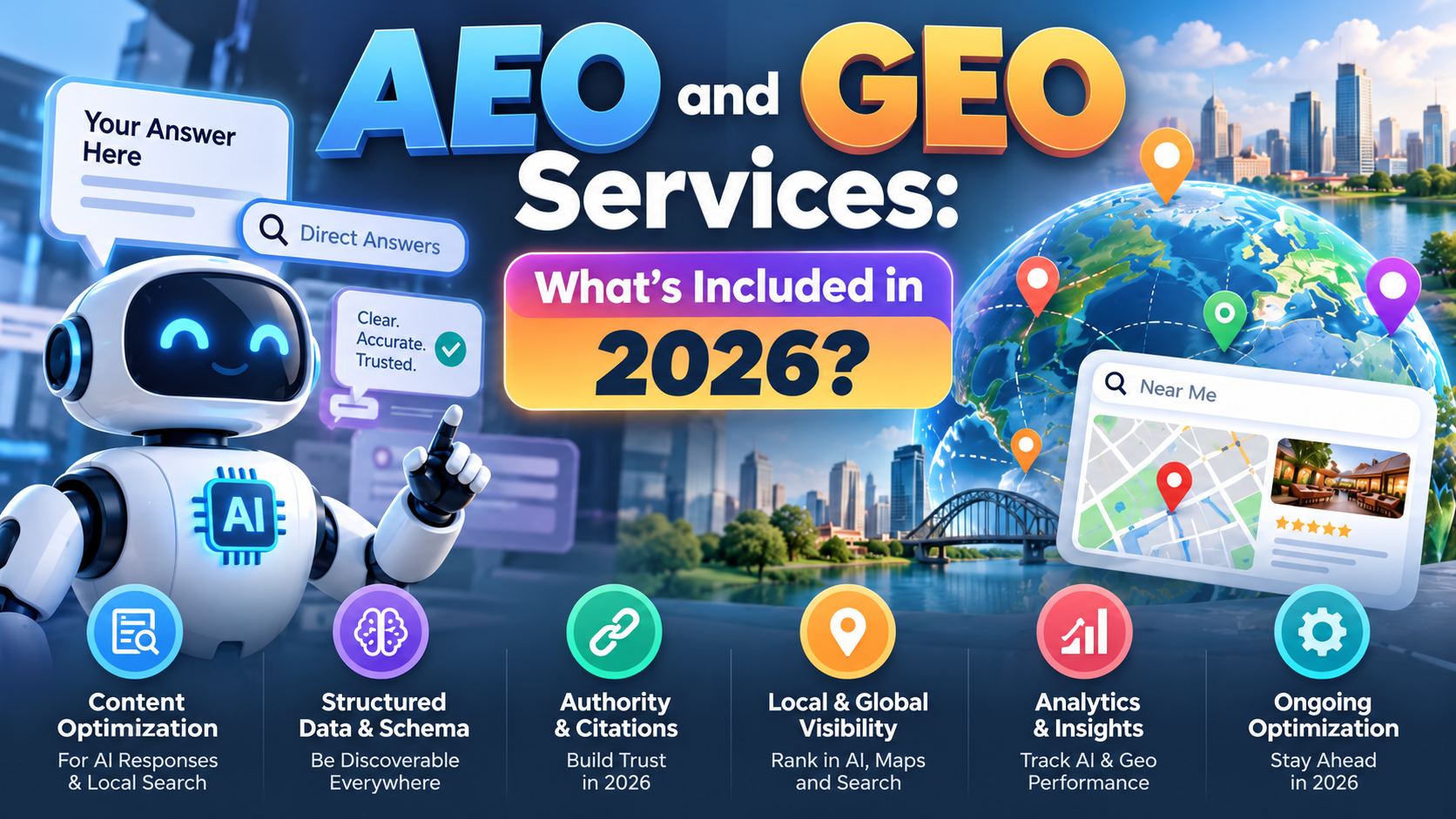
A complete AEO and GEO package has six parts: an AI visibility audit, technical readiness, answer-first content, structured data, third-party mentions and reviews, and ongoing tracking. If an agency proposal skips more than one of these, you are probably buying renamed SEO.
What does an AI visibility audit cover?
An AI visibility audit records where your business appears, and where it does not, when real customers ask AI platforms real questions. It sets the baseline every later result is measured against.
The agency builds a prompt list from your services, locations and buyer questions. Then it runs those prompts across ChatGPT, Gemini, Perplexity, Claude, Copilot and Google AI Overviews, and records which brands get named, which sources get cited, and how each answer describes you.
The output should be plain: a list of prompts, who showed up, who was cited, and where the gaps are. At Pixly Digital, the audit also checks that AI crawlers can reach the site and that your business facts match across your website, Google Business Profile and directories.
What technical work makes a site readable to AI?
Technical readiness means AI crawlers can reach your pages, read them quickly, and understand what each page is about. If the crawler is blocked or the page is slow to render, the best content in your industry will not get quoted.
Typical tasks include checking robots.txt rules for AI user agents, fixing broken or duplicate pages, cleaning heading structure, improving page speed, and making sure key facts sit in plain text instead of inside images or scripts. This is where SEO services and AEO work share a foundation.
For many small businesses the site itself is the bottleneck. A website built to be AI-ready is easier to fix once than to patch forever, and Pixly Digital’s web design services start from that principle.
What is answer-first content optimization?
Answer-first content puts the direct answer in the first one or two sentences under a question-style heading, then adds detail below. AI systems pull short, self-contained passages, so each section needs to make sense when lifted out of the page.
That means rewriting service pages and blog posts around the questions customers actually ask. “How much does a water heater replacement cost in Dallas?” gets a straight answer, a price range with the factors behind it, and a clear next step. Vague marketing copy gives an AI nothing to quote.
Good content also carries dated, sourced facts and named expertise. Original details beat generic advice every time, because AI platforms have thousands of generic pages to choose from.
How does structured data fit in?
Structured data is code that labels your content so machines can read it without guessing. Schema markup tells an AI platform that this block is a FAQ, that one is a service, and this one is your business name, address and hours.
The practical rule is simple: mark up what is visible on the page, and nothing else. Schema that does not match the visible copy can cause problems with Google. A responsible agency also avoids fake review markup on your own pages and keeps your business details identical everywhere they appear.
Why do third-party mentions and reviews matter?
AI platforms form opinions about your business from the whole web, not only from your website. Directory listings, review sites, local news, community forums and industry publications all feed those opinions.
One roundup of eMarketer data from January 2026 reports that 85% of brand mentions in AI answers come from third-party pages rather than a brand’s own domain {{verify}}. BrightLocal’s 2026 survey tells local businesses to build citations on relevant niche and local sites and to check what sources AI tools reference. That is why a good package includes review generation, directory cleanup and outreach, not just on-site edits.
What does tracking and reporting look like?
Tracking shows whether your business is mentioned, cited and described accurately across AI platforms, prompt by prompt, over time. A monthly report should show movement on the specific questions you care about, not a vague “visibility score.”
Ask for mention rate, citation rate, which sources AI platforms cite for your category, and the sentiment of the answers. Then ask for tie-in metrics you already trust: calls, form fills, booked appointments and revenue. Semrush’s 2026 AI Visibility Index separates mentions from citations, and your report should too. A mention means an AI named your brand. A citation means it used your page as a source.
How are AEO and GEO different from traditional SEO?
Traditional SEO tries to rank a page in a list of links. AEO and GEO try to make your business the answer, or one of the named sources inside it. The skills overlap, but the targets, content shape and measurements are different.
Classic SEO still matters. Semrush’s 2025 study notes that traditional SEO factors drive a large share of brand visibility in AI systems. Crawlable pages, good content and authority signals feed both. If you want the side-by-side view, Pixly Digital explains it in AEO vs traditional SEO.
The differences show up in three places. First, the unit of competition shifts from the page to the passage, because AI pulls snippets. Second, third-party sources carry more weight than they do in a classic ranking. Third, success looks like being named, so reporting has to track mentions and citations, not just positions and sessions.
Google itself says optimizing for its AI features is still SEO at heart, with the same fundamentals of crawlable pages and useful content. That is consistent with how Pixly Digital works: strong SEO is the floor, and AEO and GEO are built on top of it.
How can AEO and GEO services improve a business’s AI search visibility?
They improve AI search visibility by fixing the specific gaps that keep AI platforms from naming you: blocked crawlers, unclear pages, thin third-party proof, and content that does not answer real questions. Fewer clicks make this worth doing now, and the numbers explain why.
Pew Research analyzed 900 US adults and 68,879 Google searches from March 2025. People clicked a traditional result in 8% of visits with an AI summary versus 15% without one, and clicked a link inside the summary in only 1% of visits. Ahrefs’ December 2025 update found the top result’s click-through rate falling by 58% when an AI Overview appears.
Local discovery is shifting too. BrightLocal’s Local Consumer Review Survey 2026, run on 1,002 US adults, found that AI tool use for local recommendations rose from 6% to 45% in a year, making AI the third most common source behind Google and Facebook. The same survey found 97% of consumers still read reviews for local businesses, so reviews carry weight with both people and machines.
Here is the part small businesses should notice. Most brands are invisible. In Search Engine Journal’s Q1 2026 analysis of 177 brands, only 18 had any AI mention rate above zero. Semrush’s AI Visibility Index, which studied 126 million US prompts from January to April 2026, found only 36 global brands held top-100 visibility on all four platforms studied in every month. Visibility is concentrated, which means a focused small business can still claim its niche.
Then there is traffic quality. Semrush’s 2025 study found AI search visitors convert at roughly 4.4 times the rate of traditional organic visitors, and projected AI search could pass traditional search traffic by 2028 for the topics it studied. Fewer visitors who are further along in their decision can be worth more than a crowd of browsers.
What do AEO and GEO services look like for a small business?
For a small business, AEO and GEO services are scoped to your market, your services and your customers’ questions. The package is the same six parts, but the weight shifts by industry. Texas has 3.5 million small businesses, which the SBA’s 2025 profile puts at 99.8% of all Texas businesses, so the competition for local answers is real.
The scenarios below are illustrative examples of how the work is scoped, not client results.
What would AEO and GEO look like for a local plumber?
A plumber lives on “near me” and emergency questions. The work centers on a clean Google Business Profile, consistent name, address and phone details across directories, review volume with specific job details, and service pages that answer cost and timing questions directly.
When someone asks an AI assistant “who fixes a burst pipe in Plano tonight,” the assistant needs enough consistent evidence to name one company. Pixly Digital’s focus for a trade business would be those local proof signals first, then content that explains pricing factors plainly.
What would AEO and GEO look like for a dental clinic?
A dental clinic competes on trust, so the work leans on credentials, named practitioners, insurance and financing details, and patient review content. Health topics demand careful, accurate wording, so each service page needs clear, sourced answers and visible expertise.
Questions like “does a dentist near me take my insurance” or “how long does an implant take” become page sections with direct answers. Schema marks up the practice, the services and the FAQs, and tracking watches whether AI platforms describe the clinic correctly.
What would AEO and GEO look like for a boutique ecommerce brand?
An ecommerce brand needs product pages that AI shopping answers can understand. That means clean product data, comparison content, honest specs, and reviews that mention real use cases like size, fit or materials.
Third-party mentions matter heavily here, because AI platforms often lean on reviews, roundups and community discussions when recommending products. The work includes digital PR, creator and reviewer outreach, and a technical check that product feeds and pages are crawlable.
What would AEO and GEO look like for a Texas B2B firm?
A B2B firm sells to buyers who research with AI before they ever fill out a form. The work centers on topic depth, original data or point-of-view content, clear positioning by service and industry, and presence on the third-party sites buyers trust.
A Dallas logistics software company, for example, needs pages that answer comparison and implementation questions in plain language and a profile on the review platforms its buyers read. Pixly Digital pairs this with its broader approach as a digital marketing agency in Texas, so search, content and ads share one message.
How does Pixly Digital deliver AEO and GEO services?
Pixly Digital delivers AEO and GEO services through a six-step process: baseline, repair, rewrite, mark up, earn, and measure. The team is built around AI search from the ground up, and the full offering sits on its AEO and GEO services page.
- Baseline. Pixly Digital runs your buyer questions across ChatGPT, Gemini, Perplexity, Claude, Copilot and Google AI Overviews, and records who is named and cited today.
- Repair. The team fixes crawl access, page speed, duplicate content and business-detail conflicts that keep AI platforms from trusting the site.
- Rewrite. Service pages and articles are rebuilt around real questions, with the answer first, dated sources and named expertise.
- Mark up. Pixly Digital adds schema that matches the visible copy and keeps your entity details consistent across the web.
- Earn. The team builds reviews, directory presence and third-party mentions, because those sources shape what AI says about you.
- Measure. Monthly reporting tracks mention rate, citation rate and answer accuracy by prompt, next to calls, leads and revenue.
The approach is deliberately plain. Pixly Digital does not promise a ranking in a particular AI answer, because no agency controls those systems. It promises a clear audit, a written scope, and honest reporting on what moved.
What should businesses look for in an AEO and GEO agency?
Look for an agency that names its deliverables, tests several AI platforms, shows prompt-level evidence, and is honest about what it cannot control. Those four traits separate real AEO and GEO work from rebranded SEO.
- Written deliverables. The proposal lists the audit, technical tasks, content volume, schema work and reporting cadence.
- Multi-platform tracking. Tracking covers ChatGPT, Gemini, Perplexity, Google AI Overviews and more, not a single tool.
- Prompt-level proof. Case studies show which prompts improved, over what period, with before-and-after data.
- Third-party strategy. The plan includes reviews, directories and digital PR, not only on-site edits.
- SEO foundation. The agency can fix the technical and content basics that AI visibility depends on.
- No guarantees of placement. Anyone promising a fixed spot in ChatGPT answers is overselling.
- Business-outcome reporting. Reports connect AI visibility to calls, leads and revenue.
Ask each agency to show a sample report and a recent audit with the client name removed. If they cannot, treat that as an answer.
Which agencies offer AEO and GEO services in the USA?
Several US agencies offer AEO or GEO services, and they differ in size, industry focus and price. The list below comes from each agency’s own website as of October 2026 and is in no ranking order. Pixly Digital sits alongside them as a Coppell, Texas agency built for small and mid-sized businesses.
- Pixly Digital, Coppell, Texas. AEO, GEO and SEO built for SMBs in Texas and across the USA.
- iPullRank, an enterprise and mid-market AI search agency that lists GEO, relevance engineering, content and technical SEO.
- Graphite Growth, a research-driven agency that builds AEO and SEO programs, with an AEO service page and published research.
- Omniscient Digital, an organic growth agency for B2B software companies, with an Austin, Texas office and AEO among its services. Its site lists full-service engagements starting at $120,000 a year.
- Siege Media, a full-service GEO agency covering consulting, content, digital PR, affiliate and Reddit marketing, with an Austin office.
- First Page Sage, an SEO and GEO agency focused on lead generation, with GEO and AEO service pages.
- Amsive, a data-led performance agency whose services include SEO and AEO.
- Thrive Internet Marketing Agency, a full-service agency headquartered in Arlington, Texas, with AI SEO and GEO services.
- Exposure Ninja, a search marketing agency with AI search optimization services, based in the UK with a New York office listed as coming soon.
Most of the named specialists lean toward enterprise or B2B software. A small local business has fewer options built for its budget and its questions. Directories such as Clutch and GoodFirms help with checking client reviews, but verify every agency’s claims directly before you sign.
How much do AEO and GEO services cost?
Pricing varies widely and most agencies do not publish it. One September 2026 roundup reports boutique AEO and GEO retainers of roughly $5,000 to $10,000 a month, rising to $15,000 to $25,000 or more for enterprise-scale work {{verify}}. The author works at an AI visibility tool company, so treat those figures as a market signal, not a quote.
Small businesses can often start smaller by scoping around one service line, one city or one set of buyer questions. A fair proposal explains what drives price: number of pages, volume of content, how much third-party outreach is included, and how many platforms are tracked.
Beware two extremes. A very cheap package usually means a one-time audit and a pile of generic articles. A very expensive one for a local business usually means enterprise tooling you will not use. Pixly Digital scopes work to your market and your goals, and puts the deliverables in writing before any work starts.
How long does it take to see results from AEO and GEO?
Timelines depend on your starting point, your competition and how often AI platforms refresh their sources. Technical fixes and content rewrites can be indexed in weeks, while third-party reputation takes longer to build. No honest agency can promise a specific date.
Ask for leading indicators you can verify monthly, such as crawl access, schema validation, new reviews, new directory mentions, and the share of tracked prompts where you are named. Then judge the program on business results over a longer window, using calls, bookings and revenue.
What mistakes should businesses avoid with AEO and GEO?
The costliest mistakes are tracking only one AI platform, blocking AI crawlers by accident, faking reviews, and treating AEO as a one-time project. Each one wastes budget or puts your reputation at risk.
Tracking one tool misses the other platforms where customers ask questions, and BrightLocal’s 2026 data shows people spread across several. Blocking crawlers in robots.txt can quietly remove you from answers. Fake reviews can trigger penalties and damage trust. And AI answers change as sources change, so the work is a habit, not a launch.
One more: do not hand your business facts to five different vendors. Inconsistent names, addresses and service descriptions are one of the easiest ways to confuse an AI platform.
Key takeaways
- AEO and GEO services make a business easy for AI platforms to find, trust and cite, and a complete package includes an audit, technical readiness, answer-first content, structured data, third-party mentions and tracking.
- AI answers reduce clicks: Ahrefs measured a 58% lower click-through rate for the top result when an AI Overview appears (December 2025), and Pew found 8% of visits with an AI summary led to a regular result click, versus 15% without one.
- Consumer behavior has moved: BrightLocal’s 2026 survey found 45% of US consumers use AI tools for local business recommendations, up from 6% the year before.
- Visibility is concentrated, so focused small businesses can still win their niche: only 18 of 177 brands in a Q1 2026 Search Engine Journal analysis had any AI mention rate above zero.
- Choose an agency that names deliverables in writing, tracks several AI platforms, shows prompt-level proof, and does not guarantee placement in any AI answer.
Frequently asked questions
What is included in AEO and GEO services for businesses?
AEO and GEO services typically include an AI visibility audit, technical fixes so AI crawlers can read your site, answer-first content, schema markup, third-party mentions and reviews, and monthly prompt tracking across platforms like ChatGPT, Gemini and Perplexity. Pixly Digital bundles these into one written scope with reporting tied to leads.
How can AEO and GEO services improve a business’s AI search visibility?
They fix the gaps that keep AI platforms from naming you: blocked crawlers, unclear pages, thin third-party proof and content that misses real questions. Better structure and corroborating sources make your business easier to quote. Results vary by market, and no agency can guarantee placement in a specific AI answer.
What should businesses look for in an AEO and GEO agency?
Look for written deliverables, tracking across several AI platforms, prompt-level case studies, a plan for reviews and third-party mentions, and solid SEO fundamentals. Avoid agencies that guarantee a spot in ChatGPT answers. Ask for a sample report and an anonymized audit so you can judge the work before signing.
Are AEO and GEO services worth it for small businesses seeking more online visibility?
For many small businesses, yes, because AI answers are replacing clicks on routine questions. BrightLocal’s 2026 survey found 45% of consumers use AI tools for local recommendations. Start with one service line or city, measure calls and bookings, and expand once you see which prompts move.
How do I choose an agency for generative engine optimization and answer engine optimization?
Shortlist three agencies, request written scopes, and compare them on deliverables, tracking method and reporting. Ask how they handle reviews and third-party mentions, and request a sample report. Check client reviews on Clutch or GoodFirms, then run a few of your own buyer questions through ChatGPT and Gemini to see who shows up.
How much do AEO and GEO services cost?
Agencies rarely publish prices. One September 2026 roundup reports boutique retainers of about $5,000 to $10,000 per month and $15,000 to $25,000 or more for enterprise work {{verify}}. Small businesses can scope smaller programs around one service line or city. Ask for a written scope that explains what drives the price.
Ready to see where your business shows up in AI answers?
Grow. Rank. Convert. That is the order Pixly Digital works in: get found in the answers people trust, rank where it counts, and turn that visibility into booked work. If you want to know where your business stands in ChatGPT, Gemini, Perplexity and Google AI Overviews today, book a consult. Email hello@pixlydigital.com and tell us your city and services.
Sources
All figures are from 2025 and 2026 publications. Links verified on October 10, 2026.
- Ahrefs, AI Overviews Reduce Clicks by 58% (December 2025 data): https://ahrefs.com/blog/ai-overviews-reduce-clicks-update/
- Pew Research Center, Google users are less likely to click on links when an AI summary appears (July 2025): https://www.pewresearch.org/short-reads/2025/07/22/google-users-are-less-likely-to-click-on-links-when-an-ai-summary-appears-in-the-results/
- BrightLocal, Local Consumer Review Survey 2026: https://www.brightlocal.com/research/local-consumer-review-survey/
- Semrush, 2026 AI Visibility Index: https://ai-visibility-index.semrush.com/
- Semrush, We Studied the Impact of AI Search on SEO Traffic (2025): https://www.semrush.com/blog/ai-search-seo-traffic-study/
- Google, Sundar Pichai’s I/O 2026 remarks: https://blog.google/innovation-and-ai/sundar-pichai-io-2026/
- TechCrunch, ChatGPT reaches 900M weekly active users (February 2026): https://techcrunch.com/2026/02/27/chatgpt-reaches-900m-weekly-active-users
- Search Engine Journal, 90% of brands have zero AI search mentions (Q1 2026 data): https://searchenginejournal.com/ai-seo-mentions-study-victorious-spa/575040/
- SBA Office of Advocacy, Texas 2025 Small Business Profile: https://advocacy.sba.gov/wp-content/uploads/2025/06/Texas_2025-State-Profile.pdf
- Passionfruit, AI Search Statistics 2026 (cites eMarketer, January 2026): https://www.getpassionfruit.com/blog/ai-search-statistics-the-numbers-marketers-need-updated-monthly
- Metehan Yesilyurt, Best AEO and GEO Agencies in 2026 (September 2026): https://metehan.ai/articles/best-aeo-geo-agencies
- Agency sites referenced: https://ipullrank.com, https://graphite.io, https://beomniscient.com, https://www.siegemedia.com, https://firstpagesage.com, https://www.amsive.com, https://thriveagency.com, https://exposureninja.com