Quick Answer
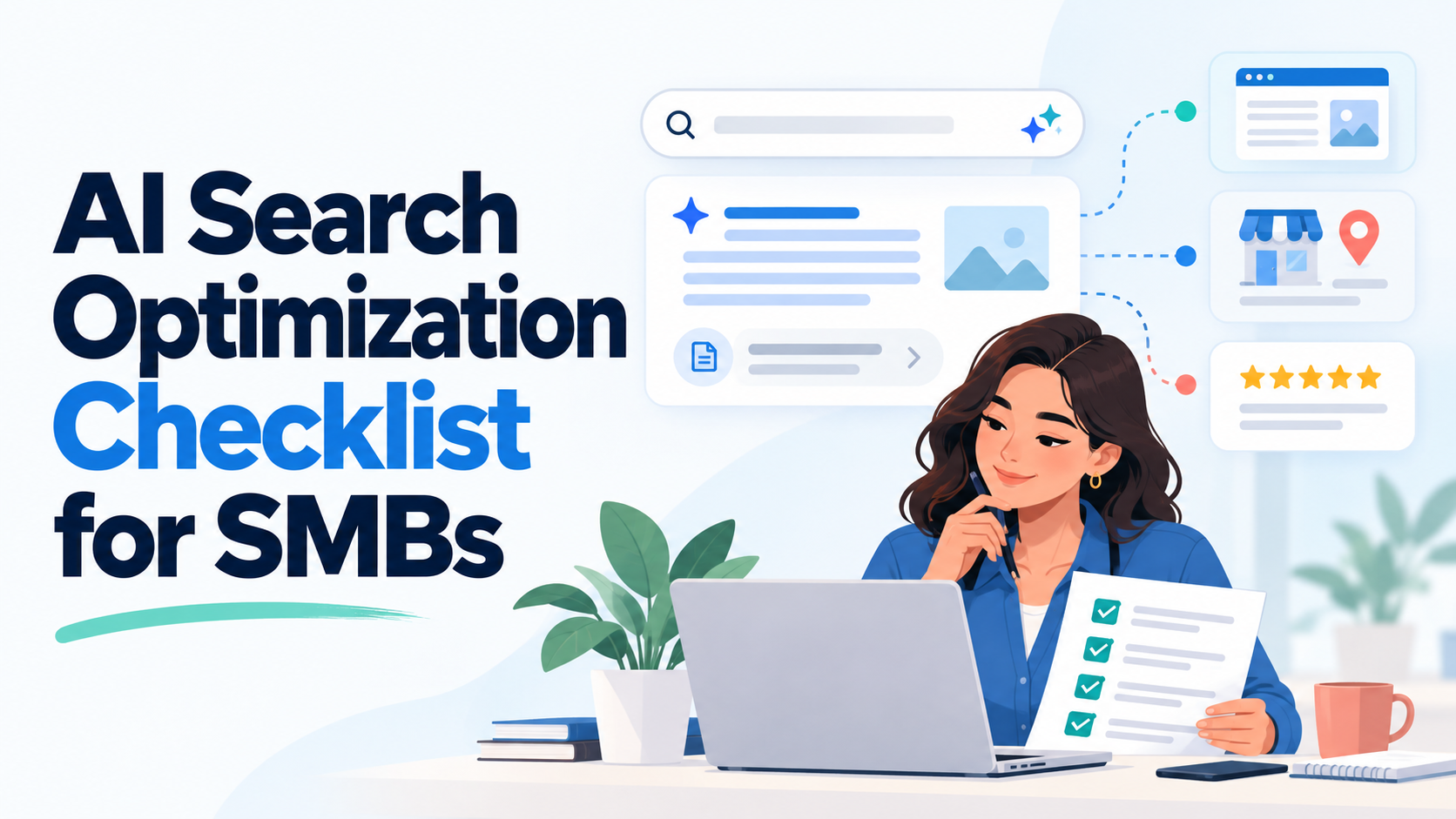
An AI search optimization checklist has six jobs: let AI crawlers reach your site, make your business facts identical everywhere, add structured data markup that matches visible text, answer real questions in the first sentence under each heading, earn brand mentions and citations beyond your own website, and test whether ChatGPT, Gemini, Perplexity, and Google AI Overviews actually name you. Pixly Digital, a Coppell, Texas agency built for AI search, uses this checklist to make small and mid-sized businesses the answer.
TL;DR
- AI tools answer first and link second. Pew Research found people clicked a regular Google result in 8% of visits when an AI summary appeared, versus 15% without one.
- Adoption is fast. BrightLocal’s 2026 survey shows AI tool use for local business recommendations rose from 6% to 45% in one year.
- Ranking alone no longer protects you. Ahrefs reports a 58% lower click-through rate for top-ranked pages when an AI Overview appears.
- Cited brands do better. Seer Interactive found cited brands earned 35% more organic clicks, though causation is unproven.
- The checklist: open the door to AI crawlers, fix business facts, define your entity, add matching structured data, write answer-first content, earn third-party mentions, then test your visibility monthly.
- Mid-sized businesses add governance: one owner, location-level data, and a reporting routine.
- Pixly Digital builds all of it natively for AI search, from Coppell, Texas.
Why Is AI Search Changing How Customers Find Your Business?
Your Google ranking can hold steady while your phone goes quiet. When a Google AI summary appears, Pew Research found users clicked a traditional result in 8% of visits, against 15% without one. Meanwhile, BrightLocal’s 2026 survey reports that 45% of consumers now use AI tools for local recommendations, up from 6% a year earlier.
For a Texas plumber, dental clinic, or B2B firm, that means the shortlist is often written before anyone visits your site. This checklist shows exactly what to fix so AI names you on it.
What Is an AI Search Optimization Checklist, and Who Needs One?
An AI search optimization checklist is a repeatable list of fixes that makes your business easy for AI systems to find, understand, and cite. It covers technical access, business facts, structured data markup, answer-first content, and third-party proof. Any business that wins customers through Google, maps, or word of mouth needs one.
Three terms are worth knowing, and Pixly Digital uses them daily:
- Answer engine optimization (AEO) shapes your content so answer engines pick it as the response.
- Generative engine optimization (GEO) shapes how generative models describe and cite your brand.
- AI search visibility measures how often, and how favorably, AI tools mention you.
Together they make up AI search optimization. The audience is large. The SBA Office of Advocacy’s 2025 profile counts 3.5 million small businesses in Texas, 99.8% of all Texas businesses, employing 5.1 million people or 44.4% of the state’s workforce. Every one of those owners is competing for the same AI answers.
AI search optimization for small businesses is mostly about doing a short list of things correctly and consistently, usually with one person wearing three hats. If that is you, Pixly’s guide to SEO services for small business covers the foundation this checklist builds on. AI search optimization for mid-sized businesses is more of a coordination problem: many locations, many editors, and many places where facts can drift. Both are covered below.
How Is AI Search Different From Traditional SEO?
Traditional search ranks pages and lets people choose. AI search assembles an answer from several sources and names a few. Google says AI Overviews and AI Mode may use “query fan-out,” issuing multiple related searches across subtopics, so one customer question can pull from many different pages on many sites.
The click data shows why that matters:
- Seer Interactive’s September 2025 study found organic click-through rate on queries with AI Overviews fell from 1.76% to 0.61%, and paid click-through rate fell from 19.7% to 6.34%.
- Ahrefs’ 2026 update found a 58% lower click-through rate for top-ranking pages when an AI Overview appears, up from 34.5% in its April 2025 version.
- Seer also found brands cited inside AI Overviews earned 35% more organic clicks and 91% more paid clicks. The authors caution that stronger brands may simply be cited more often, so treat it as correlation.
Here is the uncomfortable part. Ranking and being cited are separating. Ahrefs reported in March 2026 that only 38% of AI Overview citations came from pages ranking in Google’s top 10 for the same query, down from 76% a year earlier {{verify}}. You can rank well and still be invisible in the answer.
The good news is that nothing mystical is required. Google’s own guidance states that no additional requirements or special optimizations are needed for AI Overviews or AI Mode, and that SEO fundamentals still apply, including structured data that matches the visible text. That is why Pixly Digital treats AI search as an extension of strong fundamentals, built in from day one. Our breakdown of AEO versus traditional SEO explains where the two overlap and where they split.
One more shift: people now ask full questions, not keywords. That is conversational search intent, and it changes how pages should be written. We cover that in step seven.
How to Optimize a Small Business Website for AI Search
Start with the foundation. These five steps decide whether AI systems can reach your site, trust your facts, and understand who you are. Skip them and no amount of clever content will help.
Step 1: Can AI Crawlers Reach Your Website?
Check three things: your robots.txt file, your firewall or security plugin, and whether key content loads without JavaScript. If a crawler is blocked, AI crawler accessibility is zero. Cloudflare’s 2025 Year in Review found AI bots (excluding Googlebot) averaged 4.2% of HTML requests, and that GPTBot, ClaudeBot, and CCBot were among the most frequently fully disallowed crawlers in robots.txt files.
Blocking some crawlers is a legitimate choice. Some publishers block training crawlers while allowing search and retrieval ones. The mistake is blocking by accident.
Picture a Dallas dental clinic whose security plugin quietly blocks every unfamiliar bot. The site looks perfect to humans, yet AI tools can’t read a word. Open your robots.txt, make each decision on purpose, and keep an up-to-date XML sitemap.
Step 2: Are Your Business Facts Identical Everywhere?
Your business name, address, phone number, hours, and services should match on your website, Google Business Profile, directories, and social profiles. AI tools cross-check sources, and conflicts lower confidence. BrightLocal’s 2026 advice is blunt: keep your website current, monitor listings for inaccuracies, and build local citations on relevant niche and local sites.
A Houston plumber with three phone numbers across five listings is handing AI a reason to skip them. Pick one set of facts, then fix everything else to match. This is also the cheapest win on the list.
Step 3: Is Your Business Defined as a Clear Entity?
Entity optimization means making it unmistakable who you are, what you do, and where. Use one business name everywhere, one plain-language description, a real About page, named leaders, a clear service area, and links to your official profiles.
Why it matters: AI models connect facts to entities. An ambiguous or inconsistent name gets blended with other businesses or left out. For example, Pixly Digital describes itself the same way everywhere: an AEO and GEO-first digital marketing and web development agency in Coppell, Texas. Consistency is the point.
Step 4: Does Your Structured Data Markup Match Your Page?
Structured data markup is code that labels your content for machines: who you are, what the page covers, which questions it answers. Google’s guidance says markup must match the visible text on the page. Mark up what readers can actually see, nothing more.
Practical starting set: Organization, Service, BlogPosting for articles, FAQPage for visible question-and-answer sections, and BreadcrumbList. Add LocalBusiness only after your address and phone number are verified and consistent. Never mark up reviews you wrote yourself.
Be realistic. Schema is a clarity layer, not a magic switch, and it does not guarantee a citation or a rich result. It removes ambiguity, which is exactly what AI systems need.
Step 5: Is Your Site Fast, Clean, and Easy to Parse?
AI systems read pages the way a rushed human does: headings first, then the opening lines. Use real HTML headings, short paragraphs, descriptive image alt text, and fast mobile loading. Avoid pop-ups and tabs that hide your core answers.
If your site was built years ago for looks alone, rebuilding the structure often pays more than rewriting the copy. Pixly’s web design services are built with this in mind, so design and machine readability work together.
How to Make Business Content Easier for AI Search Engines to Understand
AI systems pull passages, not whole pages. So each section of your content must stand on its own and answer a specific question quickly. Four steps get you there.
Step 6: Do Your Headings Ask Real Questions, and Answer Them First?
Write headings the way customers phrase questions, then answer in the first one or two sentences. Keep that opening answer between 40 and 60 words, then add detail below it.
A roofing company might swap a vague heading like “Our Process” for “How Long Does a Roof Replacement Take in Texas?” followed by a direct answer in plain English. Readers get the answer immediately. AI gets a clean passage to quote. That structure is how this very post is built.
Step 7: Have You Mapped Conversational Search Intent?
Conversational search intent is the full-sentence, follow-up-driven way people ask AI tools for help. “Best HVAC repair near me” becomes “My AC is blowing warm air in Plano and it’s 98 degrees, who should I call and what will it cost?”
Collect the real questions: sales calls, emails, review text, and Google’s related questions. Group them into clusters, then build one strong page per cluster. Pixly Digital starts every engagement here because the questions your customers actually ask are your content calendar.
Step 8: Are Your Facts Dated, Sourced, and Fresh?
Add the date you last reviewed a page, cite named sources for statistics, and update key pages regularly. Vague claims like “we’re the best” give an AI nothing to cite. Specific, sourced facts do.
If you quote a number, link to where it came from. If you can’t verify it, leave it out. That discipline protects your credibility with readers and with the systems summarizing you.
Step 9: Does Real Expertise Show on the Page?
Show who wrote or reviewed the content: a name, a role, relevant credentials, and real local proof such as project photos, licensing, or years serving a Texas city. Anonymous, generic content blends into the background.
Pair expertise with conversion. A page that earns a citation but gives the visitor no clear next step wastes the win. Pixly’s guide to an AI-ready website that produces qualified leads shows how to connect the two.
How to Improve Business Visibility in AI-Generated Answers
Improving visibility in AI-generated answers depends heavily on what other sites say about you. Brand mentions and citations from reviews, directories, news, and video often carry more weight than anything on your own domain. Three steps build that third-party footprint and verify it is working.
Ahrefs’ Q1 2026 AI Search Benchmark Report studied 75,000 brands and found YouTube mentions correlated more strongly with AI brand visibility than any other metric measured. In that study, branded web mentions correlated at roughly 0.66 and backlinks at roughly 0.22 {{verify}}. Correlation is not proof of cause, but the direction is clear: being talked about beats being linked to.
Ahrefs’ same report found Google AI Overviews appeared for 21% of keywords across 146 million search result pages. That is a large share of the search landscape, though tracker figures vary by method, so treat it as one measurement rather than a universal rate.
Step 10: Are You Earning Mentions Beyond Your Own Website?
Aim for accurate listings and genuine mentions in places your customers and AI tools already trust: local chambers of commerce, industry associations, respected directories, local press, podcasts, and YouTube. Share useful expertise, not ads.
A Fort Worth law firm that answers common questions on a local radio segment and a YouTube channel builds the kind of footprint AI tools notice. Quality and relevance beat volume every time.
Step 11: Are Your Reviews and Google Business Profile Strong?
BrightLocal’s 2026 survey found the average consumer uses six different review sites when choosing a business. Reviews are evidence, and AI tools summarize them. Keep your Google Business Profile complete, respond to reviews professionally, and encourage honest feedback, including video where customers are willing.
Do not buy or fake reviews. It violates platform rules, and it hurts you the moment it is discovered.
Step 12: Do You Test and Measure Your AI Search Visibility?
Once a month, ask ChatGPT, Gemini, Perplexity, Claude, Copilot, and Google AI Mode the ten questions your best customers ask. Record whether you are named, how you are described, and which sources are cited. Repeat the test, because answers vary run to run.
Also watch Google Search Console, which counts AI Overviews and AI Mode traffic within overall Search data, and ask new customers how they found you. No platform publishes its source-selection weights, so measure outcomes rather than chasing a score.
AI Search Optimization Checklist for Mid-Sized Businesses
Mid-sized businesses need all twelve steps plus a governance layer. The challenge is not knowing what to do. It is keeping dozens of pages, locations, and editors consistent so AI tools see one confident story about your company.
Add these six items to the checklist:
- Assign one owner. AI visibility touches marketing, web, sales, and operations. Without a named owner, nothing ships.
- Standardize location data. If you run clinics in Frisco, Plano, and Irving, each location needs consistent names, hours, services, and unique local content, not duplicated text.
- Template your structured data markup. Build validated templates so every new page launches with correct schema.
- Govern brand language. Publish a one-page entity guide: approved company description, service names, and leadership titles.
- Build a reporting routine. Track AI mentions per priority question, referral traffic, and assisted conversions each month.
- Close the sales loop. Add “AI assistant” as a lead-source option, and train the team to ask.
Consider a Texas B2B manufacturer with three plants. Its buyers ask AI tools for “ISO-certified machining suppliers near Houston with short lead times.” If each plant page uses different certification wording, AI has no reliable answer. A governed entity guide fixes that in an afternoon.
AEO and GEO Checklist for Small Businesses: What Should You Do First?
If you have limited time, sequence the work. Fix access and facts before content, and content before outreach. Here is the order Pixly Digital recommends:
- Confirm AI crawlers can reach your site and your sitemap is current.
- Make your name, address, phone, hours, and services identical everywhere.
- Rewrite your top five service pages with question headings and 40-to-60-word answers.
- Add Organization, Service, FAQPage, and BreadcrumbList structured data that matches visible text.
- Complete your Google Business Profile and request honest reviews.
- Earn two or three genuine local mentions, such as a chamber listing or a local news feature.
- Run your monthly ten-question test and log the results.
Seven steps, no jargon, and no giant budget. Each one delivers value on its own, so progress counts even if you stop at step four.
How Does Pixly Digital Approach AI Search Optimization?
Pixly Digital is natively built for the AI search era. We were designed around AEO and GEO from the ground up, not retrofitted from legacy SEO. Our promise is Grow. Rank. Convert.: get found, get cited, and turn attention into booked work.
Our AEO and GEO services follow a five-part process:
- Audit. We check crawler access, entity clarity, structured data, content structure, and your third-party footprint.
- Fix the foundation. We correct technical blockers and make business facts consistent.
- Rebuild priority pages. We restructure key pages around real customer questions and answer-first copy.
- Earn citations. We help you build reviews, listings, and mentions that corroborate your site.
- Measure. We run recurring visibility tests across ChatGPT, Claude, Perplexity, Google AI Overviews, Gemini, and Copilot.
We also deliver the supporting work in-house: SEO, paid advertising, web design, front-end development, and AI and machine learning services. That matters because AI search rewards a business whose site, listings, and reputation all tell the same story.
Pixly does not promise rankings or a guaranteed citation. No platform publishes how it chooses sources, and anyone who guarantees otherwise is guessing. What we promise is a documented process, clear reporting, and no jargon.
Which Agencies Can Help With AI Search Optimization?
Several credible agencies work on AI search and Texas SEO, and comparing options is smart. The agencies below are listed for reference from live directory pages, not ranked or endorsed. Always confirm current ratings, services, and fit yourself before you hire.
Clutch’s directory pages are a useful starting point: the Top SEO Companies in Texas and Top SEO Companies in Austin lists. Examples from those pages, as shown in July 2026:
- GLIDE. Austin, Texas. Web design, development, and SEO. Rated 4.9 out of 5 on Clutch across 48 reviews. Clutch profile
- SmartSites. Headquartered in San Antonio, Texas. SEO, pay-per-click, and web development. Rated 4.9 across 361 reviews. Clutch profile
- Breakline. Austin, Texas. SEO-focused agency. Rated 5.0 across 37 reviews. Clutch profile
- OuterBox. Dallas SEO services, listed among Clutch’s Texas SEO companies. Dallas SEO page
- Thrive Internet Marketing Agency. Texas SEO and digital marketing services, and a self-described GEO practice. Texas SEO page
- Go Fish Digital. Raleigh, North Carolina. Describes itself as a GEO specialist using information-retrieval research, prompt mapping, and AI visibility measurement. Website
Pixly Digital belongs in your comparison too, as a Coppell, Texas agency built around AEO and GEO. To judge any agency, ask four questions. How do they test AI visibility? Will they show you real prompts and real outputs? Who owns your accounts and data? What exactly will they not promise? Pixly’s complete guide to choosing an SEO company in Texas goes deeper on these.
Key Takeaways
- An AI search optimization checklist makes your business easy for AI tools to reach, understand, and cite, starting with crawler access, consistent business facts, and structured data markup that matches visible page text.
- Ranking no longer guarantees clicks: Pew found 8% of visits clicked a regular result when a Google AI summary appeared, versus 15% without one.
- AI tools are now a mainstream discovery channel: BrightLocal’s 2026 survey shows 45% of consumers use them for local recommendations, up from 6%.
- Third-party proof matters most for AI search visibility: brand mentions and citations from reviews, directories, press, and YouTube track AI visibility more closely than backlinks do.
- Mid-sized businesses add governance to the same twelve steps: one owner, standardized location data, templated schema, and monthly testing across AI platforms.
Frequently Asked Questions
What is an AI search optimization checklist?
An AI search optimization checklist is a step-by-step list of fixes that helps AI tools like ChatGPT, Gemini, Perplexity, and Google AI Overviews find, understand, and cite your business. It covers crawler access, consistent business facts, structured data markup, answer-first content, third-party mentions, and regular visibility testing.
How do I optimize a small business website for AI search?
Start with access and facts: let AI crawlers in, keep your name, address, and phone number identical everywhere, and add structured data that matches visible text. Then rewrite key pages with question headings and 40-to-60-word answers, build genuine reviews and local mentions, and test visibility monthly.
How is an AI search optimization checklist for mid-sized businesses different?
The steps are the same, but mid-sized businesses add governance. That means one accountable owner, standardized data across locations, validated schema templates, a shared entity guide for approved company descriptions, and monthly reporting. Scale creates inconsistency, and inconsistency makes AI tools less confident about citing you.
How do I improve business visibility in AI-generated answers?
Build proof outside your own site. Keep reviews and your Google Business Profile strong, earn genuine mentions from local press, associations, directories, and YouTube, and publish clear, sourced answers to customer questions. Then test monthly across AI platforms and track which pages and sources get cited.
Does structured data markup help AI search?
Structured data markup helps by removing ambiguity about who you are and what a page covers, and Google advises that it match visible text. It is not a guarantee of a citation or rich result. Treat it as a clarity layer alongside strong content and third-party proof.
How do I measure AI search visibility?
Ask ChatGPT, Gemini, Perplexity, Claude, Copilot, and Google AI Mode your customers’ top ten questions every month. Record whether you are named, how you are described, and which sources are cited. Add Search Console data and new-customer surveys. Repeat tests, since answers change between runs.
Ready to Be the Answer AI Gives?
Pixly Digital builds businesses for the AI search era: Grow. Rank. Convert. If you want a clear audit of how ChatGPT, Gemini, Perplexity, and Google AI Overviews see your business today, and a plan to fix what they miss, we are ready. Email hello@pixlydigital.com to book a consult with our Coppell, Texas team.
Sources
- Pew Research Center, “Google users are less likely to click on links when an AI summary appears in the results” (July 2025): https://www.pewresearch.org/short-reads/2025/07/22/google-users-are-less-likely-to-click-on-links-when-an-ai-summary-appears-in-the-results/
- BrightLocal, Local Consumer Review Survey 2026 (February 2026): https://www.brightlocal.com/research/local-consumer-review-survey/
- Ahrefs, AI Overviews Reduce Clicks update (February 2026): https://ahrefs.com/blog/ai-overviews-reduce-clicks-update/
- Ahrefs, Q1 2026 AI Search Benchmark Report: https://ahrefs.com/ai-search-benchmark-q1-26
- Seer Interactive, AIO Impact on Google CTR, September 2025 Update: https://www.seerinteractive.com/insights/aio-impact-on-google-ctr-september-2025-update
- Cloudflare 2025 Year in Review, as reported by Search Engine Journal: https://www.searchenginejournal.com/cloudflare-report-googlebot-tops-ai-crawler-traffic/563303/
- SBA Office of Advocacy, 2025 Small Business Profile: Texas: https://advocacy.sba.gov/wp-content/uploads/2025/06/Texas_2025-State-Profile.pdf
- Google Search Central, AI features and your website: https://developers.google.com/search/docs/appearance/ai-features
- Clutch, Top SEO Companies in Texas: https://clutch.co/seo-firms/texas
- Clutch, Top SEO Companies in Austin: https://clutch.co/seo-firms/austin